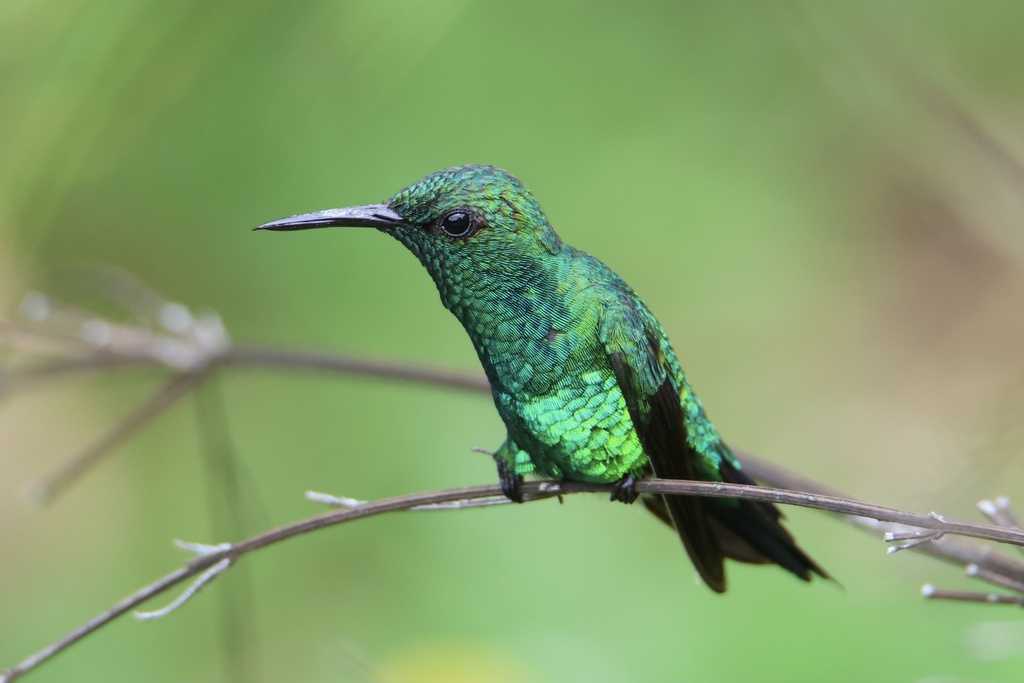
Garden Emerald
Photo © Aitor
Photo © Aitor — CC BY 4.0 — Source: iNaturalist photo #283528572Identification
The garden emerald is a tiny hummingbird measuring just 7.8 to 8.5 cm in length and weighing a mere 3 to 4.1 grams. Males are striking, with dark metallic green upperparts contrasting against brighter metallic green underparts and distinctive white thigh tufts. Their blue-black forked tail features central feathers with a light bluish-green gloss. Females are subtly different: they display bright metallic green to bronze-green upperparts and pale gray underparts, with a characteristic white or grayish-white spot behind the eye and dusky cheeks. Their blue-black tails show dull metallic green central feathers and pale gray-tipped outer feathers. Juvenile males resemble females but are darker below.
Range & Habitat
The garden emerald is endemic to Central America, found in southwestern Costa Rica, along the Pacific coast of Panama, and on the offshore Coiba and Pearl islands. This species favors open lowland landscapes, particularly the edges of woodlands, hedgerows, streamside thickets, scrublands, and gardens. It occurs from sea level to 1,500 meters in Costa Rica and 1,200 meters in Panama, making it accessible to travelers exploring both humid and semi-open terrain.
Behaviour & Diet
Generally sedentary, the garden emerald nonetheless shows some movements between mainland Panama and nearby islands. Like many hummingbirds, it practices trap-lining—visiting a consistent circuit of flowering plants to feed on nectar. It supplements this diet by gleaning small insects from vegetation. The breeding season in Panama spans at least from November to March, though many aspects of its breeding behavior remain undocumented. Its vocalizations are poorly known but are thought to resemble those of related species, consisting of wiry, repeated sounds and dry, scratchy calls.
Best Time & Places to See It
The garden emerald is most active during its breeding season from November to March in Panama, when territorial behavior and breeding activity may make sightings more frequent. The species readily adapts to man-made habitats and gardens, making it accessible even in human-modified landscapes. Visit open woodland edges, hedgerows, and flowering gardens in southwestern Costa Rica or along Panama's Pacific coast, including visits to the Coiba and Pearl islands if available. Its tolerance of disturbed habitats means gardens near coastal settlements offer reliable viewing opportunities.
Photography Tips
Photograph garden emeralds in open settings where you can position yourself near flowering plants along their usual feeding circuits. Males' iridescent green plumage requires careful exposure management in bright tropical sunlight—slight underexposure can preserve metallic highlights. Early morning light is ideal for capturing the gloss on their tail feathers and the contrast between upper and underparts. Since these birds are small and fast-moving, use a high shutter speed (at least 1/1000th second) and fast, tracking autofocus. Position yourself patient near flowering shrubs or trees; the bird's trap-lining behavior means it will likely return to the same flowers, offering multiple shooting opportunities.
Baru Volcano National Park
Braulio Carrillo National Park
Chagres National Park
Chirripó National Park
Coiba National Park
Corcovado National Park
Darién National Park
General de División Omar Torrijos Herrera National Park
La Amistad International Park
Nothing matches these filters.
No community photos yet. Log in to add the first one.
No community observations of this species yet.