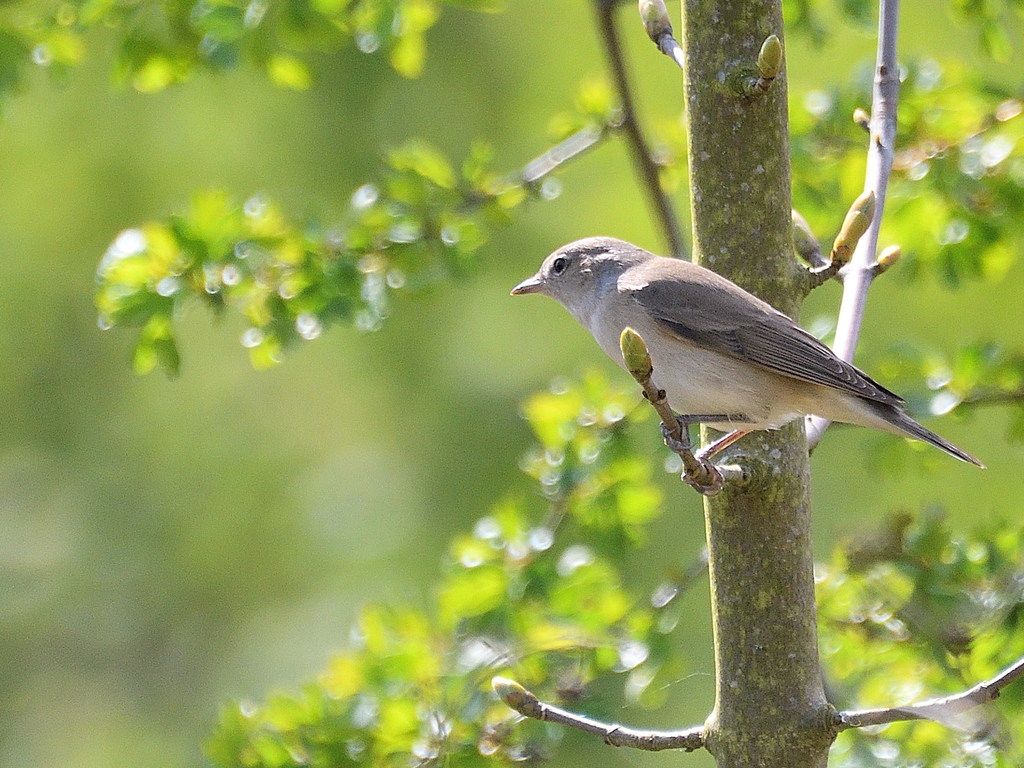
Garden Warbler
Photo © nikonbird007
Photo © nikonbird007 — CC0 1.0 — Source: iNaturalist photo #648207804Identification
The garden warbler is a plain, unstreaked warbler measuring 14 cm long with distinctly long wings and tail. Its olive-brown upperparts and dull white underparts offer few distinguishing marks, making it one of Europe's more subtle songbirds. Look for a whitish eyering, faint pale supercilium, and a buff wash to the throat and flanks. The eye is black, the legs bluish-grey, and the bill grey above with a paler lower mandible. Males and females are identical in appearance, as are juveniles, though young birds show looser plumage with paler, greyer upperparts and buff-tinged underparts.
The garden warbler's plain appearance can cause confusion with several similar species, including melodious and icterine warblers, which typically show longer bills and yellowish plumage tones. Booted warblers are smaller and more delicately built with flesh-coloured bills, while olivaceous warblers are also smaller, with white outer tail feathers and pinkish bills. Learning the garden warbler's distinctive rich, melodic song—remarkably similar to its closest relative, the blackcap—is often more helpful for identification than visual features alone.
Range & Habitat
This common and widespread species breeds across most of Europe and the Palearctic, extending east to western Siberia. Two subspecies are recognized: the nominate form breeds in western, northern and central Europe reaching Finland, central Poland, western Hungary and Bosnia, while S. b. woodwardi occurs in eastern Europe and temperate Asia. The garden warbler is strongly migratory, wintering in sub-Saharan Africa across a wide range of habitats, though it avoids both closed forest and treeless Sahel.
Despite its name, gardens are rarely occupied by this small passerine. Instead, the garden warbler prefers open woodland with dense low cover for nesting. This habitat preference, combined with its migratory nature, makes it a true woodland specialist across its Eurasian breeding range.
Behaviour & Diet
The garden warbler nests in a robust cup-shaped nest built near the ground and concealed by dense vegetation, where it lays a clutch of four or five blotched cream or white eggs. Incubation lasts 11–12 days, and the altricial chicks—hatching naked and with closed eyes—fledge approximately 10 days after hatching. Both parents feed the young, though survival is challenging; only about a quarter of young birds survive their first year. The species competes for territory with the blackcap, its closest relative, when both species nest in the same woodland.
Insects form the main food during the breeding season, but the garden warbler shifts its diet dramatically as migration approaches, consuming large quantities of fruit to build fat reserves. Figs are a particular favourite where available. In African wintering grounds, the species maintains a mixed diet of both insects and fruit, allowing it to exploit the seasonal abundance of food sources across its range.
Best Time & Places to See It
Garden warblers are summer visitors to their European breeding grounds, arriving in spring and departing in autumn for their African wintering grounds. During the breeding season, search open woodlands with dense understory vegetation, particularly mixed deciduous and coniferous forests. The bird's rich, melodic song is your best guide to locating individuals, especially during early morning hours when singing is most active.
For the best chance of observation, visit suitable woodland habitats during the breeding season in the bird's core European range. Patient listening for its distinctive song will reward you far more reliably than visual searching through vegetation, given the species' plain appearance and skulking habits.
Photography Tips
Photographing garden warblers presents genuine challenges due to their plain plumage and preference for dense vegetation. The bird's long wings and tail are key field marks worth emphasizing in images. Backlighting can help reveal the subtle buff tones on the throat and flanks that distinguish this species from similar warblers.
Focus your efforts on spring and early summer when males are actively singing and more likely to perch openly. Dawn and dusk provide better light for woodland photography, and patience is essential—waiting quietly near singing birds increases the likelihood of capturing diagnostic views. Capturing the bird's characteristic posture and proportions matters more than attempting to highlight non-existent bright plumage features.
Bwindi Impenetrable National Park
Lake Mburo National Park
Mabamba Swamp
Murchison Falls National Park
Queen Elizabeth National Park
Abijata-Shalla Lakes National Park
Abruzzo, Lazio and Molise National Park
Aggtelek National Park
Alpilles Regional Nature Park
Nothing matches these filters.
No community photos yet. Log in to add the first one.
No community observations of this species yet.