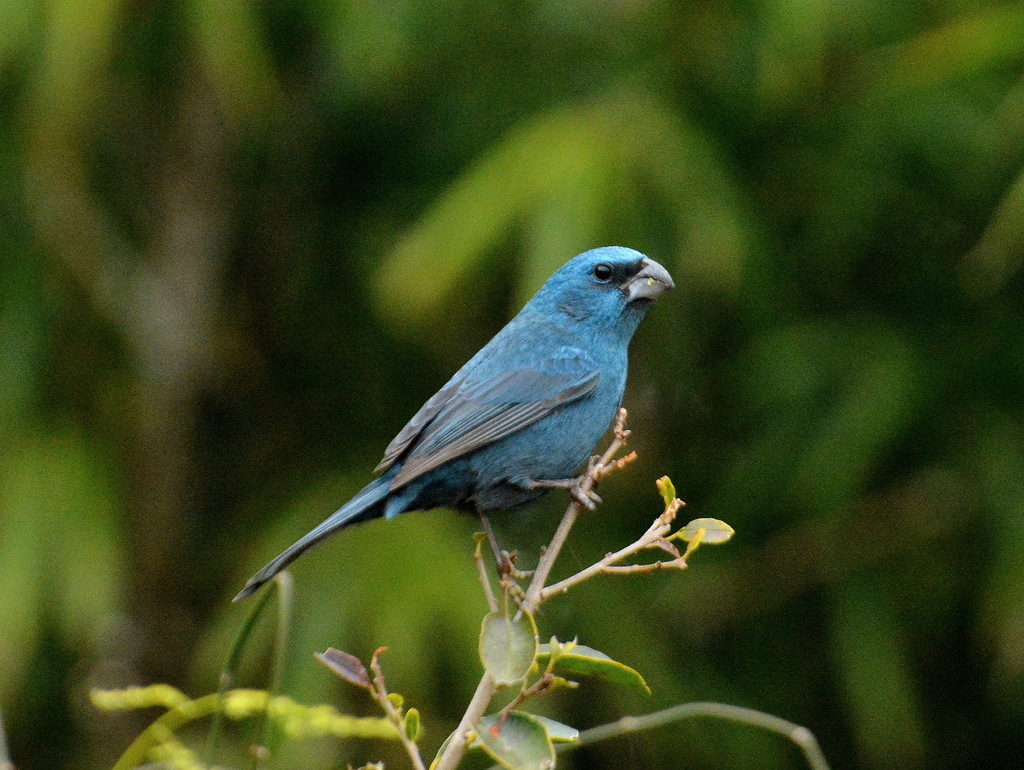
Glaucous-blue Grosbeak
Photo © vinicius_s_domingues
Photo © vinicius_s_domingues — CC BY 4.0 — Source: iNaturalist photo #410451311The glaucous-blue grosbeak (Cyanoloxia glaucocaerulea), also known as the indigo grosbeak, is a species of bird in the family Cardinalidae, the cardinals or cardinal grosbeaks. It is found in Brazil, Argentina, Paraguay, and Uruguay. == Taxonomy and systematics == The glaucous-blue grosbeak is monotypic. For much of its history, the glaucous-blue grosbeak was the only member of genus Cyanoloxia. Following a 2004 publication, the blue-black grosbeak (now Cyanoloxia cyanoides) and ultramarine grosbeak (now Cyanoloxia brissonii) were moved from genus Cyanocompsa. What is now Amazonian grosbeak (Cyanoloxia cyanoides) was later split from blue-black grosbeak. == Description == The glaucous-blue grosbeak is approximately 14 cm (5.5 in) long. Three birds weighed from 16 to 19.5 g (0.56 to 0.69 oz). The male is generally dark sky blue that is lighter on the forehead and rump and is grayish on the lower belly. It has a small black "mask". The female is brown overall, warm and dark above and orange-tinged below. The immature is orange-brown that is darker on the back, and it has a hint of blue on the forehead and cheek. == Distribution and habitat == The glaucous-blue grosbeak nests in northeastern Argentina, southeastern Brazil, and much of Uruguay. During the…
Itatiaia National Park
Brazil
+519 birds+12 mammals
Where granite peaks pierce the Atlantic rainforest canopy in southeastern Brazil, Itatiaia National Park rises as one of the country's oldest and most ecologically vital protected…
VIEW NATIONAL PARKPeixe National Park Lagoon
Brazil
+293 birds+4 mammals
Where the coastal plains of Rio Grande do Sul meet the Atlantic, Peixe National Park Lagoon sprawls across nearly 2,200 square kilometres of shallow waters, reed…
VIEW NATIONAL PARKIguaçu National Park
Brazil
+387 birds+17 mammals
Where the Paraná Plateau plunges toward the Atlantic watershed, six thousand square kilometers of subtropical rainforest cling to steep gorges and river valleys in this corner…
VIEW NATIONAL PARKSão Joaquim National Park
Brazil
+222 birds+9 mammals
Where the southern Brazilian highlands rise above the Atlantic Forest, São Joaquim National Park protects nearly 1,000 square kilometers of montane terrain that shifts between temperate…
VIEW NATIONAL PARKSerra do Gandarela National Park
Brazil
+333 birds+3 mammals
Where granite massifs rise through Atlantic Forest in southeastern Brazil's highlands, Serra do Gandarela National Park protects nearly 1,000 square kilometres of montane terrain that few…
VIEW NATIONAL PARKAraucárias National Park
Brazil
+231 birds+3 mammals
Where the southern Brazilian highlands rise into cool temperate forest, Araucárias National Park protects one of the Atlantic Forest's most distinctive ecosystems across 506 square kilometres…
VIEW NATIONAL PARKCampos Gerais National Park
Brazil
+143 birds
Where rolling plateaus rise above the Atlantic forest escarpment in Paraná's interior, Campos Gerais National Park unfolds across 539 square kilometers of highland grassland and forest…
VIEW NATIONAL PARKEl Palmar National Park
Distrito Sexto, Argentina
+244 birds+14 mammals
Across the Paraná River floodplain in northeastern Argentina, palms rise from wetland and grassland in a landscape shaped by water and time. El Palmar National Park…
VIEW NATIONAL PARKIguazú National Park
Puerto Iguazú, Argentina
+346 birds+15 mammals
Where the Paraná Plateau plunges toward the Atlantic watershed, nearly 800 square kilometers of subtropical rainforest drape across Misiones Province in a landscape carved by millennia…
VIEW NATIONAL PARKNo community photos yet. Log in to add the first one.
No community observations of this species yet.