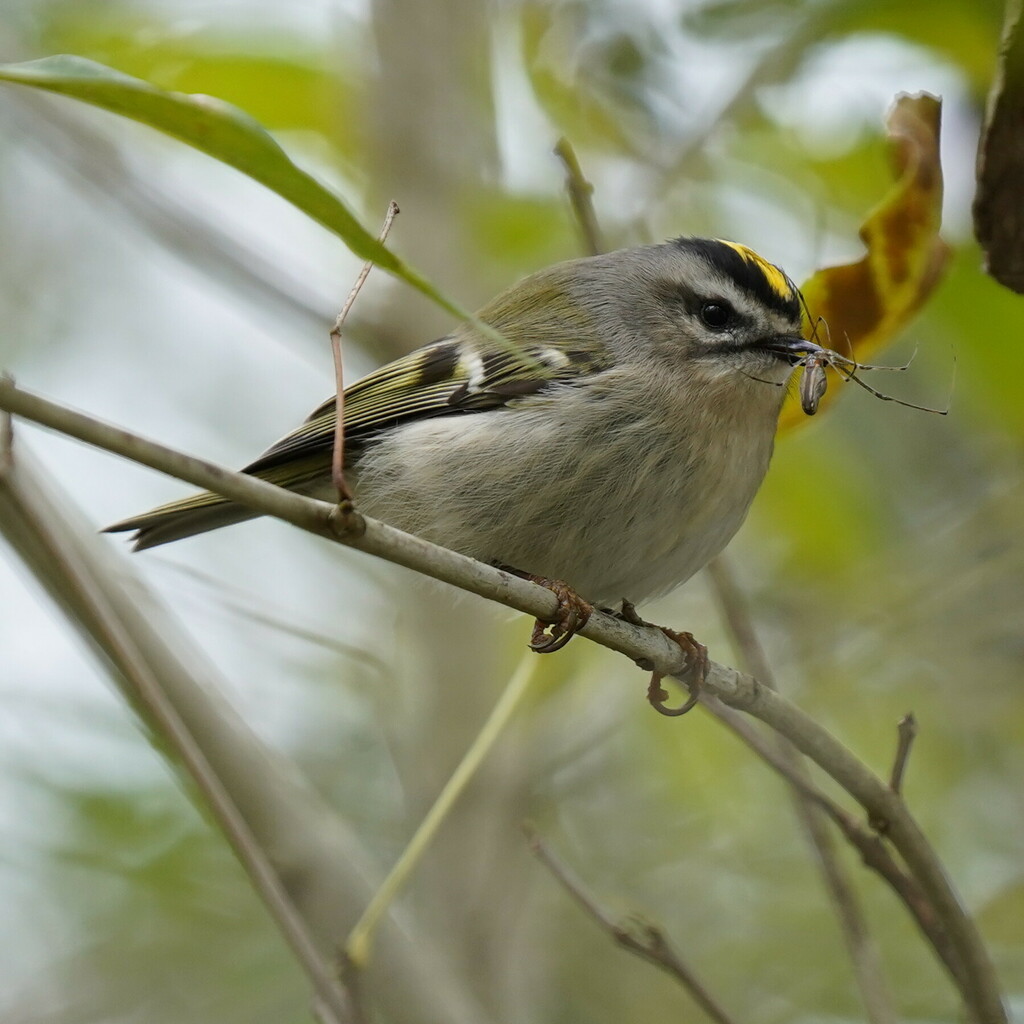
Golden-crowned Kinglet
Photo © Daniel S. Katz
Photo © Daniel S. Katz — CC BY 4.0 — Source: iNaturalist photo #244926391Identification
The golden-crowned kinglet is one of North America's tiniest songbirds, measuring just 8 to 11 cm in length—probably the shortest of any American passerine. Adults are olive-gray on the upperparts with white underparts, featuring thin bills and short tails. Look for distinctive white wing bars and a black stripe running through the eyes. The most striking feature is the yellow crown surrounded by black; adult males display an orange patch in the middle of this yellow crown, making them easily distinguishable from females. Juveniles are similar to adults but have browner backs and lack the yellow crown. With a weight averaging around 6 grams, these delicate birds are comparable in size to the American bushtit and black-tailed gnatcatcher, with a wingspan of 5.5 to 7.1 inches.
Range & Habitat
The golden-crowned kinglet is a widespread migratory bird throughout much of North America. Its breeding habitat consists of coniferous forests across Canada, the northeastern and western United States, Mexico, and Central America. During the non-breeding season, birds migrate to the United States, though some populations remain as permanent residents in coastal regions and southern parts of their range. Notably, northern birds tend to remain further north in winter than their ruby-crowned kinglet cousins. Three migratory subspecies occur across the United States and Canada, each showing subtle variations in size, bill length, and plumage coloration, while two additional non-migratory subspecies inhabit the mountains of Mexico and Guatemala.
Behaviour & Diet
Golden-crowned kinglets are insectivorous foragers that search trees and shrubs for food, specializing in insects—especially caterpillars—along with insect eggs and spiders. These birds produce a series of high-pitched calls delivered on a single note and tend not to fear human approach, making them relatively approachable for observation. Their nests are well-concealed hanging cups suspended from conifer branches, providing excellent camouflage in their woodland habitat. During harsh winters, golden-crowned kinglets employ a remarkable survival strategy: they may form tight huddles to conserve warmth and improve their chances of surviving the coldest months.
Best Time & Places to See It
For observing golden-crowned kinglets, focus on coniferous forest regions during their breeding season across Canada and the northern and western United States. During non-breeding months, birds migrate southward into the United States, offering opportunities for sightings across a broader range. Year-round residents can be found in coastal regions and the southern portions of their range. Their small size and habit of foraging in conifers means patience and careful scanning of treetops are necessary, though their tendency to approach humans without fear can work in the observer's favor.
Photography Tips
Photographing golden-crowned kinglets presents challenges due to their diminutive size and active foraging behavior. Position yourself near coniferous trees where they forage, and use a telephoto lens to capture detail without disturbing these fearless but tiny birds. The bright yellow and orange crown markings of males provide excellent subject contrast against their olive-gray plumage, so look for good lighting that illuminates these distinctive head markings. Early morning in coniferous forests during breeding season offers the best opportunities for locating and photographing these jewel-like songbirds.
Tombstone Territorial Park
Acadia National Park
Alaska Maritime National Wildlife Refuge
Algonquin Provincial Park
Alligator River National Wildlife Refuge
Arches National Park
Banff National Park
Bear River Migratory Bird Refuge
Becharof National Wildlife Refuge
Nothing matches these filters.
No community photos yet. Log in to add the first one.
No community observations of this species yet.