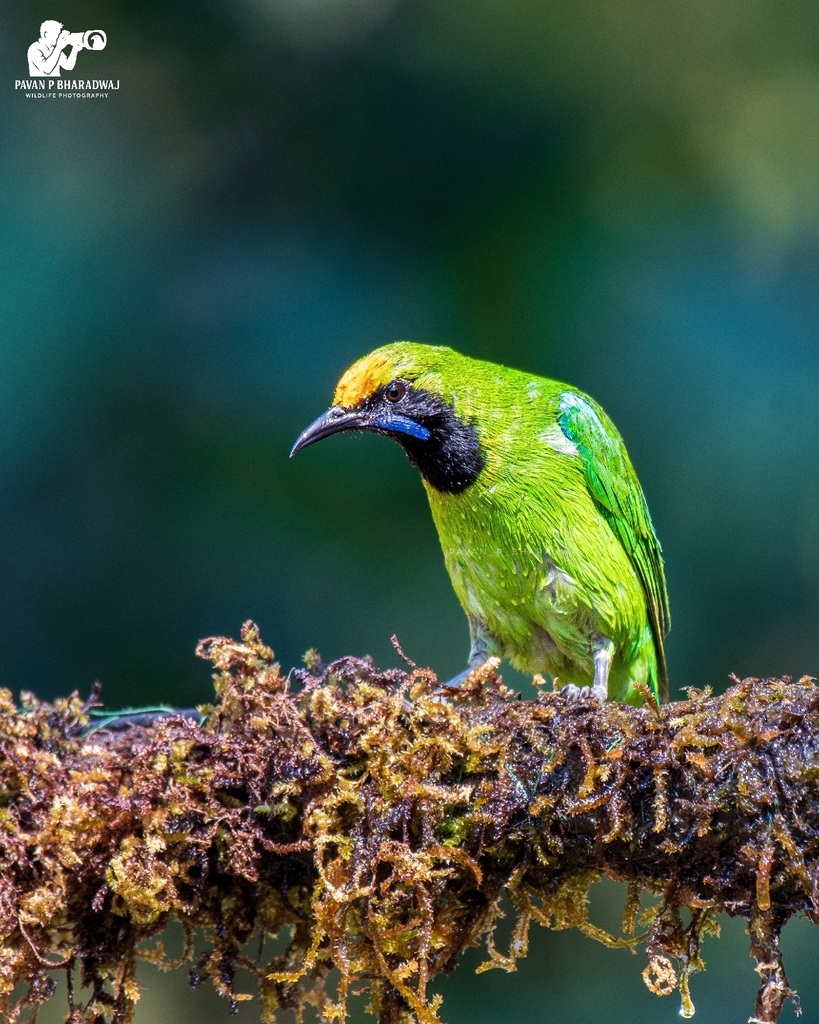
Golden-fronted Leafbird
Photo © Pavan P Bharadwaj
Photo © Pavan P Bharadwaj — CC BY 4.0 — Source: iNaturalist photo #689927152Identification
The golden-fronted leafbird is a striking small songbird with predominantly green plumage and bold facial markings. The adult male is unmistakable: it sports a bright yellowish-orange forehead, a distinctive black face and throat bordered with yellow, and a blue moustachial line. The bird has dark brown irises, a blackish bill, and blackish feet. Young birds are far less conspicuous, with a plain green head and lacking the black facial and throat markings entirely. Females display the same pattern as males but with slightly duller black colouring on the face and throat.
Geographic variation occurs across its range. The southern Indian race (C. a. frontalis) has a narrower yellow border to the black face and a duller orange forehead, while the race insularis, found towards the extreme south of India and Sri Lanka, is slightly smaller than frontalis. Unlike the closely related blue-winged leafbird, this species lacks blue flight feathers and blue tail sides.
Range & Habitat
The golden-fronted leafbird is found across a vast range extending from the Indian subcontinent and south-western China through south-east Asia to Sumatra. It is a common resident breeder throughout India, Bangladesh, Bhutan, Sri Lanka, Myanmar, Thailand, Cambodia, Laos, Vietnam, and Indonesia.
This species shows considerable habitat flexibility. It typically inhabits dense forest canopies and deciduous forests, but is equally at home in woodlands and scrublands. It frequently adapts to human-modified landscapes, appearing regularly in wooded gardens and plantations, making it accessible to travellers visiting cultivated areas as well as pristine forest.
Behaviour & Diet
The golden-fronted leafbird is highly acrobatic, often clinging to twigs upside down while gleaning insects and spiders from the canopy foliage. Beyond insects, it feeds on nectar and berries, making it a generalist forager with diverse feeding habits. The species is often found in pairs or small groups of up to eight individuals, and regularly joins mixed-species foraging flocks, a behaviour typical of many Asian forest birds.
Vocally, this leafbird is notably talented. It has a song consisting of melodic, high-pitched, whistling notes with rising and falling liquid chirps delivered in bulbul-like tones. Perhaps most impressively, it frequently imitates the calls of other bird species, including the Tailor-bird, Black Drongo, and Common Iora. Its calls may include harsh whispers, often delivered from the top of a tree. Breeding birds build their nest in a tree and typically lay 2–3 eggs.
Best Time & Places to See It
The golden-fronted leafbird's status as a common resident breeder across much of its range means it can be encountered year-round in suitable habitat. For the best viewing opportunities, focus on wooded gardens, forest edges, deciduous woodlands, and plantations where the bird is frequently recorded. Its regular presence in cultivated areas makes it particularly accessible to birdwatchers exploring gardens and parks rather than remote wilderness.
Photography Tips
The golden-fronted leafbird's active, acrobatic behaviour and bold facial markings make it an attractive photographic subject. Look for individuals foraging upside down in canopy foliage—these dynamic postures create engaging images. The bird's habit of joining mixed-species flocks may increase encounter rates. Early morning visits to wooded areas are often productive. Photographing males will showcase the vibrant yellow and orange forehead and striking black face markings to best effect, though patience may be required to capture the bird in clear, well-lit conditions within the canopy.
Kanha Tiger Reserve
Minneriya National Park
Angamedilla National Park
Bandhavgarh National Park
Bandipur National Park
Banke National Park
Bardiya National Park
Chitwan National Park
Doi Inthanon National Park
Nothing matches these filters.
No community photos yet. Log in to add the first one.
No community observations of this species yet.