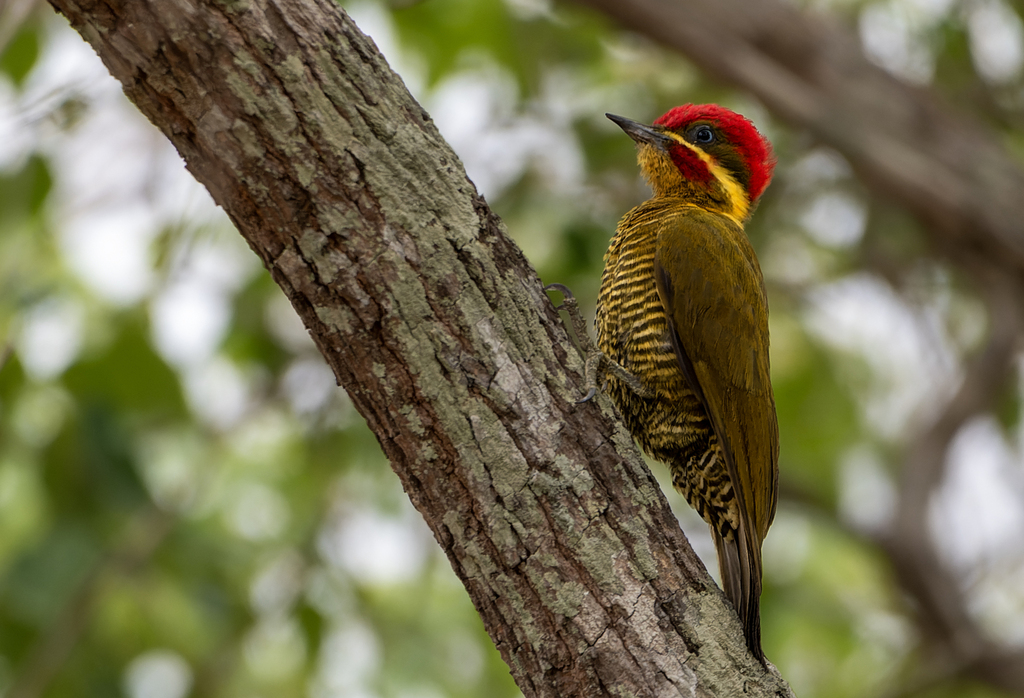
Golden-green Woodpecker
Photo © David F. Belmonte
Photo © David F. Belmonte — CC BY 4.0 — Source: iNaturalist photo #587818936Identification
The golden-green woodpecker is a medium-sized woodpecker, measuring 18 to 27 cm long and weighing 55 to 91 g. Sexual dimorphism is apparent primarily on the head. Males of the nominate subspecies feature red plumage from forehead to nape, olive-green lores extending around the eye and neck, a pale yellow stripe, a short red malar band, and an olive-green stripe below. Their chin and upper throat are yellow. Females lack red on the head entirely, displaying olive coloring from forehead to nape with an olive-brown malar area. Both sexes share olive-green upperparts, darker olive-brown flight feathers and tail, and pale yellow-buff underparts with olive-brown barring. The bill is dark gray to blackish with a paler base, the iris white to bluish-white, and legs grayish-green. Juveniles are duller with less defined barring. Subspecific variation is considerable across the species' range, with some populations showing brighter yellow tones, different head patterns in females, or cinnamon-buff coloration on underparts.
Range & Habitat
The golden-green woodpecker is found in Panama and throughout mainland South America except Chile and Uruguay, with six recognized subspecies distributed across distinct geographic regions from Colombia and Venezuela south to northern Argentina. The species inhabits a wide variety of wooded landscapes including terra firme and várzea forest, rainforest, deciduous forest, and more open areas such as treed savannah, pastures, and clearings. Elevational range varies geographically, from sea level on the Atlantic coast to 650 m in parts of Venezuela and Peru, though typically not exceeding 300–500 m in most regions. It is a year-round resident throughout its range.
Behaviour & Diet
The golden-green woodpecker is primarily a canopy and subcanopy forager, often solitary or in pairs but regularly joining mixed-species feeding flocks. It forages through gleaning as well as pecking and excavating to access prey. Though its diet remains incompletely studied, it is known to consume ants and termites. Breeding varies geographically, with records from February to March in Colombia and September in Argentina. The species excavates nest cavities in trees or in arboreal insect nests, but clutch size, incubation period, and fledging details remain undocumented. Its distinctive song consists of a series of approximately 15 almost toneless, hoarse 'schraah' notes, described as sounding like a hysterically crying baby.
Best Time & Places to See It
The golden-green woodpecker's breeding season varies by region, offering opportunities in different seasons across its range. In Colombia, target February to March; in Argentina, September offers the best chance. The species occurs in several protected areas throughout its range. Although it maintains an extremely large range with an estimated population of at least half a million mature individuals, it is considered rare to not uncommon depending on location and remains relatively inconspicuous. Canopy and subcanopy habitat offers the best viewing opportunities, particularly in forested areas and mixed woodlands where it participates in feeding flocks.
Photography Tips
Photographing golden-green woodpeckers requires patience and positioning in canopy and subcanopy habitats. The species' tendency to forage in mixed flocks increases encounter probability. Males are more conspicuous than females due to their red head markings, making them easier subjects. Early morning hours typically offer the best light and activity levels. Listen for their distinctive hoarse, harsh calls to locate individuals. Telephoto lenses are essential for capturing detail in canopy birds, and neutral density or polarizing filters help manage harsh overhead light. Subspecific variation across the range means photographers working in different regions should familiarize themselves with local plumage characteristics to capture accurately the population they encounter.
Amacayacu National Park
Amazônia National Park
Bahuaja Sonene National Park
Calilegua National Park
Campos Amazónicos National Park
Cantão State Park
Chaco National Park
Chapada Diamantina National Park
Chapada dos Guimarães National Park
Nothing matches these filters.
No community photos yet. Log in to add the first one.
No community observations of this species yet.