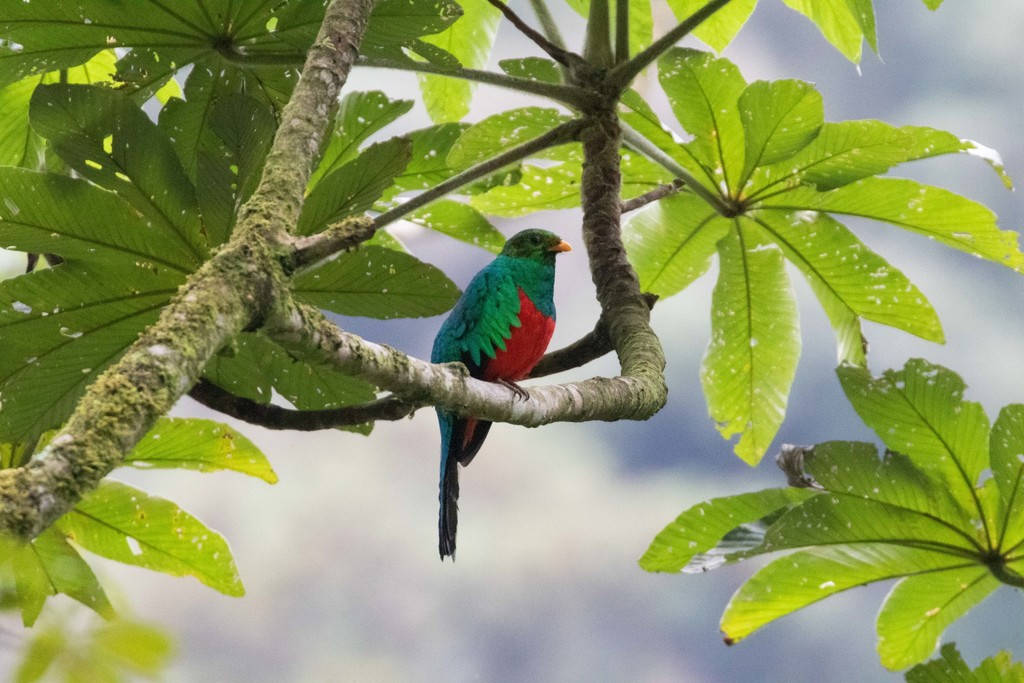
Golden-headed Quetzal
Photo © Thibaud Aronson
Photo © Thibaud Aronson — CC BY-SA 4.0 — Source: iNaturalist photo #107076861Identification
The golden-headed quetzal is a strikingly coloured bird weighing 154–182g, measuring 33–36 cm in length with an additional 8–10 cm of tail plumes and a wingspan of 30–36 cm. The species is named for the male's distinctive golden-bronze head, which contrasts sharply with its iridescent golden-green wings and breast that can appear blue depending on the light. The lower breast of both sexes displays brilliant red feathers. Females are considerably duller, with a brownish-golden head and a brownish breast, and a brownish-grey bill compared to the male's yellow bill. Like all trogons, they possess heterodactyl feet with reversed toe arrangement. Young birds are brownish-black with scattered iridescent green feathers on the neck and breast.
Range & Habitat
The golden-headed quetzal inhabits moist mid-elevation forests across Central and South America, from eastern Panama southward through the Andes of Colombia, Peru, and Bolivia, with a separate population in the Venezuelan Andes. The species favours humid montane and foothill forests, cloud forests, and elfin forests at elevations between 1200m and 3100m, though it occasionally ventures to forest edges and clearings.
Behaviour & Diet
Generally a solitary and quiet bird, the golden-headed quetzal sits motionless for extended periods. When vocalizing, it produces a distinctive mournful, hawk-like whistle repeated 6–8 times, along with horse-like whinnying and throaty melancholy calls. During breeding season, males become seasonally monogamous, establishing territories and advertising them through song to attract females. Both sexes share brooding and feeding duties in cavity nests within old trees for 25–30 days until chicks fledge.
The species' diet consists mainly of fruit—comprising 87.5% of stomach contents in studies—with insects making up the remainder. This fruit-heavy diet makes it an important seed disperser in its forest habitat.
Best Time & Places to See It
The golden-headed quetzal is fairly common throughout its range and considered a species of least concern. It is most reliably encountered during breeding season, when males are more vocal and active in advertising territories. Birdwatchers should focus on humid montane forests at mid-elevations, particularly in Colombia, Peru, and Bolivia along the Andean slopes, and in Venezuelan highlands, searching quietly through the canopy and mid-storey levels.
Photography Tips
Patience is essential when photographing this quiet, often motionless species. Early morning visits to montane forests offer the best light for capturing the male's iridescent green and golden plumage. During breeding season, males are more active and vocal, providing better opportunities for approach. A telephoto lens is recommended for discreet shooting in dense forest, and fast film or high ISO settings will be necessary given the shaded conditions of montane cloud forest habitat. Position yourself near cavity trees during breeding season for the best chances of natural behaviour shots.
Birdwatching in Peru
Nothing matches these filters.
Nothing matches these filters.
Antisana National Park
Cordillera Azul National Park
El Tamá National Park
Guácharos Cave National Natural Park
Llanganates National Park
Manu National Park
Natural Chingaza National Park
Natural Farallones de Cali National Park
Natural Munchique National Park
Nothing matches these filters.
No community photos yet. Log in to add the first one.
No community observations of this species yet.