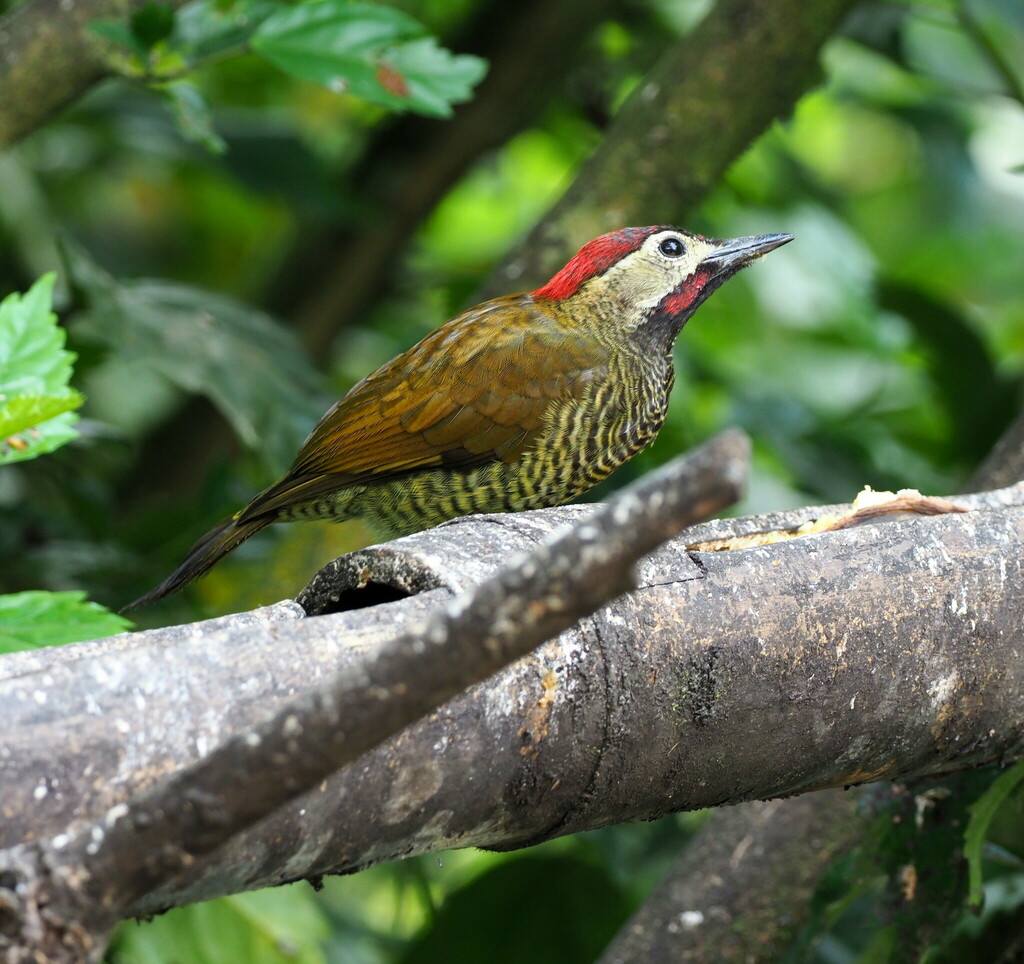
Golden-olive Woodpecker
Photo © Rosario
Photo © Rosario — CC BY 4.0 — Source: iNaturalist #182332261Identification
The golden-olive woodpecker is a medium-sized woodpecker, measuring 18 to 23 cm in length. The most distinctive feature is its predominantly green upperparts with a bronze tinge, contrasting with pale buffy-yellow underparts heavily barred with blackish-olive markings. Males and females differ primarily in head coloration: males display a slate-gray forehead and crown bordered in red, with a red nape and a prominent wide red malar stripe, while females lack the red crown and instead show streaks in the malar area. Both sexes share a slaty-gray to black bill, deep dull red iris, and gray to olive-gray legs. Juveniles are generally duller with less defined barring on their underparts.
The species is highly variable across its range, with nineteen recognized subspecies differing in size, back coloration, and the intensity of barring on the underparts. Some subspecies display bronzy-gold backs with red tinges, while others show brighter yellow-green plumage. This variation reflects the bird's adaptation to diverse montane environments across the tropical Americas.
Range & Habitat
The golden-olive woodpecker is found from Mexico southward through Central America and Panama, and across every mainland South American country except Chile, Paraguay, and Uruguay. Its range encompasses diverse montane regions, from the highlands of southern Mexico through the Andean slopes of Colombia and Ecuador, across the mountainous terrain of Venezuela and the Guiana Shield, down through Peru and Bolivia. Subspecies distribution reflects this broad geographical spread, with populations adapted to specific regional conditions.
This woodpecker inhabits montane forest environments throughout its range, occupying elevations suited to its various subspecies and the forest types they have evolved to exploit.
Behaviour & Diet
Like other members of the woodpecker family, the golden-olive woodpecker is adapted for foraging on tree trunks and branches, using its strong bill to excavate food and create nesting cavities. The species feeds on insects and other invertebrates found within bark and wood, typical of the Picidae family's feeding ecology.
Best Time & Places to See It
Birdwatchers and nature travelers seeking the golden-olive woodpecker should focus on montane forest regions throughout its broad range. The species occurs in mountains from Mexico through Central America and across northern South America, including Venezuela, Colombia, Ecuador, Peru, and Bolivia. The numerous subspecies means that different regional populations may be encountered depending on which part of the bird's extensive range is visited.
Photography Tips
Photographers should look for this woodpecker foraging on tree trunks and branches within montane forests. The bird's green and bronze upperparts provide natural camouflage against foliage, so scanning the middle and upper levels of trees is recommended. The striking red and gray head markings on males offer excellent photographic contrast. The subspecific variation across the range means that photographers traveling through different regions may encounter distinctly different plumages, making comparative photography across the range a rewarding project for dedicated wildlife photographers.
Guided Birding Tour
Arenal Volcano National Park
Peñas Blancas, Costa Rica
+551 birds+21 mammals
Straddling the border between Alajuela and Guanacaste in northwestern Costa Rica, this national park rises dramatically around one of Central America's most active volcanic systems. The…
VIEW NATIONAL PARKChirripó National Park
Rivas, Costa Rica
+274 birds+6 mammals
Where the volcanic spine of Costa Rica's Central Cordillera reaches its apex, Chirripó National Park encompasses a landscape that shifts dramatically with elevation, from montane cloud…
VIEW NATIONAL PARKBraulio Carrillo National Park
Las Horquetas, Costa Rica
+547 birds+18 mammals
Where the Caribbean slope descends from the central volcanic cordillera toward the humid lowlands of Heredia, Braulio Carrillo National Park preserves one of Costa Rica's most…
VIEW NATIONAL PARKGuanacaste National Park
Santa Elena, Costa Rica
+461 birds+17 mammals
Where the Pacific slopes of northwestern Costa Rica rise toward the Continental Divide, dry tropical forest gives way to cloud-laden peaks and misty ridges—a landscape that…
VIEW NATIONAL PARKVolcán Poás National Park
Toro Amarillo, Costa Rica
+237 birds+4 mammals
Where volcanic slopes rise sharply from the Central Valley floor, Volcán Poás National Park protects one of Costa Rica's most active and accessible volcanic systems. The…
VIEW NATIONAL PARKCerros de Amotape National Park
District of San Jacinto, Ecuador
+246 birds+1 mammals
Arid mountains rise abruptly from Peru's northwestern frontier, their slopes clothed in xerophytic scrubland and seasonal deciduous forest that transforms these Andean foothills into one of…
VIEW NATIONAL PARKPodocarpus National Park
Zamora, Ecuador
+496 birds+6 mammals
Where the Andes descend toward the Amazon basin, Podocarpus National Park sprawls across nearly 2,800 square kilometres of the most biodiverse terrain in Ecuador's southern highlands.…
VIEW NATIONAL PARKSumaco Napo-Galeras National Park
Loreto, Ecuador
+563 birds+4 mammals
Where Ecuador's Amazon transitions into cloud forest, a massive shield volcano rises from the emerald lowlands of Orellana Province, anchoring one of the continent's most biodiverse…
VIEW NATIONAL PARKCotopaxi National Park
Mulaló, Ecuador
+211 birds+6 mammals
High in Ecuador's volcanic corridor, where the páramo transitions into cloud forest along the slopes of Cotopaxi volcano, the national park unfolds across nearly 500 square…
VIEW NATIONAL PARKLlanganates National Park
Tena, Ecuador
+239 birds+8 mammals
Where the eastern slopes of the Andes plunge toward the Amazon basin, Llanganates National Park sprawls across nearly 3,500 square kilometers of montane wilderness, its terrain…
VIEW NATIONAL PARKNatural Munchique National Park
El Tambo, Colombia
+194 birds
Where the Western Cordillera rises steeply from the Pacific plains of southwestern Colombia, Natural Munchique National Park sprawls across 1,078 square kilometers of montane forest that…
VIEW NATIONAL PARKNatural Serranía de los Yariguíes National Park
El Carmen de Chucurí, Colombia
+320 birds+3 mammals
Where the northern cordilleras of Colombia rise toward cloud forest, the Serranía de los Yariguíes unfolds across nearly 1,820 square kilometers of some of the most…
VIEW NATIONAL PARKNatural Farallones de Cali National Park
Buenaventura, Colombia
+733 birds+27 mammals
Where the Pacific coastal plain meets the western slopes of the Andes, Farallones de Cali National Park sprawls across nearly 3,500 square kilometers of dramatic topography…
VIEW NATIONAL PARKNatural el Cocuy National Park
Güicán, Colombia
+313 birds+3 mammals
Where the Andes rise to their highest peaks in Colombia's eastern cordillera, El Cocuy National Park sprawls across more than 6,600 square kilometers of some of…
VIEW NATIONAL PARKMorrocoy National Park
Municipio Silva
+290 birds
Where the Caribbean coast of northwestern Venezuela meets protected coastal waters, a mosaic of mangrove forests, sandy beaches, and coral reef systems defines Morrocoy National Park.…
VIEW NATIONAL PARKPuracé National Natural Park
Puracé, Colombia
+327 birds+2 mammals
Where the Andes thrust upward across southwestern Colombia, Puracé National Natural Park spans nearly 2,631 square kilometers of some of South America's most dramatic montane terrain.…
VIEW NATIONAL PARKGuácharos Cave National Natural Park
Acevedo, Colombia
+359 birds
High in the Andean foothills of southern Huila, where mist-laden slopes rise above 1,600 metres, lies a landscape carved by underground rivers and crowned by karst…
VIEW NATIONAL PARKNatural Sumapaz National Park
Cubarral, Colombia
+368 birds+1 mammals
Where the Andes descend toward the Amazon basin, the high páramo grasslands of Sumapaz National Park sprawl across more than five thousand square kilometers of Meta…
VIEW NATIONAL PARKEl Tamá National Park
Toledo, Colombia
+435 birds
Where the Andes descend toward the Caribbean coastal lowlands of northern Colombia, El Tamá National Park sprawls across nearly 3,800 square kilometres of montane forest, cloud…
VIEW NATIONAL PARKNatural Nevado del Huila National Park
Planadas, Colombia
+117 birds
Where the Colombian Andes rise above 5,000 metres, tropical cloud forest yields to páramo and glaciated peaks, and the Planadas region of Tolima contains one of…
VIEW NATIONAL PARKMonte Roraima National Park
Brazil
+226 birds+1 mammals
Where the tepuis rise from the Amazon basin like islands in a sea of forest, Monte Roraima National Park sprawls across 3,714 square kilometres of one…
VIEW NATIONAL PARKYanachaga–chemillén National Park
Palcazu, Peru
+639 birds+6 mammals
Where the eastern slopes of Peru's central cordillera plunge into cloud forest, Yanachaga–Chemillén National Park protects nearly three thousand square kilometres of montane wilderness that few…
VIEW NATIONAL PARKManu National Park
Manu, Peru
+892 birds+26 mammals
Across the eastern slopes of the Peruvian Andes, tropical rainforest descends into the Amazon basin with a complexity that few terrestrial ecosystems match. Manu National Park…
VIEW NATIONAL PARKBahuaja Sonene National Park
San Pedro de Putina Punco, Peru
+602 birds+8 mammals
Where the Madre de Dios and Heath rivers converge in southeastern Peru rises one of South America's most biodiverse wilderness regions: a vast protected realm of…
VIEW NATIONAL PARKTingo Maria National Park
Mariano Dámaso Beraún, Peru
+423 birds
Where the eastern slopes of the Peruvian Andes descend toward the Amazon basin, the landscape fractures into a maze of limestone ridges, humid gorges, and cloud-wrapped…
VIEW NATIONAL PARKCordillera Azul National Park
Pampa Hermosa, Peru
+322 birds+1 mammals
Where the eastern Andes descend into the western Amazon basin, Cordillera Azul National Park sprawls across nearly 38,000 square kilometres of some of Peru's most pristine…
VIEW NATIONAL PARKBaru Volcano National Park
Cerro Punta, Panama
+402 birds+6 mammals
Where the land rises sharply toward the Caribbean's western spine, Baru Volcano National Park sprawls across roughly 220 square kilometres of southwestern Panama, anchored by the…
VIEW NATIONAL PARKGeneral de División Omar Torrijos Herrera National Park
La Pintada, Panama
+401 birds+2 mammals
Across the highlands of central Panama, where the continental divide funnels moisture-laden trade winds into steep river valleys, the terrain rises and falls in a landscape…
VIEW NATIONAL PARKParque Internacional la Amistad
Teribe, Panama
+325 birds+11 mammals
Where the continental divide rises between the Caribbean and Pacific watersheds, a wilderness of extraordinary biological richness unfolds across the Talamanca Range and into lowland rainforest—a…
VIEW NATIONAL PARKEl Rey National Park
Municipio de Las Lajitas, Argentina
+317 birds+4 mammals
Where the eastern slopes of the Andes descend into northwestern Argentina's subtropical transition zone, El Rey National Park unfolds across 841 square kilometers of dramatically varied…
VIEW NATIONAL PARKCalilegua National Park
Municipio de Calilegua, Argentina
+288 birds+8 mammals
Where the eastern Andean slopes plunge into northwestern Argentina's humid subtropics, nearly 2,645 square kilometers of steep terrain and luxuriant forest compose one of South America's…
VIEW NATIONAL PARKLagunas de Montebello National Park
Laguna de Montebello, Mexico
+360 birds+2 mammals
Where turquoise lagoons pierce the limestone plateau of southeastern Chiapas, the Lagunas de Montebello National Park unfolds across roughly 174 square kilometers of spectral water and…
VIEW NATIONAL PARKSian Ka’an
Chunyaxché, Mexico
+350 birds+16 mammals
Where the Yucatán Peninsula dissolves into wetland and mangrove, a vast mosaic of forest, lagoon, and coastal margin creates one of Mexico's most biodiverse strongholds. Across…
VIEW BIOSPHERE RESERVESierra de Tamaulipas
El Porvenir, Mexico
+98 birds+19 mammals
Where limestone peaks thrust skyward through dense subtropical forest, Mexico's northeastern frontier reveals one of the continent's most biodiverse mountain ranges. Canyons carved by perennial rivers…
VIEW NATURE RESERVEMontes Azules
Candelaria, Mexico
+395 birds+47 mammals
Where jungle-clad limestone plateaus plunge into canyon systems carved by the Usumacinta River, Mexico's most pristine rainforest reserve unfolds across the Lacandón region of Chiapas. Montes…
VIEW BIOSPHERE RESERVETikal National Park
Tikal, Guatemala
+399 birds+16 mammals
Dense rainforest canopy rises above the limestone plateau of Petén, where archaeological wonder and ecological richness merge seamlessly across one of Central America's most biodiverse landscapes.…
VIEW NATIONAL PARKLaguna del Tigre National Park
Petén, Guatemala
+399 birds+29 mammals
Where the Petén lowlands dissolve into wetland and forest, Laguna del Tigre National Park protects one of Guatemala's most ecologically vital landscapes. This sprawling reserve encompasses…
VIEW NATIONAL PARKSierra del Lacandón National Park
Petén, Guatemala
+348 birds+7 mammals
Where the Petén rainforest rises into limestone ridges and deep ravines, Sierra del Lacandón National Park protects one of Central America's most intact tropical wilderness zones.…
VIEW NATIONAL PARKLos Quetzales National Park
Copey, Costa Rica
+232 birds+3 mammals
Cloud forest sweeps across the upper slopes of the Central Valley watershed, where elevation and persistent moisture forge an ecosystem unlike any other in Costa Rica.…
VIEW NATIONAL PARKTapantí Macizo de la Muerte National Park
Orosi, Costa Rica
+503 birds+18 mammals
Where montane cloud forest rises steeply from the Orosi Valley, Tapantí Macizo de la Muerte National Park enfolds a landscape of perpetual moisture and emerald complexity.…
VIEW NATIONAL PARKLa Amistad International Park
Crorina, Costa Rica
+532 birds+20 mammals
Where the Caribbean slopes of Costa Rica's Talamanca Mountains rise steeply inland from Limón, the boundary between two nations dissolves into an unbroken expanse of rainforest.…
VIEW NATIONAL PARKVolcán Tenorio National Park
Guatuso, Costa Rica
+480 birds+12 mammals
Where volcanic slopes rise through Costa Rica's northwestern borderlands, Volcán Tenorio National Park sprawls across terrain shaped by ancient lava flows and mineral-rich springs. The park's…
VIEW NATIONAL PARKCaño Negro National Wildlife Refuge
Caño Negro District, Costa Rica
+486 birds+16 mammals
Where the San Juan River's seasonal floodplain opens into expansive wetlands, Caño Negro Wildlife Sanctuary sprawls across one of Central America's most productive freshwater ecosystems. This…
VIEW WILDLIFE SANCTUARYBarra del Colorado National Wildlife Refuge
Tortuguero, Costa Rica
+462 birds+36 mammals
Where the Caribbean's restless waters meet the Limón Province coastline, Barra del Colorado National Wildlife Sanctuary unfolds across a landscape of extraordinary ecological complexity. This equatorial…
VIEW WILDLIFE SANCTUARYNo community photos yet. Log in to add the first one.
No community observations of this species yet.