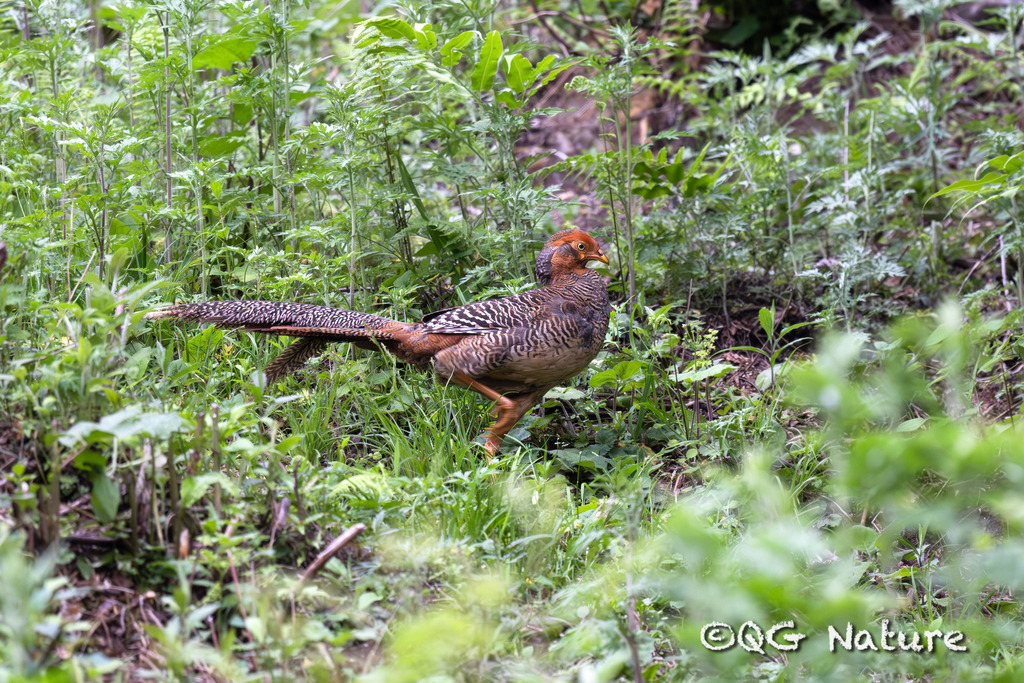
Golden Pheasant
Photo © Wang.QG
Photo © Wang.QG — CC BY 4.0 — Source: iNaturalist photo #382009190Identification
The golden pheasant is one of nature's most spectacular gamebirds. Males are unmistakable, measuring approximately 100 cm in length with a tail accounting for two-thirds of that impressive size. Their plumage is a riot of colour: a golden crest and rump, bright red body, and an orange "cape" on the back that can be spread during display to reveal alternating black and orange feathers like a fan. The face, throat, and neck sides are rusty tan with bright yellow eyes and eye-rings, while the breast is scarlet and the flanks are scarlet and light chestnut. The upper back is green and the tertiary wing feathers are blue. Females are far more subdued, measuring 60–80 cm with mottled brown plumage similar to female common pheasants but darker and more slender, with barred buff and blackish-brown breasts and plain buff abdomens. Both sexes have yellow bills and legs, making them easy to distinguish from other pheasant species.
Range & Habitat
The golden pheasant is native to the forests of mountainous western China, but its striking appearance has led to numerous introductions worldwide. Established feral populations now exist across the United Kingdom, Canada, the United States, Mexico, parts of South America, several European countries, and Australia and New Zealand. In the UK, where the species first appeared in Norfolk in 1845, the largest stable populations historically occurred in the Breckland and Galloway, with populations concentrated in Norfolk and Suffolk today. The species has also colonised areas of Hawaii, particularly on Maui at elevations between 1,700–2,400 metres on the windward slope.
Behaviour & Diet
Golden pheasants are ground-feeding birds that prefer to run and hide rather than fly, though they are capable of short, clumsy bursts of flight when necessary. They spend most of their time on the ground foraging for grain, leaves, and invertebrates, and roost in trees at night. During winter, they forage in flocks near human settlements at forest edges, feeding primarily on wheat leaves and seeds. They also consume berries, grubs, and various vegetation. The breeding season is marked by the male's distinctive metallic call. Females lay 8 to 12 eggs and incubate them for approximately 22–23 days.
Best Time & Places to See It
For those seeking golden pheasants in the wild, the UK remains your best bet outside of China. Norfolk and Suffolk in England hold the most reliable populations, while Scottish sightings are now rare. The Breckland region has historically supported good numbers. Winter may offer better viewing opportunities when birds forage near human settlements. In Hawaii, Maui's Waikamoi Preserve and surrounding areas between 1,700–2,400 metres elevation are where introduced populations are established, though sightings remain relatively uncommon. The breeding season, when males are vocal, provides an additional way to locate birds.
Photography Tips
The golden pheasant's spectacular plumage makes it a photographer's dream, but patience is required since birds prefer running to flying. Focus on early morning and winter months when birds forage more openly near forest edges and human settlements. The male's display—spreading his orange and black cape—is a particularly photogenic moment, though this is most likely during breeding season. Position yourself near known roosting trees at dawn, or near forest edges during winter feeding periods. Given their preference for ground-level movement through dense vegetation, a low vantage point and a longer lens will help you capture these elusive birds in their natural habitat.
Exmoor National Park
Somerset, United Kingdom
+159 birds+32 mammals
Where the Bristol Channel wind scours windswept moorland into rolling open heath, Exmoor rises from the Somerset coast as one of England's most rugged upland landscapes.…
VIEW NATIONAL PARKLake District National Park
Westmorland and Furness, United Kingdom
+209 birds+36 mammals
Where slate fells rise steeply from mirror-still waters, the Lake District unfolds as one of Britain's most ecologically intricate mountain landscapes. The park's patchwork of deep…
VIEW NATIONAL PARKNorth York Moors National Park
North Yorkshire, United Kingdom
+234 birds+32 mammals
Across the high moorlands of North Yorkshire, where heather and bilberry sprawl beneath vast skies, the landscape rises and falls in gentle undulation—a patchwork of open…
VIEW NATIONAL PARKSouth Downs National Park
Chichester, United Kingdom
+298 birds+45 mammals
Chalk downland ridges rise and fall across the South Downs, their open grasslands and beech hangers creating a mosaic of habitats that has shaped human settlement…
VIEW NATIONAL PARKOlympic National Park
Jefferson County, United States
+263 birds+35 mammals
Where temperate rainforest meets alpine wilderness, Olympic National Park sprawls across nearly 11,000 square kilometers of the Pacific Northwest's most pristine landscape. The park's three distinct…
VIEW NATIONAL PARKGiant Panda National Park
Mianyang, China
+447 birds+47 mammals
Where the eastern slopes of China's Sichuan plateau descend into cloud-wrapped valleys, one of Asia's most biodiverse landscapes unfolds across more than 350,000 square kilometres. This…
VIEW NATIONAL PARKJiuzhai Valley
Jiuzhaigou County, China
+226 birds+7 mammals
Where crystalline alpine streams cascade through limestone gorges and karst terrain rises in dramatic vertical walls, Jiuzhai Valley unfolds across nearly 1,300 square kilometers of southwestern…
VIEW NATURAL MONUMENTHuanglong Scenic and Historic Interest Area
Ngawa Tibetan and Qiang Autonomous Prefecture, China
+194 birds+7 mammals
Across the high plateau of northwestern Sichuan, a geological wonder unfolds where limestone terraces and mineral-rich springs have sculpted one of China's most distinctive natural monuments.…
VIEW NATURAL MONUMENTWolong National Nature Reserve
Wenchuan County, China
+333 birds+17 mammals
Where the Qingyi River cuts through the eastern flanks of the Minshan Range, a temperate montane forest cloaks steep valleys in dense canopy that thins dramatically…
VIEW NATURE RESERVENo community photos yet. Log in to add the first one.
No community observations of this species yet.