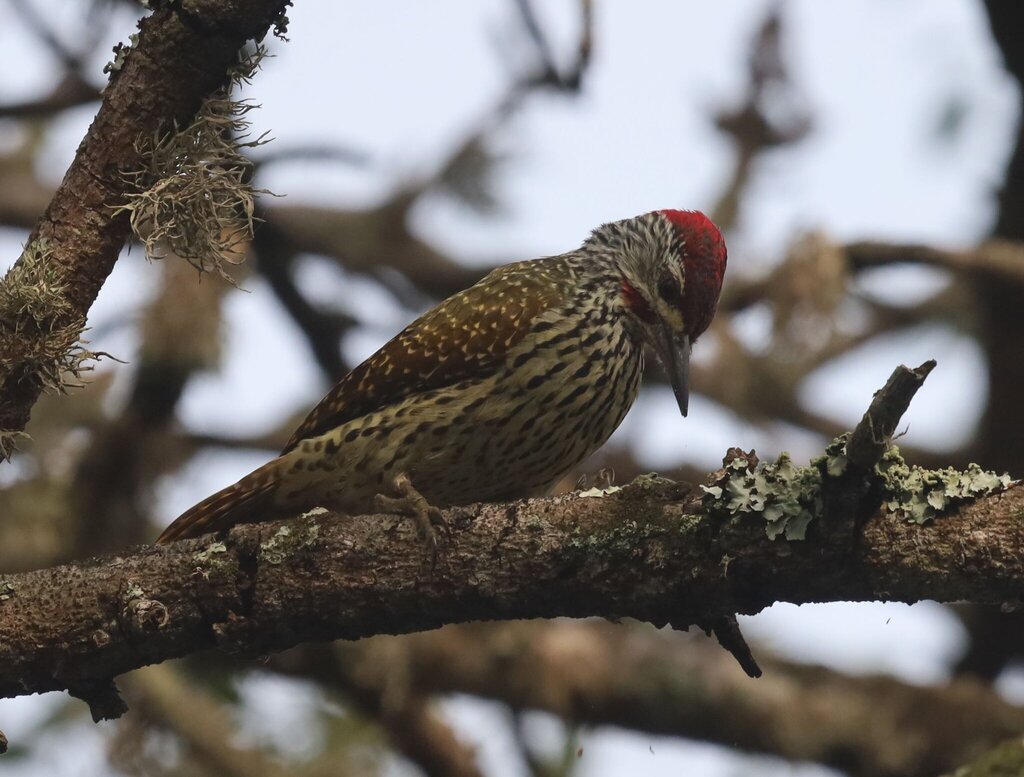
Golden-tailed Woodpecker
Photo © Paul Hoekman
Photo © Paul Hoekman — CC BY 4.0 — Source: iNaturalist photo #537100270Identification
The golden-tailed woodpecker is a compact woodpecker measuring 20 to 21 cm, with a distinctive combination of barred, greenish upper plumage and streaked underparts. Males are on average larger and heavier than females, weighing up to 70 g in southern races, though the northern race is smaller at around 55 g. The most reliable way to distinguish the sexes is by head markings: males display red and brown fore-crowns with red malar stripes, while females have black and white spotted fore-crowns with mottled black and white malar stripes. The golden-olive tail is characteristic, though similar to related species, and the iris is typically dark red. Juveniles are heavily streaked on the throat and breast with a barred belly and mottled malar stripes.
Range & Habitat
This species is very widespread in woodlands and forests south of the equator across sub-Saharan Africa, though very localized north of it. It occurs across an extensive range from West Africa (Senegal, Guinea, Mali, Mauritania) through central regions (Chad, Cameroon, Central African Republic) to East Africa (Kenya, Tanzania, Uganda) and southern Africa (Angola, Botswana, Namibia, South Africa, Zimbabwe). The golden-tailed woodpecker favours coastal forests, miombo, mopane, and acacia woodlands, showing a strong preference for riparian woodland, particularly in the drier parts of southern Africa. It establishes fairly large territories of 10 to 15 hectares and forages in the lower to middle strata of trees, sometimes covering considerable distances between feeding sites.
Behaviour & Diet
The golden-tailed woodpecker is most vocal through a characteristic single, strident call-note—a sharp "waaa" or "weeea"—usually delivered by males. It also produces a long-range repeated "yaooaak-yaaaaaak" and drums softly. Unlike some woodpeckers that rely heavily on hammering, this species obtains most of its food through probing and gleaning, though it does hammer dead or infected wood more frequently than other Campethera species. Its diet consists primarily of arboreal ants and termites, supplemented by millipedes, wood-boring larvae, and leaf-feeding moth larvae. It often forages alongside the Cardinal woodpecker, which tends to exploit thinner branches.
Best Time & Places to See It
The golden-tailed woodpecker nests during early summer, when breeding activity makes birds more conspicuous. Both sexes excavate nest cavities, usually on the underside of branches in the lower to middle canopy. Two to three glossy white eggs are incubated for about 13 days, with males taking the night shift. Chicks fledge after 22 to 25 days. For the best viewing opportunities, visit riparian woodlands and acacia zones in southern Africa, or miombo and coastal forests in East and West Africa. Its presence across such a vast range means numerous opportunities for observation throughout sub-Saharan Africa.
Photography Tips
The distinctive head markings are key to identifying this species in photographs—focus on capturing the male's red and brown crown or the female's black and white spotted pattern. Its preference for the lower to middle canopy makes it more accessible than many woodpeckers. Early morning light will best reveal the subtle barring of the greenish upper plumage and the delicate streaking of the underparts. While the golden-olive tail is characteristic, patience is needed to capture it in an identifiable context alongside the diagnostic head and breast patterns. Listen for its strident, single call-note to locate birds, then position yourself to capture the distinctive facial markings that clinch identification.
Serengeti National Park
Tanzania
+558 birds+57 mammals
Across Tanzania's northern plateau, where volcanic soils meet acacia woodland and open grassland, unfolds one of Earth's most dynamic ecosystems. The Serengeti National Park sprawls across…
VIEW NATIONAL PARKArusha National Park
Tanzania
+555 birds+16 mammals
Where the slopes of Mount Mawenzi rise above the Arusha region, a compact yet ecologically rich national park unfolds across montane forest, moorland, and alpine zones.…
VIEW NATIONAL PARKMapungubwe National Park
Musina Local Municipality, South Africa
+358 birds+29 mammals
Where the Limpopo River cuts through sandstone ridges at the convergence of South Africa, Botswana, and Zimbabwe, Mapungubwe National Park preserves a landscape of profound ecological…
VIEW NATIONAL PARKKhaudum National Park
Botswana
+213 birds+13 mammals
Where the Okavango's northern tributaries meander through miombo woodland and riverine forest, Khaudum National Park unfolds across a landscape of profound ecological richness and isolation. This…
VIEW NATIONAL PARKBwindi Impenetrable National Park
Kanyashogi, Uganda
+603 birds+26 mammals
Steep ridges cloaked in montane forest rise from Uganda's southwestern borderlands, where the landscape grows so dense and tangled that early explorers named it impenetrable. At…
VIEW NATIONAL PARKLake Mburo National Park
Uganda
+505 birds+24 mammals
Rolling acacia woodland and scattered lakes define this intimate savanna preserve in southwestern Uganda, where the rift valley's geological drama shapes every water source and grassland.…
VIEW NATIONAL PARKTarangire National Park
Tanzania
+527 birds+50 mammals
Acacia woodland and grassland sweep across the Manyara Region where the Tarangire River carves through low hills and volcanic soils, creating one of East Africa's most…
VIEW NATIONAL PARKNgorongoro Conservation Area
Tanzania
+626 birds+55 mammals
Volcanic calderas and open grassland dominate this high plateau in northern Tanzania, where the landscape rises above 2,000 metres and ancient geological forces have shaped both…
VIEW WILDLIFE MANAGEMENT AREAQueen Elizabeth National Park
Uganda
+672 birds+30 mammals
Across the southwestern escarpment of Uganda, where the Western Rift Valley descends through ancient volcanic terrain, Queen Elizabeth National Park sprawls across more than 8,300 square…
VIEW NATIONAL PARKPilanesberg National Park
Moses Kotane Local Municipality, South Africa
+364 birds+49 mammals
Granite peaks and volcanic ridges rise unexpectedly from the savanna floor across this 734-square-kilometre expanse in the North West province, creating a landscape of profound ecological…
VIEW NATIONAL PARKMokala National Park
Siyancuma Local Municipality, South Africa
+246 birds+35 mammals
Across the semi-arid savanna of the Northern Cape, where red earth meets sparse acacia woodland and open grassland punctuated by rocky outcrops, lies a landscape shaped…
VIEW NATIONAL PARKKruger National Park
Ba-Phalaborwa Local Municipality, South Africa
+540 birds+91 mammals
Across the low-lying savanna of northeastern South Africa unfolds one of Africa's largest and most ecologically intact protected areas, where acacia woodlands merge into mopane scrub…
VIEW NATIONAL PARKAugrabies Falls National Park
Kai !Garib Local Municipality, South Africa
+176 birds+20 mammals
Where the Orange River cuts a dramatic scar through the Northern Cape's arid interior, Augrabies Falls National Park sprawls across nearly 1,200 square kilometers of raw,…
VIEW NATIONAL PARKAddo Elephant National Park
Sundays River Valley Local Municipality, South Africa
+388 birds+55 mammals
Where the Eastern Cape's semi-arid scrublands meet transitional woodland, Addo sprawls across 13,478 square kilometres of one of southern Africa's most biodiverse landscapes. The terrain rises…
VIEW NATIONAL PARKMarakele National Park
Modimolle Local Municipality, South Africa
+341 birds+36 mammals
Granite ridges and sprawling grasslands dominate this 1,176-square-kilometre reserve in Limpopo's heartland, where bushveld transitions between rocky outcrops and open savanna. The park's rugged topography creates…
VIEW NATIONAL PARKKhaudum National Park
Namibia
+221 birds+13 mammals
Where the Kavango River flows through northeastern Namibia, vast miombo woodlands and riverine forests create one of southern Africa's most remote and biodiverse wilderness corridors. Khaudum…
VIEW NATIONAL PARKNamib-Naukluft National Park
Namibia
+217 birds+33 mammals
Across nearly 94,000 square kilometers of southwestern Namibia, a landscape of extremes unfolds where towering sand dunes meet rugged mountain ranges, and ancient riverbeds carve through…
VIEW NATIONAL PARKNkasa Rupara National Park
Namibia
+283 birds+17 mammals
Where the Zambezi's floodplains spill across the border between Namibia and Botswana, Nkasa Rupara National Park unfolds across 518 square kilometers of wetland and woodland mosaic.…
VIEW NATIONAL PARKBwabwata National Park
Namibia
+377 birds+35 mammals
Where the Kavango River winds through northeastern Namibia, vast floodplains and dense riparian woodland create one of southern Africa's most ecologically dynamic protected landscapes. Spanning 14,249…
VIEW NATIONAL PARKWaterberg Plateau National Park
Okambukonde, Namibia
+198 birds+27 mammals
Where ancient sandstone cliffs rise 200 metres above the surrounding bushveld, a fortress of geology creates one of southern Africa's most compelling ecosystems. The plateau's steep…
VIEW NATIONAL PARKMakgadikgadi Pans National Park
Gucta, Botswana
+272 birds+27 mammals
Where salt-crusted flatlands stretch endlessly toward a shimmering horizon, one of Africa's most extraordinary ecosystems awakens with the rains. The Makgadikgadi Pans comprise vast mineral-rich basins…
VIEW NATIONAL PARKNairobi National Park
Nairobi, Kenya
+515 birds+35 mammals
Just minutes from Kenya's capital, where the Nairobi River winds through acacia woodland and open grassland, lies one of Africa's most paradoxical wildlife sanctuaries. The park's…
VIEW NATIONAL PARKNo community photos yet. Log in to add the first one.
No community observations of this species yet.