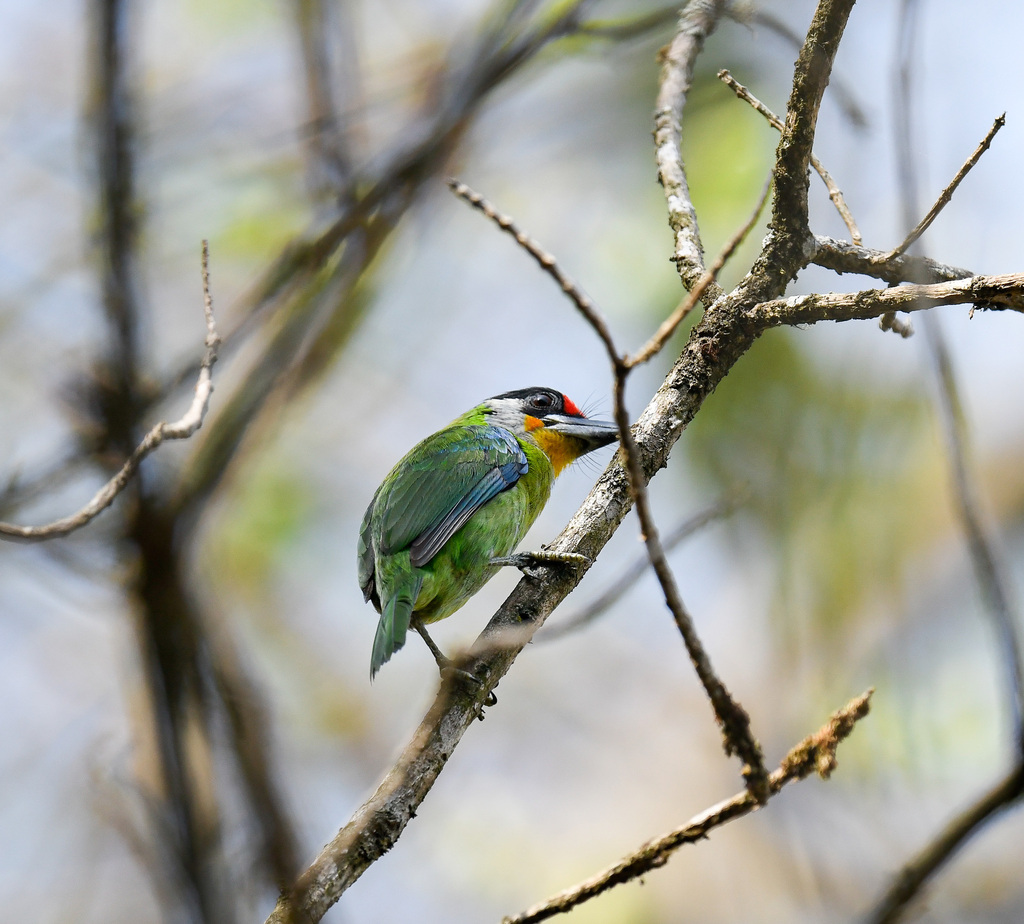
Golden-throated Barbet
Photo © Rejoice Gassah
Photo © Rejoice Gassah — CC BY 4.0 — Source: iNaturalist #304402661Identification
The golden-throated barbet is a striking small bird, measuring 20.5–23.5 cm in length and weighing 50–101 g. Its most distinctive features are its vivid green upperparts contrasting with paler yellowish-green underparts, a crimson forehead, and a brilliant orange throat that gives the species its name. Look for deep blue wings and verditer-blue undertail coverts, a dusky black bill, black eye-lores, and greenish legs.
Range & Habitat
This species is distributed across the Himalayan foothills and Southeast Asia, from central Nepal eastward through India, Bhutan, Myanmar, Thailand, Laos, and into the Malay Peninsula, with populations also in southern Vietnam and southwestern China. It is a resident throughout its range, preferring tropical and subtropical moist forests at elevations between 900 and 2,700 m (3,000–8,900 ft).
Behaviour & Diet
The golden-throated barbet is a territorial species, with males producing a very loud and distinctive call—a repeated pukwowk that echoes through forested hillsides. This loud vocalisation is often the first indication of the bird's presence, as it can be heard from considerable distances in its montane forest habitat.
Best Time & Places to See It
The bird's wide distribution and stable population across multiple countries offer numerous opportunities for sightings. Visitors to montane forests between 900 and 2,700 m in Nepal, Bhutan, Myanmar, Thailand, and Malaysia are most likely to encounter this species. Listen for its distinctive loud call to locate birds in dense forest canopy, where they may be difficult to spot visually despite their colourful plumage.
Photography Tips
The golden-throated barbet's vivid green and orange colouration makes it a rewarding photographic subject, though patience is essential. Position yourself in montane forest habitat during daylight hours and use the bird's loud territorial call to locate individuals. The species' preference for forest canopy means a telephoto lens is advantageous, and early morning when birds are most vocal offers the best opportunities for both sightings and photography.
Langtang National Park
Helambu, Nepal
+364 birds+14 mammals
Where the southern slopes of the Himalayan highlands descend toward the subtropical valleys of central Nepal, Langtang National Park sprawls across one of the subcontinent's most…
VIEW NATIONAL PARKKhangchendzonga National Park
Sakkyong, India
+290 birds+1 mammals
Where the eastern Himalayas surge toward their crowning peaks, Khangchendzonga National Park embraces a landscape of almost overwhelming vertical drama. Rising from subtropical river valleys into…
VIEW NATIONAL PARKKhao Laem National Park
Sangkhla Buri District, Thailand
+197 birds
Where the Vajiralongkorn Reservoir sprawls across the forested valleys of Kanchanaburi's northern borderlands, Khao Laem National Park protects a landscape where limestone ridges rise dramatically from…
VIEW NATIONAL PARKTaman Negara National Park
Kampong Samas, Malaysia
+393 birds+48 mammals
Where ancient rainforest meets limestone peaks, one of Southeast Asia's oldest protected wilderness preserves sprawls across 4,343 square kilometers of primordial landscape. Dipterocarp giants tower overhead,…
VIEW NATIONAL PARKGaoligong Mountain National Nature Reserve
Nujiang Lisu Autonomous Prefecture, China
+443 birds+13 mammals
VIEW NATURE RESERVENo community photos yet. Log in to add the first one.
No community observations of this species yet.