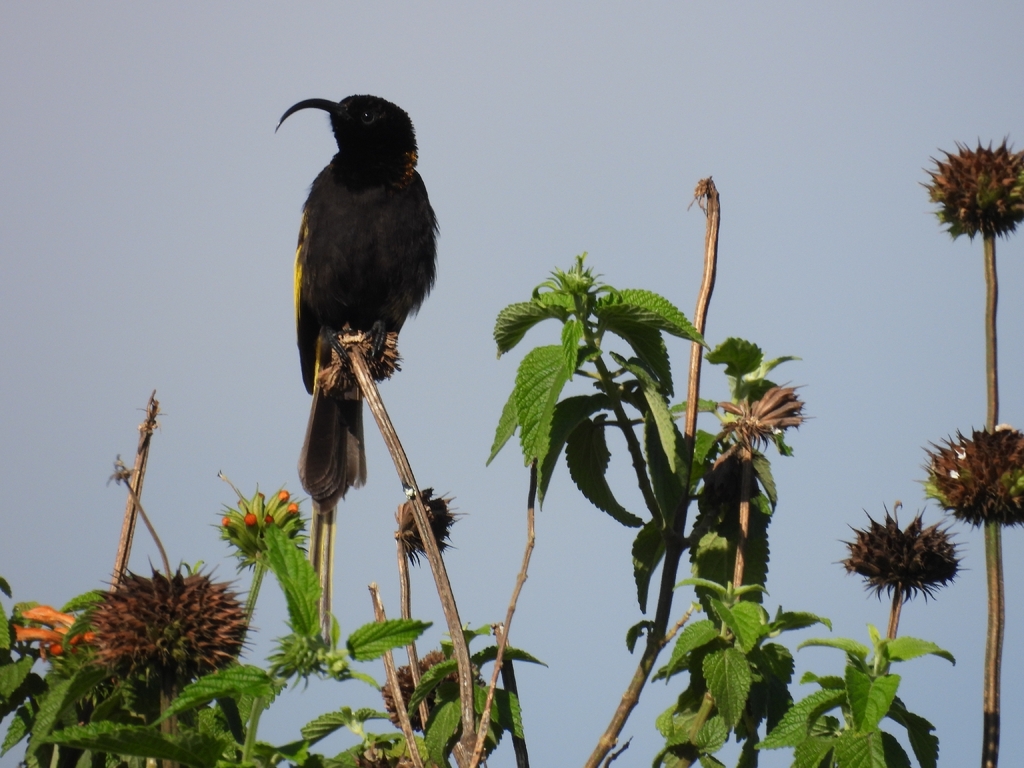
Golden-winged Sunbird
Photo © danielarah
Photo © danielarah — CC0 1.0 — Source: iNaturalist #330613613Identification
The golden-winged sunbird is a small passerine with striking sexual dimorphism. Males measure about 9 inches (23 cm) in length, notably longer than females at approximately 6 inches (15 cm), a difference largely due to the male's elongated central tail feathers. The most reliable identification feature across all plumages and both sexes is the presence of yellow-edged feathers in the wings and tail. Breeding males display conspicuous metallic reddish-copper body plumage, which transforms to dull black in non-breeding season, with brownish-black underparts year-round. Females are olive-green above and yellowish below, while immatures resemble females but with darker underparts. Three subspecies are recognized, with subspecies lathburyi showing a more pronounced red-metallic sheen and smaller overall size, while subspecies shellyae females possess a grey rather than green crown.
Range & Habitat
This distinctive sunbird is native to the montane forests of the Albertine Rift and East Africa, inhabiting elevations between 1,170 and 2,300 meters. The nominate subspecies ranges across southern and western Uganda, Kenya (including Mount Kilimanjaro), and Tanzania. Subspecies lathburyi occupies the more montane regions of Kenya at higher elevations, while subspecies shellyae is restricted to the Democratic Republic of the Congo above 2,100 meters. The species favors forest verges and clearings, cultivated areas, bamboo forests, and tall grassland habitats, and exhibits local nomadic movements in response to food availability.
Behaviour & Diet
Golden-winged sunbirds are primarily nectarivores, with the flowers of Leonotis nepetifolia forming their staple diet. They supplement this with nectar from various other flowering plants including Aloe, Crotalaria, Erythrina, Fuchsia, and Jacaranda species, particularly during breeding season. They also consume insects including beetles, flies, ants, bees, wasps, and larvae. These are highly territorial birds, defending patches of flowering plants outside the breeding season—a strategy that proves energetically profitable when flowers contain sufficient nectar. Territory sizes vary dramatically from 6.7 to 2,300 square meters, yet each territory contains approximately the same number of flowers. Territorial defense is exhibited by all age and sex classes, and birds will contest resources both against their own species and inter-specifically against other sunbirds. Occasionally, females coexist with males on larger territories. When females intrude on other sunbird territories, they may perform a distinctive begging display, quivering their wings and spreading their tails to gain foraging tolerance.
Best Time & Places to See It
Golden-winged sunbirds are active diurnal foragers and can be observed throughout their range in suitable montane habitats. They are most readily found in areas where Leonotis nepetifolia flowers bloom in July, when competing food sources are scarce. Visitors should focus on montane forest edges, clearings, and cultivated areas at elevations above 1,170 meters, particularly in Uganda, Kenya (including Kilimanjaro), Tanzania, and the Democratic Republic of the Congo. The birds spend considerable time perched while defending territories, making them relatively approachable during observation.
Photography Tips
The sexual dimorphism and seasonal plumage changes of golden-winged sunbirds offer diverse photographic opportunities. Males in breeding plumage display brilliant reddish-copper coloration that photographs spectacularly in clear montane light, while the yellow-edged wing and tail feathers provide excellent contrast in any lighting. Focus on capturing the long central tail feathers of males for size perspective. The birds' habit of spending extended periods on perches while defending territories allows for patient composition and focus. Territorial interactions between individuals offer dynamic behavioral photography opportunities, as do female begging displays. The surrounding flowering plants, particularly Leonotis, provide valuable context and habitat information in images.
Serengeti National Park
Tanzania
+558 birds+57 mammals
Across Tanzania's northern plateau, where volcanic soils meet acacia woodland and open grassland, unfolds one of Earth's most dynamic ecosystems. The Serengeti National Park sprawls across…
VIEW NATIONAL PARKArusha National Park
Tanzania
+555 birds+16 mammals
Where the slopes of Mount Mawenzi rise above the Arusha region, a compact yet ecologically rich national park unfolds across montane forest, moorland, and alpine zones.…
VIEW NATIONAL PARKMount Elgon National Park
Matumbei ward, Kenya
+164 birds+7 mammals
Where the volcanic slopes of Mount Elgon rise above the Trans-Nzoia landscape, a montane wilderness unfolds across multiple ecological zones, each harbouring distinct communities adapted to…
VIEW NATIONAL PARKAmboseli National Park
Etonet/Lenkism ward, Kenya
+501 birds+43 mammals
Where the Amboseli basin opens toward the Tanzanian frontier, a shallow alkaline lake mirrors vast skies across one of East Africa's most iconic savanna landscapes. The…
VIEW NATIONAL PARKKilimanjaro National Park
Kenya
+207 birds+16 mammals
Africa's highest mountain rises not in isolation but as the centerpiece of a vast national park that sweeps across the borderlands of northern Tanzania, where savanna…
VIEW NATIONAL PARKMount-Kenya National Park
Abothuguchi west ward, Kenya
+334 birds+11 mammals
Where the slopes of Kenya's second-highest mountain rise steeply from the Meru County foothills, a landscape of profound ecological richness unfolds across Mount Kenya National Park.…
VIEW NATIONAL PARKTarangire National Park
Tanzania
+527 birds+50 mammals
Acacia woodland and grassland sweep across the Manyara Region where the Tarangire River carves through low hills and volcanic soils, creating one of East Africa's most…
VIEW NATIONAL PARKNgorongoro Conservation Area
Tanzania
+626 birds+55 mammals
Volcanic calderas and open grassland dominate this high plateau in northern Tanzania, where the landscape rises above 2,000 metres and ancient geological forces have shaped both…
VIEW WILDLIFE MANAGEMENT AREANairobi National Park
Nairobi, Kenya
+515 birds+35 mammals
Just minutes from Kenya's capital, where the Nairobi River winds through acacia woodland and open grassland, lies one of Africa's most paradoxical wildlife sanctuaries. The park's…
VIEW NATIONAL PARKLake Nakuru National Park
Nakuru West, Kenya
+494 birds+32 mammals
Alkaline waters ringed by acacia woodland and grassland create one of East Africa's most distinctive wetland ecosystems, where the interplay of geology and climate sustains a…
VIEW NATIONAL PARKAberdare National Park
Mweiga ward, Kenya
+394 birds+30 mammals
Where the central highlands of Kenya rise to their elemental grandeur, the Aberdare range unfolds across Nyeri County as a montane stronghold of cool, misty forest…
VIEW NATIONAL PARKHell’s Gate National Park
Olkaria ward, Kenya
+388 birds+18 mammals
Volcanic scarps and geothermal vents dominate the floor of Hell's Gate, where the East African Rift has carved a dramatic gorge through crystalline rock formations. The…
VIEW NATIONAL PARKChyulu Hills National Park
Kibwezi East, Kenya
+232 birds+30 mammals
Volcanic cones rise abruptly from the Kenyan savanna floor, their flanks clothed in dense acacia woodland and grassland that transforms the Chyulu Hills into an ecological…
VIEW NATIONAL PARKNo community photos yet. Log in to add the first one.
No community observations of this species yet.