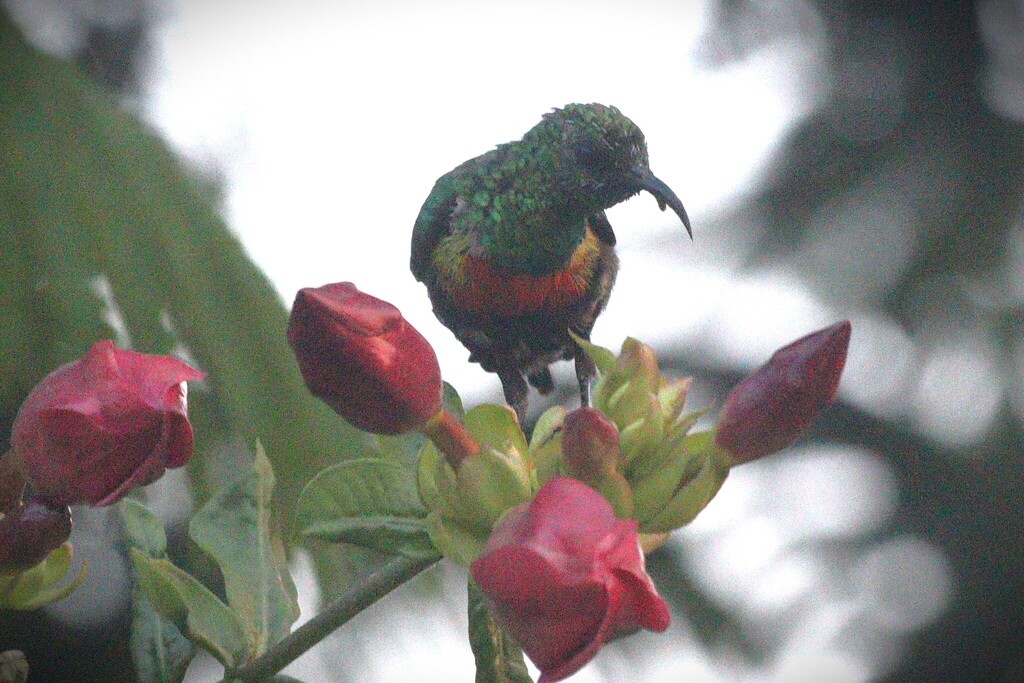
Gorgeous Sunbird
Photo © Edmundas Greimas
Photo © Edmundas Greimas — CC BY 4.0 — Source: iNaturalist #372268117The gorgeous sunbird (Cinnyris melanogastrus) is a small passerine bird in the sunbird family Nectariniidae that is found in southern Kenya and Tanzania. It was formerly placed in the Nectarinia genus, a genus of the Nectariniidae family but was later changed to the Cinnyrus genus. It was also formerly considered to be conspecific with the beautiful sunbird. == Taxonomy == The gorgeous sunbird was formally described in 1884 by the German explorer Gustav Fischer and ornithologist Anton Reichenow based on a specimen collected near the Nguruman Escarpment in southern Kenya. They coined the binomial name Nectarinia melanogastra. The specific epithet combines the Ancient Greek μελας/melas meaning "black" and γαστηρ/gastēr meaning "belly". The gorgeous sunbird is now one of 64 sunbirds placed in the genus Cinnyris that was introduced in 1816 by the French naturalist Georges Cuvier. It was formerly considered to be conspecific with the beautiful sunbird (Cinnyris pulchellus). The species were split based on the differences in morphology. The gorgeous sunbird is monotypic: no subspecies are recognised. == Description == Male sunbirds have bright green feathers, a blue and black tail, and a yellow and red chest, which helps them stand out easily. They normally grow to about 15-17…
Serengeti National Park
Tanzania
+558 birds+57 mammals
Across Tanzania's northern plateau, where volcanic soils meet acacia woodland and open grassland, unfolds one of Earth's most dynamic ecosystems. The Serengeti National Park sprawls across…
VIEW NATIONAL PARKArusha National Park
Tanzania
+555 birds+16 mammals
Where the slopes of Mount Mawenzi rise above the Arusha region, a compact yet ecologically rich national park unfolds across montane forest, moorland, and alpine zones.…
VIEW NATIONAL PARKTsavo West National Park
Mwatate, Kenya
+513 birds+49 mammals
Where volcanic ridges and weathered lava flows meet the semi-arid lowlands of south-central Kenya, Tsavo West National Park unfolds across a landscape sculpted by fire and…
VIEW NATIONAL PARKAmboseli National Park
Etonet/Lenkism ward, Kenya
+501 birds+43 mammals
Where the Amboseli basin opens toward the Tanzanian frontier, a shallow alkaline lake mirrors vast skies across one of East Africa's most iconic savanna landscapes. The…
VIEW NATIONAL PARKTarangire National Park
Tanzania
+527 birds+50 mammals
Acacia woodland and grassland sweep across the Manyara Region where the Tarangire River carves through low hills and volcanic soils, creating one of East Africa's most…
VIEW NATIONAL PARKNgorongoro Conservation Area
Tanzania
+626 birds+55 mammals
Volcanic calderas and open grassland dominate this high plateau in northern Tanzania, where the landscape rises above 2,000 metres and ancient geological forces have shaped both…
VIEW WILDLIFE MANAGEMENT AREANairobi National Park
Nairobi, Kenya
+515 birds+35 mammals
Just minutes from Kenya's capital, where the Nairobi River winds through acacia woodland and open grassland, lies one of Africa's most paradoxical wildlife sanctuaries. The park's…
VIEW NATIONAL PARKHell’s Gate National Park
Olkaria ward, Kenya
+388 birds+18 mammals
Volcanic scarps and geothermal vents dominate the floor of Hell's Gate, where the East African Rift has carved a dramatic gorge through crystalline rock formations. The…
VIEW NATIONAL PARKRuma National Park
Suba, Kenya
+250 birds+8 mammals
Where the Winam Gulf narrows toward the Kenyan mainland, Ruma National Park rises as a sanctuary of evergreen woodland set within the humid tropics of Homa…
VIEW NATIONAL PARKNo community photos yet. Log in to add the first one.
No community observations of this species yet.