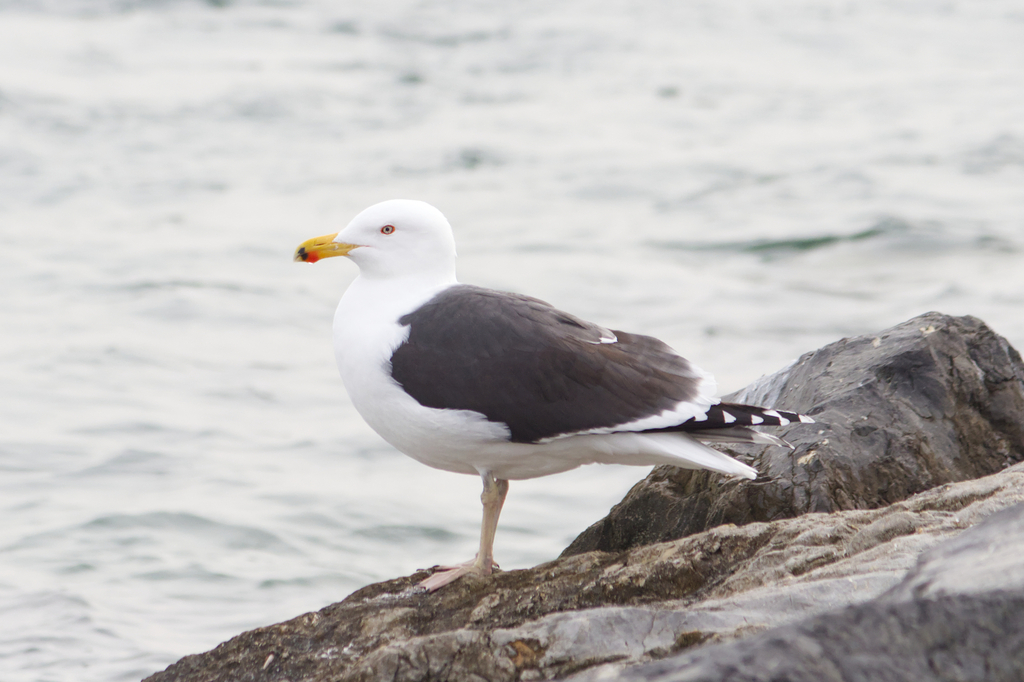
Great Black-backed Gull
Photo © Adam Leisenring
Photo © Adam Leisenring — CC BY 4.0 — Source: iNaturalist photo #616170929Identification
The great black-backed gull is the largest gull in the world, measuring 64–79 cm long with a wingspan of 1.5–1.7 m. Adults are unmistakable: they display a white head, neck and underparts contrasted sharply against dark blackish-grey wings and back, with conspicuous white "mirrors" at the wing tips. The bill is yellow or yellow-pink with orange or red near the tip of the lower bill, and the legs are pinkish. This dark-backed colouration is distinctive in the North Atlantic, where no other very large gull shares this combination of features.
Juvenile birds look markedly different, with scaly, checkered black-brown upper parts, grey-brown streaking on the head and underparts, and a neat wing pattern with blackish-brown flight feathers. The juvenile's tail is white with zigzag bars and spots at the base, broken by a blackish band near the tip. Young birds take at least four years to reach full maturity, developing gradually through increasingly contrasting plumage stages. Their distinctive deep "laughing" call—kaa-ga-ga, with an almost bovid-like quality—is noticeably deeper than most other gull species.
Range & Habitat
This species breeds across the North Atlantic coasts and islands, from northwestern Russia and Scandinavia through the Baltic Sea, to the United Kingdom, Ireland, and northwestern France. In North America, it breeds from the Atlantic coasts of Canada and the United States, and has expanded its range southward to include colonies in the New England states and as far south as North Carolina. Northern populations migrate considerable distances in winter, while southern populations are generally sedentary.
The great black-backed gull occupies diverse coastal habitats including rocky and sandy coasts, estuaries, and inland wetland environments such as lakes, ponds, rivers, wet fields and moors. Wintering birds are found on northern European coasts from the Baltic Sea to southern Portugal, and regularly reach coastal Florida in North America. Exceptionally, the species can range as far south as the Caribbean and off the coast of northern South America.
Behaviour & Diet
The great black-backed gull is a very aggressive hunter, pirate and scavenger. This powerful predator uses its large, formidable bill to pursue a varied diet, taking advantage of whatever food sources are available in its environment. Its aggressive nature makes it a dominant presence in mixed gull colonies and coastal feeding areas.
Best Time & Places to See It
Breeding birds can be found from late spring through summer on rocky coasts, islands, and coastal cliffs throughout the North Atlantic region. Winter offers excellent viewing opportunities on northern European coasts and in North America, particularly around ports, estuaries, and fishing areas where birds congregate. Southern populations provide year-round viewing opportunities in places like the United Kingdom and Ireland.
Photography Tips
The great black-backed gull's large size and striking plumage make it a rewarding photography subject. Photograph adults in bright light to capture the contrast between their white underparts and dark backs, and to show the yellow bill with its distinctive red spot. The white wing mirrors are particularly striking in flight. Juvenile birds offer different photographic opportunities with their complex pattern of browns and greys—photograph these birds carefully to document the progression of plumage as they mature over their four-year development period.
Acadia National Park
Algonquin Provincial Park
Alligator River National Wildlife Refuge
Åsnens National Park
Bannau Brycheiniog National Park
Bic National Park
Biscayne National Park
Blackwater National Wildlife Refuge
Bombay Hook National Wildlife Refuge
Nothing matches these filters.
No community photos yet. Log in to add the first one.
No community observations of this species yet.