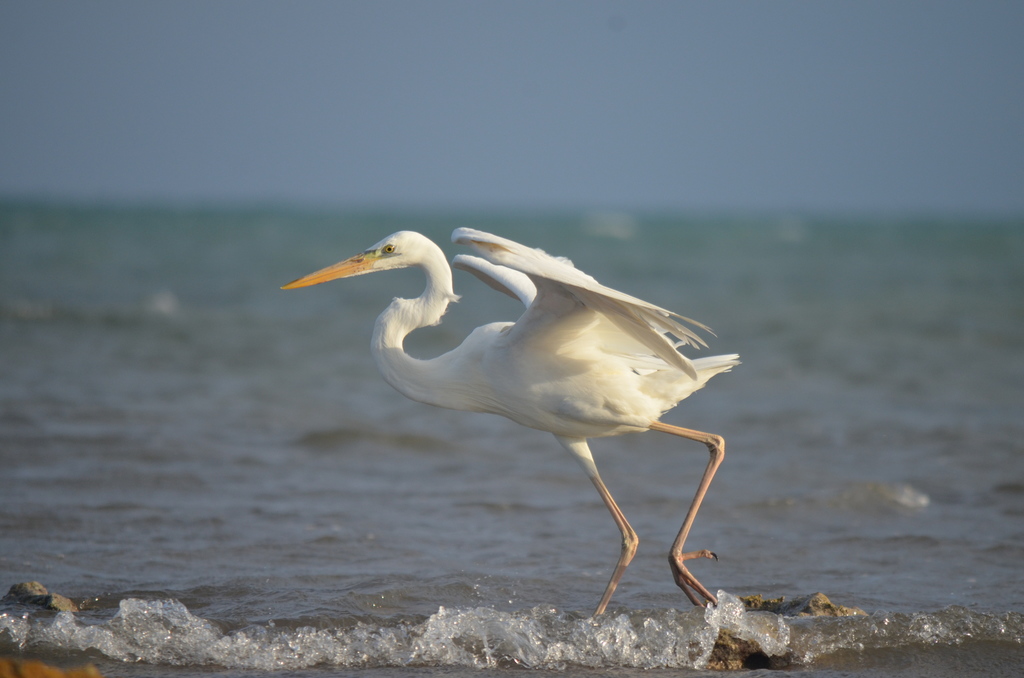
Great Blue Heron
Photo © Josiah Londerée
Photo © Josiah Londerée — CC BY 4.0 — Source: iNaturalist photo #181908836Identification
The great blue heron is the largest heron native to North America, surpassed in size globally only by the Goliath heron and the White-bellied heron. Adults measure 91–137 cm in head-to-tail length, with a wingspan of 167–201 cm and weights ranging from 1.82–3.6 kg, making them roughly twice as heavy as great egrets. Males are slightly larger than females, though the sexes are otherwise difficult to distinguish in the field.
Plumage is distinctive: slaty-blue flight feathers contrast with a rusty-gray neck featuring black and white streaking. Red-brown thighs and flanks marked with paired red-brown and black stripes are characteristic, as is the paler head with a nearly white face and black or slate plumes extending from above the eye to the back of the head. The bill is dull yellowish, becoming orange at the start of breeding season, and the lower legs are gray, also brightening to orange during breeding. Immature birds are duller overall, lacking plumes and showing a weakly defined flank pattern. An all-white morph, known as the great white heron, occurs in South Florida and the Florida Keys; these birds are larger than typical great blues, with yellow legs that distinguish them from great egrets, which have black legs.
Range & Habitat
The great blue heron is common near shores of open water and wetlands throughout most of North and Central America, as well as northwestern South America, the Caribbean, and the Galápagos Islands. It is occasionally found in the Azores and is a rare vagrant to Europe. The species occupies an ecological niche in North America analogous to that filled by the grey heron in Eurasia.
Behaviour & Diet
As a wading bird, the great blue heron forages in shallow water habitats, using its long legs and neck to access prey. The heron's stride measures approximately 22 cm and falls almost in a straight line, an adaptation for stalking through wetlands.
Best Time & Places to See It
Great blue herons are widespread and relatively common throughout their range, making them accessible to nature travellers across North America. They are best found near open water and wetland habitats, from coastal marshes to inland lakes and rivers. In South Florida and the Florida Keys, the all-white morph provides a distinctive and sought-after variant for field birders.
Photography Tips
The great blue heron's large size and striking plumage make it an excellent photography subject. Look for them in shallow-water habitats where their patient stalking behavior provides opportunities for close observation. The breeding season brings additional visual interest, with the bill and legs brightening to orange tones and the development of decorative plumes on the head and lower back. Photographers should note the bird's characteristic S-shaped neck posture in flight, which distinguishes it from cranes.

11 Days Safari to Uganda Including Gorilla Trekking.
Nothing matches these filters.
Acadia National Park
Alaska Maritime National Wildlife Refuge
Algonquin Provincial Park
Alligator River National Wildlife Refuge
Arches National Park
Arenal Volcano National Park
Arrecifes de Cozumel National Park
Badlands National Park
Banff National Park
Nothing matches these filters.
No community photos yet. Log in to add the first one.
No community observations of this species yet.