Identification
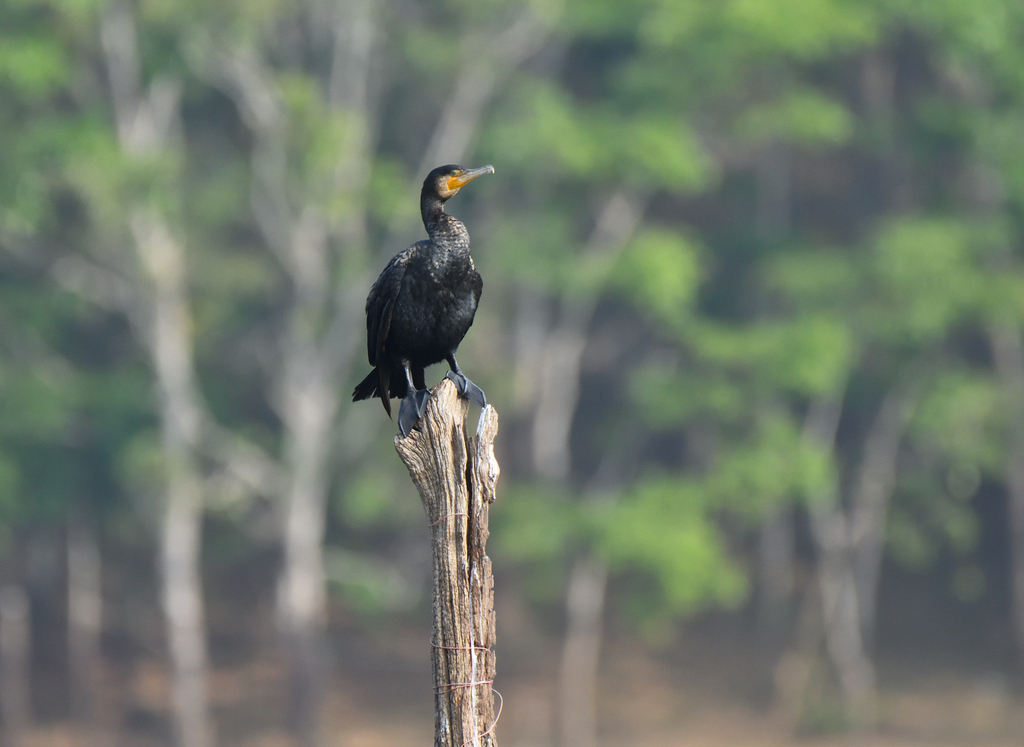
The great cormorant is a large seabird with mostly black plumage displaying striking bronze to greenish iridescence on the wings and tail, and purple iridescence on the body. Adults possess distinctive deep sea-green eyes, a stout bill strongly hooked at the tip, and a yellow or sometimes red patch of bare gular skin on the throat. The legs are short and dark grey, with large, fully webbed feet. Length ranges from 70 to 102 centimetres, with wingspans between 121 and 160 centimetres, making it one of the largest cormorant species. Males are typically larger than females.
In breeding season, adults develop striking white filoplume patches on the thighs and on the head and upper neck, though these are shed in winter when plumage becomes more uniformly black and duller. Juveniles and immatures have pale to whitish underparts, gradually darkening over three to four years to reach full adult plumage. The tail comprises 14 feathers, a useful distinguishing feature from related species like the European shag and double-crested cormorant, which have only 12 tail feathers.
Range & Habitat
The great cormorant is widespread throughout much of the Old World, Australasia, and the Atlantic coast of North America. Different subspecies occupy distinct ranges: the nominate form P. c. carbo inhabits Atlantic waters, northwestern European coasts, the Faroe Islands, Iceland, Greenland, and northeastern North America; P. c. sinensis is found across mainland Europe eastward through the Palearctic to Siberia and southeastern Asia; and P. c. novaehollandiae occurs in Australian and New Zealand waters. The species shows considerable regional variation in size across its range.
These birds favour inshore coastal waters, estuaries, and freshwater lakes and rivers where fish are abundant. Northern populations migrate south during winter to escape frozen waters, relocating to any unfrozen coast or freshwater body with adequate food supplies. In warmer regions, birds disperse locally rather than migrate. They rarely cross large bodies of water such as the North Sea.
Behaviour & Diet
Great cormorants are pursuit divers that hunt fish in water, feeding in inshore marine environments as well as freshwater systems. They are mostly silent birds but produce various guttural noises at their breeding colonies, where they gather in sometimes substantial numbers. The species breeds in much of its range, with different populations exhibiting varying breeding chronologies depending on their geographic location and local environmental conditions.
Seasonal plumage changes are pronounced in this species. During breeding season, the acquisition of white filoplumes provides visual signals at colonies. The extent and distribution of these breeding plumes varies with both individual age and subspecies, with older birds displaying more extensive white markings than younger birds. This variation in breeding plumage, combined with differences in gular skin patch shape, helps distinguish between subspecies.
Best Time & Places to See It
As a very common and widespread species, great cormorants are readily encountered throughout their range. Coastal areas, estuaries, and inland waterways with good fish populations offer the best viewing opportunities. Breeding colonies are particularly rewarding, where birds gather in significant numbers and display their striking breeding plumage with white filoplume patches. The breeding season offers the most visually dramatic viewing experience, as birds develop their ornamental head and thigh plumage.
Regional populations show seasonal movements, with northern birds moving southward in winter. This migration pattern means that specific locations may offer better viewing at particular times of year depending on latitude. Sheltered coastal waters, river systems, and large lakes are reliable locations year-round in appropriate geographic regions.
Photography Tips
Photograph breeding birds during the breeding season to capture the stunning white filoplume patches on the head, upper neck, and thighs—these distinctive markings make compelling subjects and are particularly visible in strong natural light. The deep sea-green eyes of adults provide striking focal points; position your camera to catch this eye colour clearly. The bird's large size and heavy build create strong, dynamic silhouettes, especially when perched on rocks or water.
To differentiate this species from similar cormorants in your images, ensure you capture the 14-tail feathers (visible when spread), the purple iridescence on the body, and the characteristic gular skin patch. Colony shots offer opportunities to show behaviour and the striking contrast between breeding and non-breeding plumage if birds at different stages are present. The darker winter plumage is more subdued photographically, so prioritise breeding season visits when possible for maximum visual impact.
Lake Kerkini Photography Tour
Nothing matches these filters.
Parque del Centenario
Delta de l’Ebre Natural Park
Bwindi Impenetrable National Park
Kanha Tiger Reserve
Mabamba Swamp
Minneriya National Park
Murchison Falls National Park
Queen Elizabeth National Park
Abel Tasman National Park
Nothing matches these filters.
No community photos yet. Log in to add the first one.