Identification
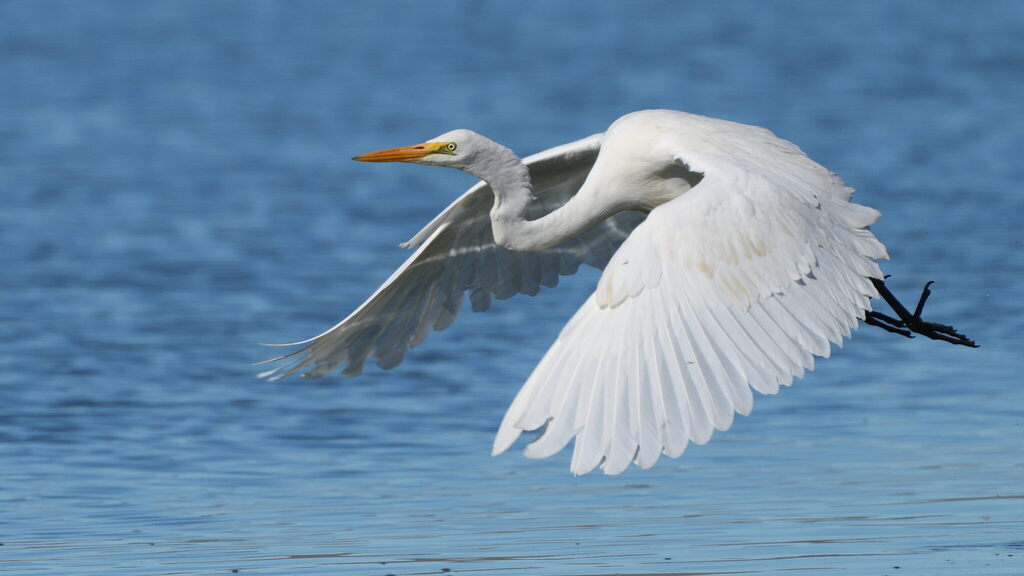
The great egret is a large heron with distinctive all-white plumage, standing up to 1 metre tall with a length of 80 to 104 centimetres and a wingspan of 131 to 170 centimetres. Its most identifying features are a yellow bill and black legs and feet, though these may change colour during breeding season when the bill darkens and lower legs lighten. In breeding plumage, delicate ornamental feathers adorn the back. Males and females are identical, and juveniles resemble non-breeding adults.
The great egret can be distinguished from similar species by its size and bill characteristics. It is larger than the snowy egret and intermediate egret, and differs from the latter by its gape, which extends well beyond the eye rather than ending just behind it. In flight, the great egret holds its neck retracted in the characteristic heron fashion, distinguishing it from storks, cranes, and ibises. When walking, it extends its neck and holds its wings close to its body.
Range & Habitat
The great egret is a widely distributed and highly successful species found across temperate and tropical regions worldwide. Four subspecies occur across Asia, Africa, the Americas, and southern Europe. The species is ubiquitous across the Sun Belt of the United States and throughout the Neotropics. Recently, it has been expanding northward into previously uncolonized areas of Europe, with breeding now established in the Nordic countries including Sweden, Denmark, and Finland, as well as in Great Britain and Scotland.
Great egrets build tree nests in colonies positioned close to large lakes with reed beds or other extensive wetlands, preferring nest heights between 3 and 12 metres. They thrive in wetland habitats throughout their range and have successfully adapted to new northern territories, indicating their ecological flexibility and expanding presence in response to environmental changes.
Behaviour & Diet
The great egret is not normally a vocal bird, though it produces a low, hoarse croak when disturbed. At breeding colonies, it becomes notably more vocal, giving loud croaking "cuk cuk cuk" calls and higher-pitched squawks. The species is gregarious during breeding, establishing colonies with other herons and species that share similar wetland habitats.
Great egrets breed in tree colonies and display characteristic heron behaviours. They share their habitats with numerous similar species across their range, including the little egret, intermediate egret, snowy egret, and various regional species depending on location. This ecological overlap requires careful field identification to distinguish the great egret from its many relatives.
Best Time & Places to See It
The great egret's expanding range offers increasingly diverse opportunities for observation. In North America, the species is ubiquitous across the Sun Belt. In Europe, established breeding populations can now be found in Britain and Scandinavia, with Somerset's Shapwick Heath and Holkham National Nature Reserve in Norfolk offering confirmed sighting locations. Recent breeding success in Scotland at Loch of Strathbeg indicates the species' continued northward expansion.
As a colonial breeder, the great egret is most reliably found near extensive wetlands with reed beds and suitable nesting trees. Breeding season provides excellent opportunities for observation and photography, with colonies offering concentrated numbers and dramatic breeding plumage displays featuring ornamental feathers on the back.
Photography Tips
The great egret's all-white plumage presents both opportunities and challenges for photographers. The pure white coloration requires careful exposure metering to avoid blown highlights; underexpose slightly to preserve detail in the plumage. The bird's large size and slow, deliberate movements make it an approachable subject, though the retracted-neck flight posture should be anticipated for in-flight shots.
Breeding colonies offer exceptional photography opportunities, with dramatic ornamental plumage, dynamic colony interactions, and nesting behaviours providing compelling compositions. The yellow bill and black legs and feet provide strong colour contrast against white plumage. Position yourself near wetland habitats at dawn or dusk when egrets are most active, and use the bird's preference for extended-neck ground postures to capture striking portraits that showcase its impressive stature and elegant proportions.