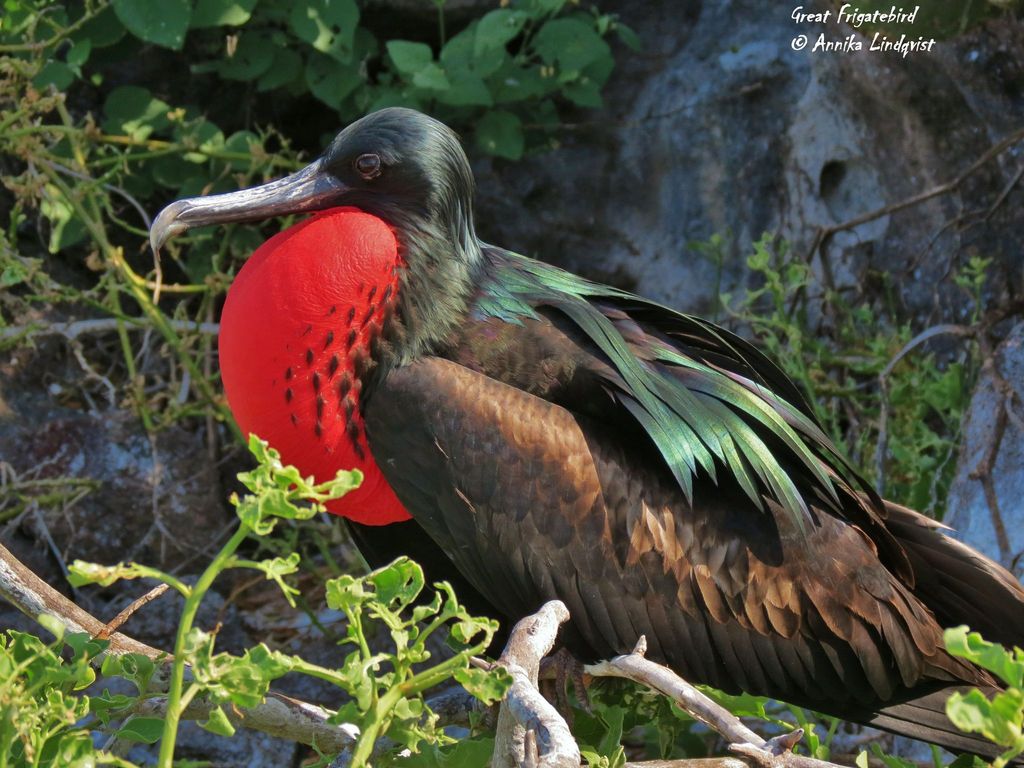
Great Frigatebird
Photo © Annika Lindqvist
Photo © Annika Lindqvist — CC BY 4.0 — Source: iNaturalist photo #1447239Identification
The great frigatebird is a large, lightly built seabird measuring 85 to 105 cm in length with a remarkable wingspan of 205–230 cm. These birds possess the highest ratio of wing area to body mass of any bird species, giving them an unmistakable silhouette in flight with long, narrow pointed wings and a deeply forked tail. Both sexes are predominantly black, but sexual dimorphism is striking: females are larger than males and display a distinctive white throat and breast with a red eye ring, while males feature iridescent green-tinged scapular feathers. During breeding season, males can inflate a brilliant red gular sac—one of nature's most dramatic visual displays. Juveniles are black with rust-tinged white on the face, head, and throat.
Range & Habitat
Great frigatebirds inhabit tropical seas worldwide, with major nesting populations distributed across the Pacific, Indian, and Atlantic Oceans. In the Pacific, they range from Hawaii in the north down through the Galápagos Islands, with colonies on most island groups extending to New Caledonia and Australian possessions in the Coral Sea. Indian Ocean populations breed on renowned island groups including the Seychelles (Aldabra and Aride Islands), Christmas Island, the Maldives, and Mauritius. The Atlantic population is tiny, confined to St. Helena, Ascension Island, and the Brazilian islands of Trindade and Martim Vaz.
These birds undertake regular migrations across their range and can travel remarkable distances—some individuals have been recorded traveling over 4,400 km between breeding and feeding grounds. Despite their wandering nature, frigatebirds exhibit strong philopatry, consistently returning to breed in their natal colonies.
Behaviour & Diet
Great frigatebirds are specialized aerial hunters that forage in pelagic waters within 80 km of their breeding colonies or roosting areas. Flying fish from the family Exocoetidae form the primary diet, though they also consume other fish species and squid. They snatch prey in flight, either from just below the surface or from the air when flying fish are flushed upward. These birds often follow schools of predatory tuna or dolphin pods that drive fish to the surface, taking advantage of the hunting efforts of larger marine predators.
Unlike other frigatebirds, great frigatebirds engage in kleptoparasitism—stealing food from other birds—less frequently than their relatives. A notable adaptation is their inability to take off from the water surface, so they maintain their aerial lifestyle, never alighting to rest on the ocean.
Best Time & Places to See It
For travelers seeking great frigatebirds, the Hawaiian Islands offer reliable viewing opportunities, with around 10,000 pairs nesting mostly in the Northwestern Hawaiian Islands. The Galápagos Islands provide excellent sightings in a spectacular setting, while Indian Ocean destinations like the Seychelles (particularly Aldabra and Aride Islands) and Mauritius offer island-based viewing experiences. St. Helena and Ascension Island in the Atlantic provide opportunities for seeing this species in a more remote setting. The breeding season is the optimal time to observe males with their distinctive inflated red gular sacs and to witness the dramatic aerial displays these birds are famous for.
Photography Tips
Photograph great frigatebirds in flight to capture their extraordinary aerial grace and the impressive wingspan that makes them unmistakable against tropical skies. Backlighting can highlight the iridescent green sheen on males' scapular feathers. During breeding season, prioritize males in display, as the inflated red gular sac against black plumage creates a striking and iconic image. The high contrast between white-breasted females and all-black males makes composition straightforward. Patience is essential—position yourself near roosting areas or nesting colonies where birds are active, and use a fast shutter speed to freeze their dynamic aerial hunting sequences as they snatch prey from the ocean surface.
Hawaiʻi Volcanoes National Park
Hawaiʻi County, United States
+84 birds+2 mammals
Where volcanic slopes descend toward the Pacific across more than five thousand square kilometers, Hawaiʻi Volcanoes National Park presents one of Earth's most dynamic laboratories of…
VIEW NATIONAL PARKParque Nacional de Galápagos
Santo Tomás, Ecuador
+139 birds+23 mammals
Volcanic peaks and weathered lava fields dominate this remote archipelago in the Pacific, where the interplay of cold ocean currents and tropical latitude creates an ecological…
VIEW ISLAND & ARCHIPELAGODaintree National Park
Dedin, Australia
+362 birds+37 mammals
Daintree National Park is one of the world’s oldest and most biologically diverse tropical rainforests, protecting an extraordinary landscape where ancient forests meet the Great Barrier…
VIEW NATIONAL PARKEndeavour River National Park
Philadelphia, Australia
+203 birds+1 mammals
Where the Endeavour River winds through northeastern Queensland's tropical lowlands, a compact mosaic of rainforest, open woodland, and riverine corridor creates one of Australia's most ecologically…
VIEW NATIONAL PARKWest Bali National Park
Gerokgak, Indonesia
+240 birds+8 mammals
Across West Bali's northwestern reaches, where the Indian Ocean meets volcanic slopes and limestone cliffs plunge toward turquoise shallows, sprawls a protected realm of roughly 325…
VIEW NATIONAL PARKAketajawe Lolobata National Park
Oba Tengah, Indonesia
+123 birds+2 mammals
Across the northeastern arm of Halmahera, where the Wallace Line once marked the boundary between Asian and Australasian fauna, lies a sprawling wilderness of over 13,800…
VIEW NATIONAL PARKKomodo National Park
Komodo, Indonesia
+155 birds+14 mammals
Where volcanic peaks rise dramatically from turquoise waters, a primordial landscape unfolds across three main islands and countless smaller ones scattered throughout the Lesser Sunda archipelago.…
VIEW NATIONAL PARKGreat Sandy National Park
Australia
+306 birds+40 mammals
Where coastal dunes rise inland from the Queensland coastline, Great Sandy National Park encompasses a landscape of remarkable ecological diversity shaped by subtropical humid conditions year-round.…
VIEW NATIONAL PARKHaleakalā National Park
Maui County, United States
+66 birds+4 mammals
Ascending from sea level to over 10,000 feet across a mere thirty miles, Haleakalā National Park commands one of the Pacific's most dramatic elevation gradients, where…
VIEW NATIONAL PARKNational Park of American Samoa
Leusoaliʻi, United States
+31 birds+1 mammals
The volcanic ridges of American Samoa rise steeply from the Pacific, their slopes cloaked in tropical rainforest that cascades down to a coast where reef systems…
VIEW NATIONAL PARKKīlauea Point National Wildlife Refuge
Kilauea, United States
+79 birds+1 mammals
At the northernmost tip of Kauai, where the Pacific trades collide with volcanic rock, Kīlauea Point National Wildlife Sanctuary crowns a dramatic headland overlooking one of…
VIEW WILDLIFE SANCTUARYMidway Atoll National Wildlife Refuge
United States
+91 birds+1 mammals
Straddling the international date line roughly midway between North America and Asia, this atoll sanctuary rises from the North Pacific as a cluster of coral and…
VIEW WILDLIFE SANCTUARYNo community photos yet. Log in to add the first one.
No community observations of this species yet.