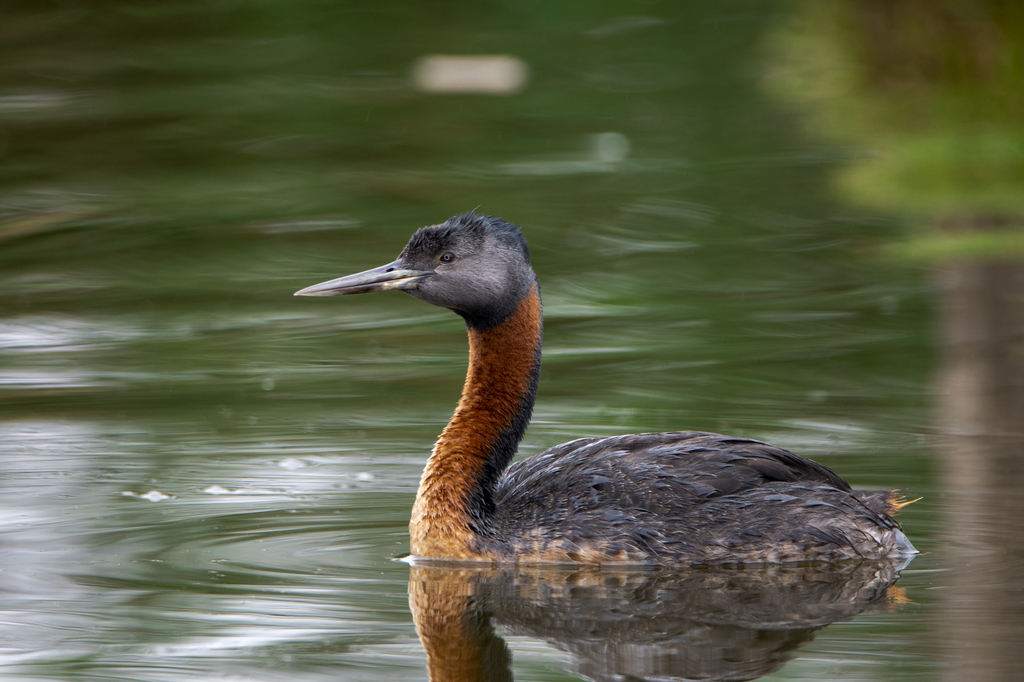
Great Grebe
Photo © David F. Belmonte
Photo © David F. Belmonte — CC BY 4.0 — Source: iNaturalist photo #113147630Identification
The great grebe is the largest species of grebe in the world, with proportions more reminiscent of a goose or cormorant than a typical grebe. Adults range from 67 to 80 cm in length and typically weigh around 1,600 grams, though individuals can reach 2 kg or more. They are unmistakable in the field: the neck and chest are buffy-rufous, the back is blackish, and the belly whitish. The head is sooty gray with a distinctive reddish-brown eye. Due to its size and unique coloration, the great grebe is unlikely to be confused with any other bird, including other grebes.
Range & Habitat
The great grebe has a discontinuous distribution across South America. A disjunct population exists in northwestern Peru, while the main range extends from extreme southeastern Brazil south through Paraguay and Uruguay to central Chile and southern Argentina. The population from southern Chile is recognized as a separate subspecies. These birds prefer open waterways, most commonly seen on low-altitude lakes and sluggish rivers surrounded by forests, as well as estuarine marshes. During breeding season they frequent heavily vegetated inlets off large lakes. Outside the breeding season, most birds move to estuaries and bays rich in kelp, and occasionally venture onto the open sea. Non-breeding birds may inhabit coastal areas year-round. The species remains widespread and common throughout most of its range, with much of its native habitat remaining intact, particularly in southern portions of the range.
Behaviour & Diet
Great grebes are highly social outside the breeding season, gathering in groups numbering up to several hundred individuals. They feed primarily on fish, often exceeding 11 cm in length though typically smaller. They also take insects, crustaceans, and mollusks, and can switch to a diet nearly half composed of crabs during winter months along the coasts. Occasionally they prey on the young of other waterbirds, particularly coots. While cormorants compete with great grebes for fish, the smaller cormorants typically capture larger individual fish. During breeding season, these birds move inland and become moderately social, occasionally forming breeding colonies. Most populations lay eggs from October to January, with timing becoming later further south. The Peru population nests in September and October, with possible second clutches in January or February. Clutches typically contain three to five eggs, sometimes six, and two or more broods may be raised simultaneously.
Best Time & Places to See It
Great grebes are widespread and common throughout their range, making them relatively reliable to find in suitable habitat. The best viewing opportunities depend on the season and location. Visit low-altitude lakes and sluggish forest-bordered rivers during breeding season (October to January in most areas, September-February in Peru) to observe nesting behavior and family groups. Outside breeding season, concentrate efforts on estuaries, bays, and coastal areas where birds congregate in larger numbers. The southern portions of the range offer particularly good chances due to habitat preservation and year-round populations in some coastal areas.
Photography Tips
The great grebe's large size, distinctive coloration, and aquatic habits present excellent photography opportunities. The contrast between the buffy-rufous neck and chest and the blackish back is striking and photographs well in natural light. Capture birds in estuaries and coastal areas during non-breeding season when they gather in groups, allowing for compelling compositions. The reddish-brown eye provides a strong focal point—use telephoto lenses to achieve frame-filling portraits. Early morning or late afternoon light will best emphasize the subtle coloration variations. When photographing breeding birds on heavily vegetated lake inlets, position yourself to take advantage of the vegetation as compositional elements framing the birds.
Cabo de Hornos National Park
Campos del Tuyú National Park
Cerro Castillo National Park
Chiloé National Park
Corcovado National Park
El Palmar National Park
Iguaçu National Park
Lago Puelo National Park
Laja National Park Lagoon
Nothing matches these filters.
No community photos yet. Log in to add the first one.
No community observations of this species yet.