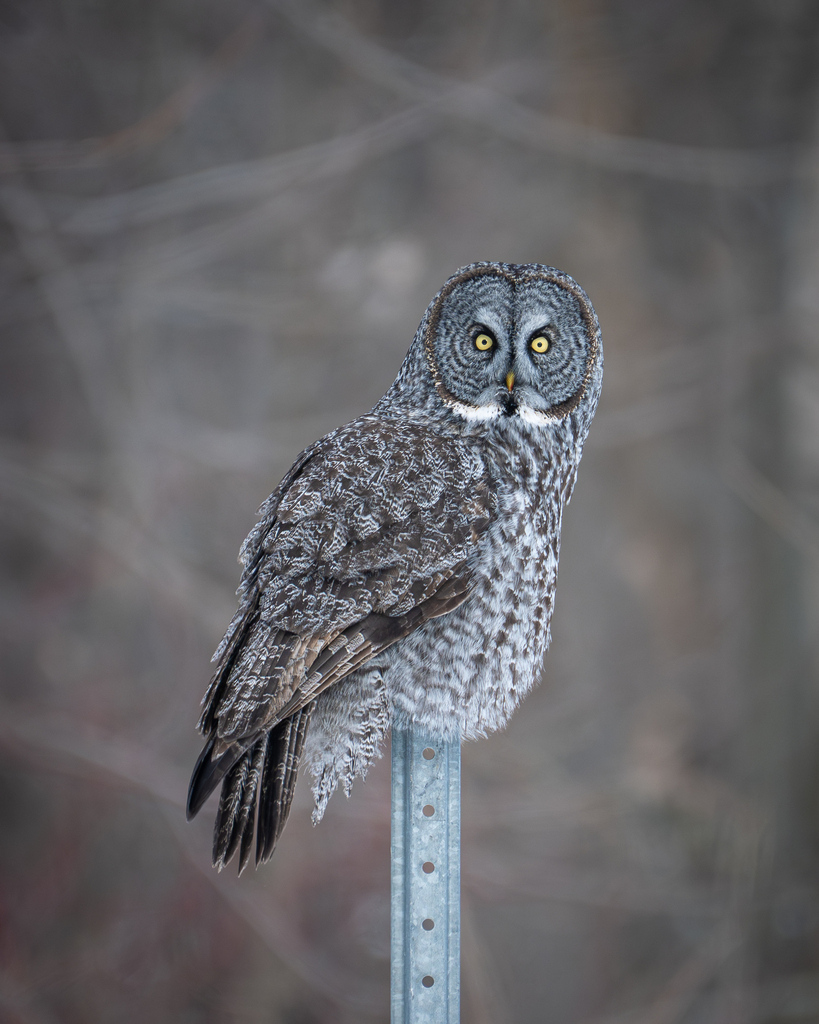
Great Grey Owl
Photo © Martin Tremblay
Photo © Martin Tremblay — CC BY 4.0 — Source: iNaturalist photo #609814775Identification
The great grey owl is the world's largest owl species by length, though its apparent size is deceptive—much of its bulk comes from fluffy plumage and an enormous facial disc rather than solid body mass. Adults are unmistakable, with large rounded heads featuring distinctive grey faces, yellow eyes ringed by dark circles, and a striking white "bow-tie" or collar just below the beak. The upper parts are grey with pale bars, while the underparts are light with dark streaks. This species lacks ear tufts and possesses the longest tail of any living owl species. Length ranges from 61 to 84 centimetres, with females averaging slightly larger than males, and wingspan often exceeding 152 centimetres.
The great grey owl's deep, rhythmic territorial call—a series of very deep "who" sounds—is distinctive and helps confirm identification in the field. Young birds may chatter, shriek, or hiss, quite different from the measured calls of adults.
Range & Habitat
This species is distributed across the entire Northern Hemisphere and is the only owl in its genus found in both Eastern and Western Hemispheres. In North America, great grey owls breed from central Alaska and Quebec southward to northern California, Idaho, Montana, Wyoming, and northeastern Minnesota. In Eurasia, they range from Fennoscandia through Siberia to Sakhalin and Kamchatka, extending south to Mongolia, Manchuria, and northeastern China.
Great grey owls favour dense coniferous taiga forests near open areas such as meadows and bogs, though they also nest in mixed oak woodlands in Oregon and California. Once thought to require cold climates, the species is now known to survive in regions where summer temperatures exceed 38°C. While many populations are permanent residents, northerly birds may move south and southeast when food becomes scarce. In winter, they typically remain in their territories but may descend to lower elevations to escape deep snow.
Behaviour & Diet
Great grey owls are primarily nocturnal hunters that must capture their prey on the ground, making them vulnerable to deep snow cover. Like most owls, males are noticeably smaller than females. Adults are characteristically silent except during territorial disputes or interactions with offspring, when they produce their deep, rhythmic calls. The species shows impressive longevity, with wild birds recorded living between 10 and 20 years, and captive individuals reaching approximately 27 years; one individual was documented to have lived to age 40.
Best Time & Places to See It
In the Pacific states, sedentary populations exist in California, Oregon, and Washington, though birds are scattered across disjunct areas of suitable habitat. Oregon's breeding range extends from the Siskiyou Mountains in the southwest to the Blue Mountains in the northeast. Two May bird festivals—the Ladd Marsh Festival in La Grande and the Mountain Bird Festival in Ashland—feature field trips specifically targeting this species. In California, the great grey owl is listed as endangered, with fewer than 300 birds estimated statewide; key locations include the Tahoe National Forest and the Yosemite region, where the first nest south of Canada was discovered in 1914.
In the east, great grey owls are found year-round in southern Quebec and Ontario, occasionally moving further south into New York and New England during winter in pursuit of prey. They breed farther east across Idaho, Montana, and Wyoming, with populations present in the Grand Teton and Yellowstone National Parks region.
Photography Tips
The great grey owl's enormous facial disc and striking pale plumage with dark markings make it a rewarding photographic subject. The bird's preference for hunting on the ground in open meadows and bogs offers opportunities for ground-level photography. Since they must capture prey on exposed ground rather than from dense forest cover, patient photographers may have better chances of observing hunting behaviour in areas with appropriate open habitat adjacent to forest edges.
Winter offers particular opportunities in northeastern North America, when birds may move into more accessible areas. The distinctive yellow eyes and white collar markings are key features to capture, and the species' impressive wingspan—often exceeding five feet—makes wide-angle composition worthwhile when photographing perched birds.
Färnebofjärden National Park
Gävleborgs län, Sweden
+170 birds+20 mammals
Where the Gävle River widens into a sprawling delta before meeting the Gulf of Bothnia, Färnebofjärden National Park unfolds across a landscape of exceptional ecological complexity.…
VIEW NATIONAL PARKJasper National Park
Improvement District No. 12, Canada
+235 birds+34 mammals
Where the Canadian Rockies rise in dramatic succession across western Alberta, Jasper National Park spans over 11,000 square kilometres of subalpine and alpine terrain, glaciated valleys,…
VIEW NATIONAL PARKDenali National Park
Denali Borough, United States
+144 birds+18 mammals
Across nearly 31,000 square kilometres of interior Alaska, subarctic boreal forest gives way to alpine tundra, where the raw architecture of mountains—including the continent's tallest peak—shapes…
VIEW NATIONAL PARKYosemite National Park
Mariposa County, United States
+224 birds+28 mammals
Granite cliffs soar nearly a kilometer above the valley floor in this expanse of high Sierra wilderness, where glacial U-shaped valleys sculpt a landscape of dramatic…
VIEW NATIONAL PARKGrand Teton National Park
Teton County, United States
+247 birds+38 mammals
Where the Teton Range tears skyward in a dramatic escarpment above the Snake River valley, nearly 2,550 square kilometers of montane wilderness unfolds across Teton County,…
VIEW NATIONAL PARKYellowstone National Park
Park County, United States
+253 birds+43 mammals
Across nearly 11,400 square kilometres of the Rocky Mountain plateau, geothermal fury and pristine wilderness converge in one of Earth's most dynamic landscapes. Hot springs, geysers…
VIEW NATIONAL PARKRedwood National Park
Humboldt County, United States
+343 birds+43 mammals
Where the Pacific fog rolls deep into northern California's coastal valleys, some of the tallest trees on Earth rise from a landscape shaped by tectonic forces…
VIEW NATIONAL PARKKurjenrahka National Park
Nousiainen, Finland
+114 birds+3 mammals
Across the forests and wetlands of southwestern Finland, Kurjenrahka National Park spans 112 square kilometres of the kind of landscape that defines the boreal transition zone—a…
VIEW NATIONAL PARKLosiny Ostrov National Park
Balashikhinsky District, Russia
+173 birds+20 mammals
Across the forested plateaus of Moscow Oblast, where the Losinka River winds through mixed woodland and marshy clearings, lies a national park that captures the ecological…
VIEW NATIONAL PARKGlacier National Park
United States
+246 birds+39 mammals
Where jagged peaks pierce a subarctic sky and glacial valleys carve through ancient rock, Glacier National Park spans the spine of the Northern Rockies along Montana's…
VIEW NATIONAL PARKNational Elk Refuge
Jackson, United States
+230 birds+27 mammals
Where the sagebrush flats of northwestern Wyoming rise toward the Gros Ventre Mountains, winter transforms the landscape into a realm of survival and spectacle. The National…
VIEW WILDLIFE SANCTUARYNo community photos yet. Log in to add the first one.
No community observations of this species yet.