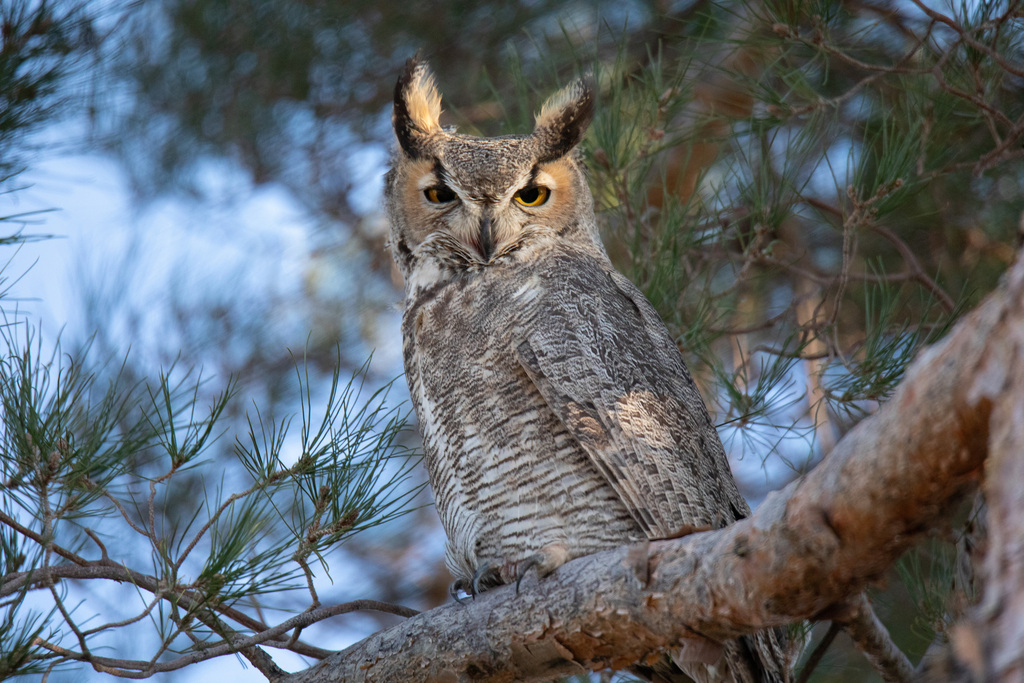
Great Horned Owl
Photo © Kevin Floyd
Photo © Kevin Floyd — CC BY 4.0 — Source: iNaturalist photo #463875088Identification
The great horned owl is a large owl with distinctive ear tufts that give it its common name, though these are feathers rather than true horns. The species is generally colored for camouflage, with upper parts and wings displaying mottled brown plumage bearing heavy, complex darker markings. The underparts are usually light with brown horizontal barring, and all subspecies show dark barring along the sides. A variable-sized white patch adorns the throat, which may continue as a streak down the middle of the breast—particularly prominent in pale individuals—though South American birds typically show a smaller, less visible throat patch.
Coloration varies considerably across regions and individuals. Birds from subarctic regions display a washed-out, light-buff color, while those from the Pacific Coast, Central America, and much of South America tend toward darker brownish tones overlaid with blackish blotching. The legs and feet are black, though almost entirely concealed by feathers.
Range & Habitat
The great horned owl is native to the Americas and is the most widely distributed true owl in the Western Hemisphere. With fifteen currently recognized subspecies and an extremely adaptable nature, this owl occupies an vast range across North America, Central America, and South America, from west Alaska and northeast Canada south to Argentina and central Peru. Its remarkable adaptability allows it to thrive in diverse environments throughout this expansive territory.
Behaviour & Diet
The great horned owl is one of the earliest nesting birds in North America, often laying eggs weeks or even months before other raptorial birds begin their breeding seasons. Its diet consists primarily of rabbits and hares, rats and mice, and voles, making it one of the few regular predators of skunk. The owl's hunting repertoire is impressively broad, also including rodents, larger mid-sized mammals, birds, reptiles, amphibians, and invertebrates.
Ecologically, the great horned owl occupies a similar niche to the Eurasian eagle-owl in Eurasia. It often shares similar habitat, prey, and nesting habits with the red-tailed hawk during daylight hours, making the hawk something of a diurnal ecological equivalent to this nocturnal hunter.
Best Time & Places to See It
Given the great horned owl's vast range across the Americas and its presence in diverse habitats, opportunities to encounter this species exist throughout much of the Western Hemisphere. Its early nesting season in North America makes late winter and early spring particularly promising times for observation, especially near suitable nesting sites. The owl's wide distribution means that birders and wildlife enthusiasts across the Americas have reasonable chances of encountering this adaptable predator in appropriate habitats.
Photography Tips
The great horned owl's camouflaged plumage—mottled browns with complex darker markings—makes it a challenging but rewarding photographic subject. The distinctive ear tufts and pale eye are key identifying features to capture. The variable white throat patch and chest markings, particularly pronounced in paler individuals, provide useful compositional elements. Given the owl's nocturnal habits and early nesting season, photographers should be prepared for low-light conditions and should research local nesting sites during late winter and early spring for the best opportunities to document this magnificent predator.
Manitoba Owls
Nothing matches these filters.
Tombstone Territorial Park
Acadia National Park
Alaska Maritime National Wildlife Refuge
Algonquin Provincial Park
Antisana National Park
Arches National Park
Arctic National Wildlife Refuge
Badlands National Park
Banff National Park
Nothing matches these filters.
No community photos yet. Log in to add the first one.
No community observations of this species yet.