Identification
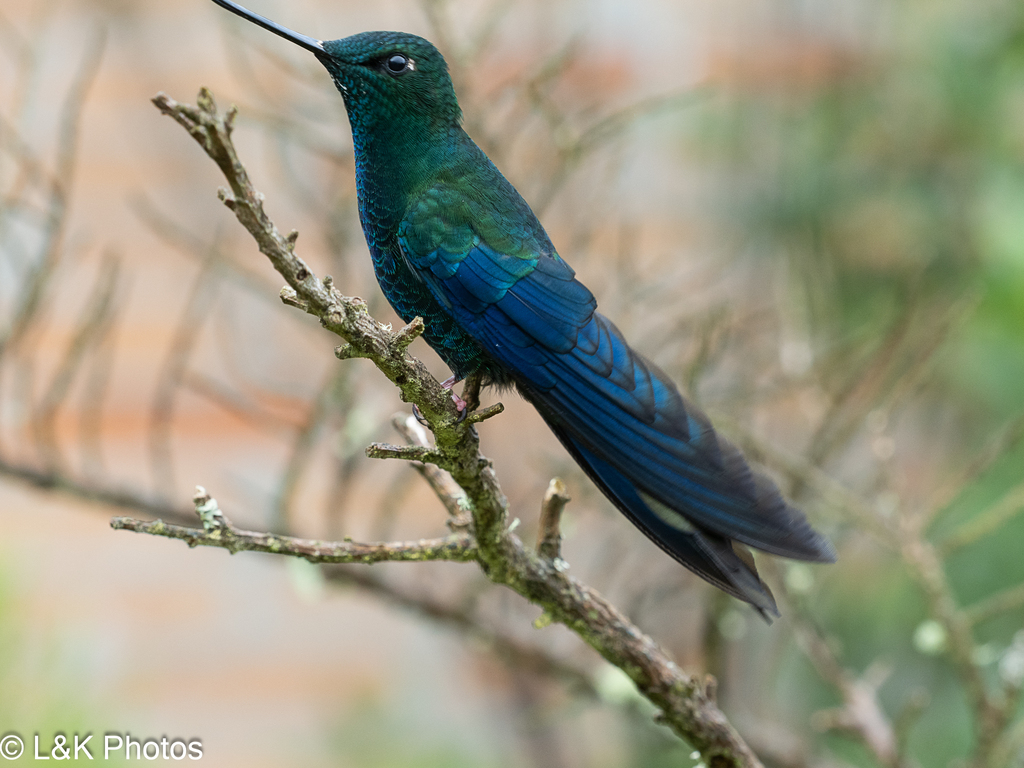
The great sapphirewing is one of the largest hummingbirds, measuring 15.5 to 19 cm long including a distinctive 3.6 cm bill. Only the two species of genus Topaza and the giant hummingbird exceed it in size. Both sexes display a small white spot behind the eye, a useful field mark in this high-altitude specialist.
Males of the nominate subspecies are strikingly iridescent, with dark shining blue-green upperparts and mostly shining blue wings paired with a greenish-black tail. Their underparts are also blue-green but with a slightly bluer tone. Females present a more subdued appearance, featuring dark metallic green upperparts with a dusky gray crown, blue wing coverts only, and a mostly greenish-black tail with prominent white on the outermost feathers. Their underparts are distinctive cinnamon, mixed with green on the sides. The three subspecies show subtle variations in the balance of blue versus green plumage.
Range & Habitat
The great sapphirewing is found in the Andes mountains of four countries: Colombia, Ecuador, Peru, and Bolivia. The nominate subspecies inhabits Colombia's Eastern Andes; P. c. caeruleus occupies the Central and Western Andes of Colombia; and P. c. peruvianus, the most widespread, ranges from Colombia's Western Andes south through Ecuador and Peru to central Bolivia. These birds are elevation specialists, typically occurring between 2,600 and 3,700 m across their range, with Bolivian populations mostly above 3,000 m.
They inhabit the edges of humid evergreen and elfin forest, shrubby slopes with scattered trees, and well into the páramo ecosystem, at least seasonally. As a species tolerant of forest edges, the great sapphirewing is less vulnerable to habitat fragmentation than many other montane forest species, though it remains sensitive to forest loss.
Behaviour & Diet
The great sapphirewing is mostly sedentary, though some populations move to lower elevations during the austral winter. These birds feed on the nectar of a wide variety of flowering plants, typically foraging at low to mid-levels and both hovering and perching at the outside of host plants. In Peru, they show a preference for Tristerix longebracteatus, while in the Colombian páramo they favor Puya clava-herculis. They defend patches of flowers but also employ trap-lining, visiting a regular circuit of feeding sites.
Beyond nectar feeding, great sapphirewings supplement their diet by capturing small arthropods through gleaning from foliage and aerial hawking. Their breeding season extends at least from February to May, though it is not sharply defined. Vocalizations include high, thin liquid chatters, drawn-out piercing zeee calls, and agitated titititirrr notes. A remarkable documented nest was a three-compartment moss structure suspended about 4 m above ground, shared between a breeding female sapphirewing and a female tyrian metaltail.
Best Time & Places to See It
The great sapphirewing's breeding season from February to May offers the best opportunity for observation. The species is variously rare to locally common across different parts of its range. Target the high-altitude regions of the Andes—the páramo and elfin forest edges between 2,600 and 3,700 m elevation—where these birds are most active among flowering plants.
Visiting suitable habitat in Colombia's Eastern, Central, or Western Andes, Ecuador's highlands, Peru's Western Andes, or Bolivia's mountain regions may yield sightings. The species' stability and large range suggest reasonable prospects for patient observers willing to work at high elevations in appropriate montane habitat.
Photography Tips
The great sapphirewing's brilliant iridescent plumage rewards photography but presents challenges. The shining blue and blue-green coloration is highly angle-dependent, so position yourself to catch sunlight reflecting off the male's wings and upperparts for maximum brilliance. The white spot behind the eye can serve as a useful focusing point and aids in species confirmation.
These birds typically feed at low to mid-vegetation levels, making them more accessible than canopy species. Watch for them both hovering at flowers and perching at the outside of host plants—the latter offers steadier shooting opportunities. Work during clear weather at high altitude when light is strong, and be prepared for the cool, often misty conditions of páramo and elfin forest environments. Patience and knowledge of their preferred food plants will increase your chances of productive encounters.
Sangay National Park
Cebadas, Ecuador
+320 birds+10 mammals
High in Ecuador's Andean spine, where the Western Cordillera rises to touch perpetual snow, a landscape of volcanic drama and ecological intensity unfolds across Sangay National…
VIEW NATIONAL PARKPodocarpus National Park
Zamora, Ecuador
+496 birds+6 mammals
Where the Andes descend toward the Amazon basin, Podocarpus National Park sprawls across nearly 2,800 square kilometres of the most biodiverse terrain in Ecuador's southern highlands.…
VIEW NATIONAL PARKYacuri National Park
Las Juntas, Ecuador
+166 birds+1 mammals
Where the eastern slopes of the Andes descend into Ecuador's southern frontier, Yacuri National Park unfolds across nearly 1,300 square kilometers of montane cloud forest and…
VIEW NATIONAL PARKAntisana National Park
Quijos, Ecuador
+432 birds+21 mammals
Where the eastern Andean slopes descend into the Amazon basin, Antisana National Park sprawls across roughly 2,500 square kilometers of some of South America's most dramatic…
VIEW NATIONAL PARKCotopaxi National Park
Mulaló, Ecuador
+211 birds+6 mammals
High in Ecuador's volcanic corridor, where the páramo transitions into cloud forest along the slopes of Cotopaxi volcano, the national park unfolds across nearly 500 square…
VIEW NATIONAL PARKLlanganates National Park
Tena, Ecuador
+239 birds+8 mammals
Where the eastern slopes of the Andes plunge toward the Amazon basin, Llanganates National Park sprawls across nearly 3,500 square kilometers of montane wilderness, its terrain…
VIEW NATIONAL PARKCajas National Park
Cuenca, Ecuador
+190 birds+7 mammals
High in the Andes above Cuenca, where elevation ranges from 3,100 to 4,200 metres, the páramo landscape dominates—a windswept realm of cushion plants, alpine grasses, and…
VIEW NATIONAL PARKNatural Farallones de Cali National Park
Buenaventura, Colombia
+733 birds+27 mammals
Where the Pacific coastal plain meets the western slopes of the Andes, Farallones de Cali National Park sprawls across nearly 3,500 square kilometers of dramatic topography…
VIEW NATIONAL PARKNatural Chingaza National Park
Junín, Colombia
+285 birds+6 mammals
Where the Andes rise above three thousand metres in the Cundinamarca region, high-altitude grasslands and cloud forests converge in a landscape shaped by both geology and…
VIEW NATIONAL PARKNatural Pisba National Park
Socotá, Colombia
+95 birds
High-altitude grasslands and páramo ecosystems sweep across the Andean terrain of this national park, where thin soils and cool, windswept conditions define a landscape shaped by…
VIEW NATIONAL PARKNatural el Cocuy National Park
Güicán, Colombia
+313 birds+3 mammals
Where the Andes rise to their highest peaks in Colombia's eastern cordillera, El Cocuy National Park sprawls across more than 6,600 square kilometers of some of…
VIEW NATIONAL PARKPuracé National Natural Park
Puracé, Colombia
+327 birds+2 mammals
Where the Andes thrust upward across southwestern Colombia, Puracé National Natural Park spans nearly 2,631 square kilometers of some of South America's most dramatic montane terrain.…
VIEW NATIONAL PARKNatural Sumapaz National Park
Cubarral, Colombia
+368 birds+1 mammals
Where the Andes descend toward the Amazon basin, the high páramo grasslands of Sumapaz National Park sprawl across more than five thousand square kilometers of Meta…
VIEW NATIONAL PARKYanachaga–chemillén National Park
Palcazu, Peru
+639 birds+6 mammals
Where the eastern slopes of Peru's central cordillera plunge into cloud forest, Yanachaga–Chemillén National Park protects nearly three thousand square kilometres of montane wilderness that few…
VIEW NATIONAL PARKManu National Park
Manu, Peru
+892 birds+26 mammals
Across the eastern slopes of the Peruvian Andes, tropical rainforest descends into the Amazon basin with a complexity that few terrestrial ecosystems match. Manu National Park…
VIEW NATIONAL PARKNo community photos yet. Log in to add the first one.
No community observations of this species yet.