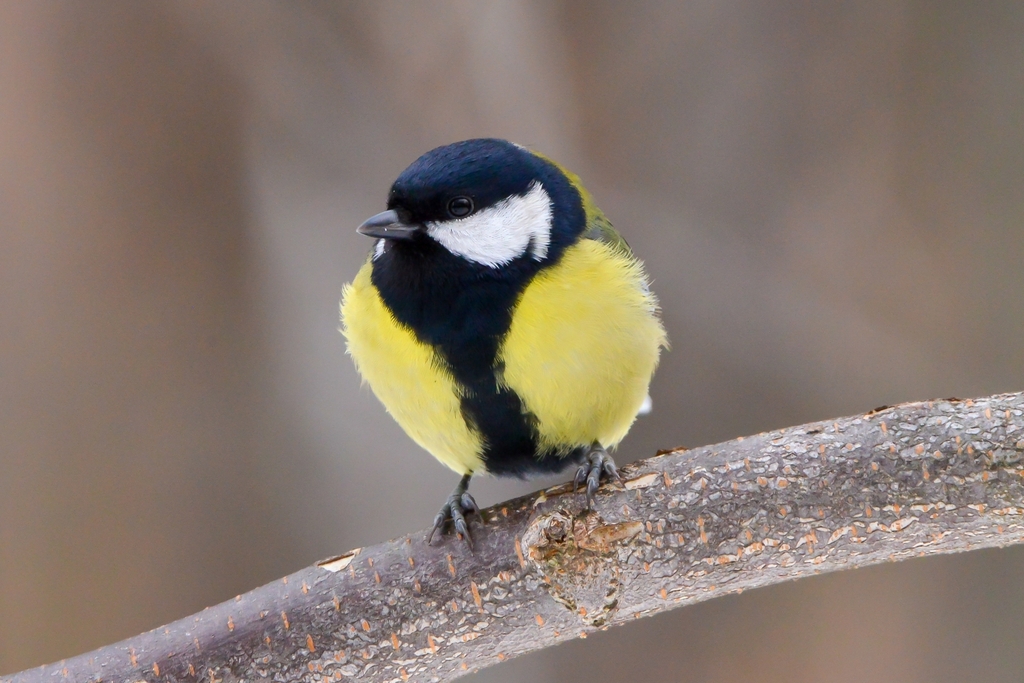
Great Tit
Parus major
Photo © Валерия Ковалева
Photo © Валерия Ковалева — CC BY 4.0 — Source: iNaturalist photo #258978510ABOUT
Subspecies of Great Tit
Common Great TitBritish Great TitWestern Turkestan TitCretan great titSouthern european great titNorthwestern mediterranean great titNorthwestern african great titBalearic great titEastern Turkestan TitCentral Turkestan TitNortheastern iranian great titLevant great titSardinian great titCentral Mesopotamian great titEast-Central asian great tit
Identification
The great tit is a distinctive and unmistakable small passerine bird. It displays a striking black head and neck with prominent white cheeks that stand out against its olive-coloured upperparts. The underparts are bright yellow, creating a bold and elegant colour pattern. There is some variation amongst the numerous subspecies, but the core plumage pattern remains recognisable across its range, making it one of the most identifiable members of the tit family.
Range & Habitat
The great tit is widespread and common throughout Europe, the Middle East, Central Asia and as far east as the Amur River. It also occurs in parts of North Africa. Most populations are resident year-round, remaining in their territories except during extremely harsh winters. The species has adapted exceptionally well to human-modified environments and is a familiar presence in urban parks and gardens, though it occurs naturally in any sort of woodland habitat.
Behaviour & Diet
The great tit is predominantly insectivorous during the summer months, actively foraging for insects in trees and foliage. In winter, it broadens its diet considerably, consuming a wider range of food items—a survival strategy that includes even small hibernating bats. Like all tits, it is a cavity nester, typically selecting tree holes for breeding. The female lays around 12 eggs and incubates them alone, though both parents cooperate to raise the chicks. In most years, pairs will successfully raise two broods. However, nests face threats from predators including woodpeckers, squirrels and weasels, and may become infested with fleas. Adult birds may also fall prey to sparrowhawks.
Best Time & Places to See It
The great tit is common and familiar across its range year-round, making it accessible to observers in virtually any season. It is particularly easy to locate in urban parks and gardens, where it has become well adapted to human presence. Woodland habitats throughout Europe, the Middle East and Central Asia offer reliable viewing opportunities. Its non-migratory habits mean that populations remain relatively stable throughout the year in most locations.
Photography Tips
The great tit's bold black-and-white head pattern and yellow underparts make it highly photogenic and relatively easy to identify in images. Its small size and active foraging behaviour require a telephoto lens and fast shutter speeds to capture sharp images. Urban park birds are often accustomed to human presence, allowing photographers to approach more closely than wild woodland populations. The species' cavity-nesting habit means that spring offers opportunities to photograph birds visiting nest holes, while winter feeding provides reliable predictable shooting opportunities, particularly at garden feeders.
HIDES
Sort by
50 €/ person
Book now
80 €/ person
Book nowNothing matches these filters.
HOTSPOTS
Country
Type
Sort by
National Park
Abruzzo, Lazio and Molise National Park
Pescasseroli·Italy
+139 birds+18 mammals
National Park
Aggtelek National Park
Szin·Hungary
+119 birds+13 mammals
Natural Park
Alpilles Regional Nature Park
Saint-Rémy-de-Provence·France
+219 birds+37 mammals
National Park
Alta Murgia National Park
Bari·Italy
+168 birds+6 mammals
National Park
Appennino Lucano Val d’Agri Lagonegrese National Park
Spinoso·Italy
+121 birds+3 mammals
National Park
Appennino Tosco-Emiliano National Park
Ventasso·Italy
+86 birds+8 mammals
National Park
Asinara National Park
Porto Torres·Italy
+103 birds+5 mammals
National Park
Åsnens National Park
Kronoberg County·Sweden
+141 birds+8 mammals
National Park
Aspromonte National Park
Careri·Italy
+89 birds+5 mammals
Nothing matches these filters.
COMMUNITY
Share your photo of this species
Sort by
0
Observed by
0
Hotspots reported
0
Countries
No community observations of this species yet.