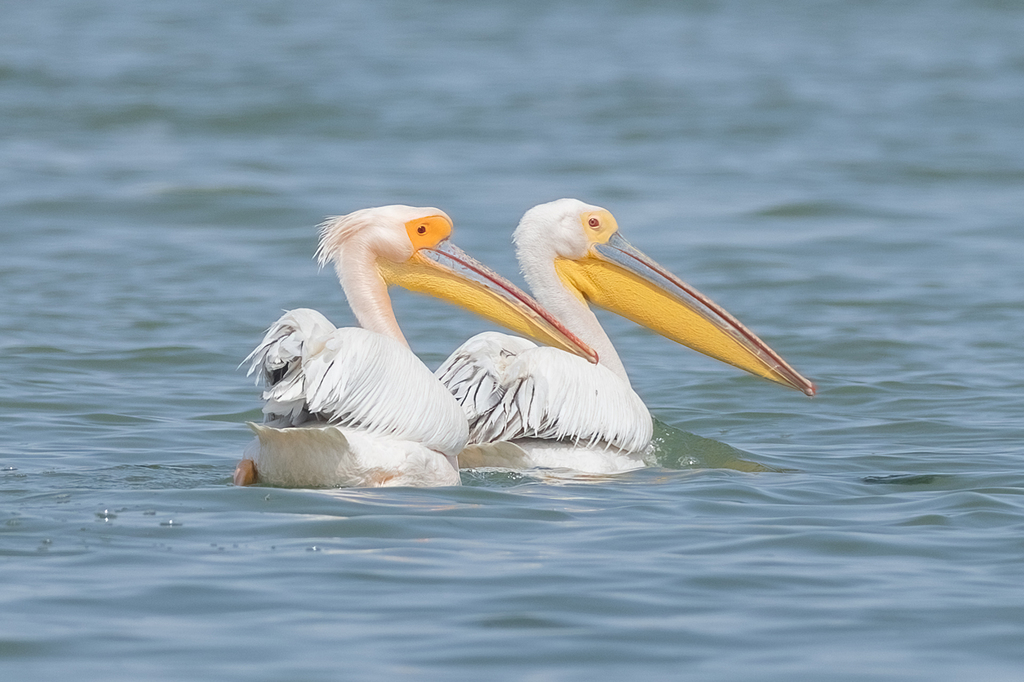
Great White Pelican
Photo © egorbirder
Photo © egorbirder — CC BY 4.0 — Source: iNaturalist photo #497391957Identification
The great white pelican is a massive waterbird and one of the largest flying birds in the world. Adults measure 140 to 180 cm in length with a wingspan of 226 to 360 cm—the latter figure represents the highest wingspan among extant flying animals outside of the great albatross. Males are noticeably larger than females, weighing 9 to 15 kg compared to females at 5.4 to 9 kg, making this species one of the most sexually dimorphic of all pelicans.
Plumage is predominantly white with striking black primary and secondary feathers that contrast sharply in flight. The distinctive bill is enormous, measuring 28.9 to 47.1 cm, and is mostly bluish-grey with a red tip and a dull pale-yellow gular pouch. During breeding season, males display pinkish facial skin while females show orangey skin. Juveniles are much darker, with brownish underparts and greyish bills, making them readily distinguishable from adults. The great white pelican is unique among pelicans in having a naked face with forehead feathering that tapers to a fine point.
Range & Habitat
The great white pelican breeds from southeastern Europe through Asia and Africa, inhabiting swamps and shallow lakes throughout its range. The species occurs within 43 Important Bird Areas in its European range and is listed within 108 Special Protection Areas in the European Union, reflecting its significant conservation importance across the continent.
Behaviour & Diet
The great white pelican's scientific name, onocrotalus, derives from ancient Greek and literally means "one who brays like a donkey," a reference to its harsh mating calls during the breeding season. These vocalizations are among the most distinctive features of the species' social behaviour.
Best Time & Places to See It
The great white pelican is listed as a species of least concern on the IUCN Red List, indicating a stable population. Its importance is recognized internationally through multiple conservation agreements, including listing under Appendix I of the Convention on the Conservation of Migratory Species of Wild Animals and Appendix II of the Berne Convention. The species is also covered by the Agreement on the Conservation of African-Eurasian Migratory Waterbirds, suggesting that observing it may require consideration of migratory movements across its broad geographic range.
Photography Tips
The stark contrast between white plumage and black flight feathers makes the great white pelican highly photogenic, especially in flight when the underwing pattern is visible. The enormous wingspan and size offer excellent opportunities for dramatic silhouettes and detail shots of the distinctive bill and facial markings. Breeding plumage, with its delicate pink and yellow tints, provides particularly striking colour for photographers.

Birdwatching trip in Danube Delta

Lake Kerkini Photography Tour
Nothing matches these filters.
Bwindi Impenetrable National Park
Lake Mburo National Park
Mabamba Swamp
Murchison Falls National Park
Queen Elizabeth National Park
Aberdare National Park
Abijata-Shalla Lakes National Park
Addo Elephant National Park
Agulhas National Park
Nothing matches these filters.
No community photos yet. Log in to add the first one.
No community observations of this species yet.