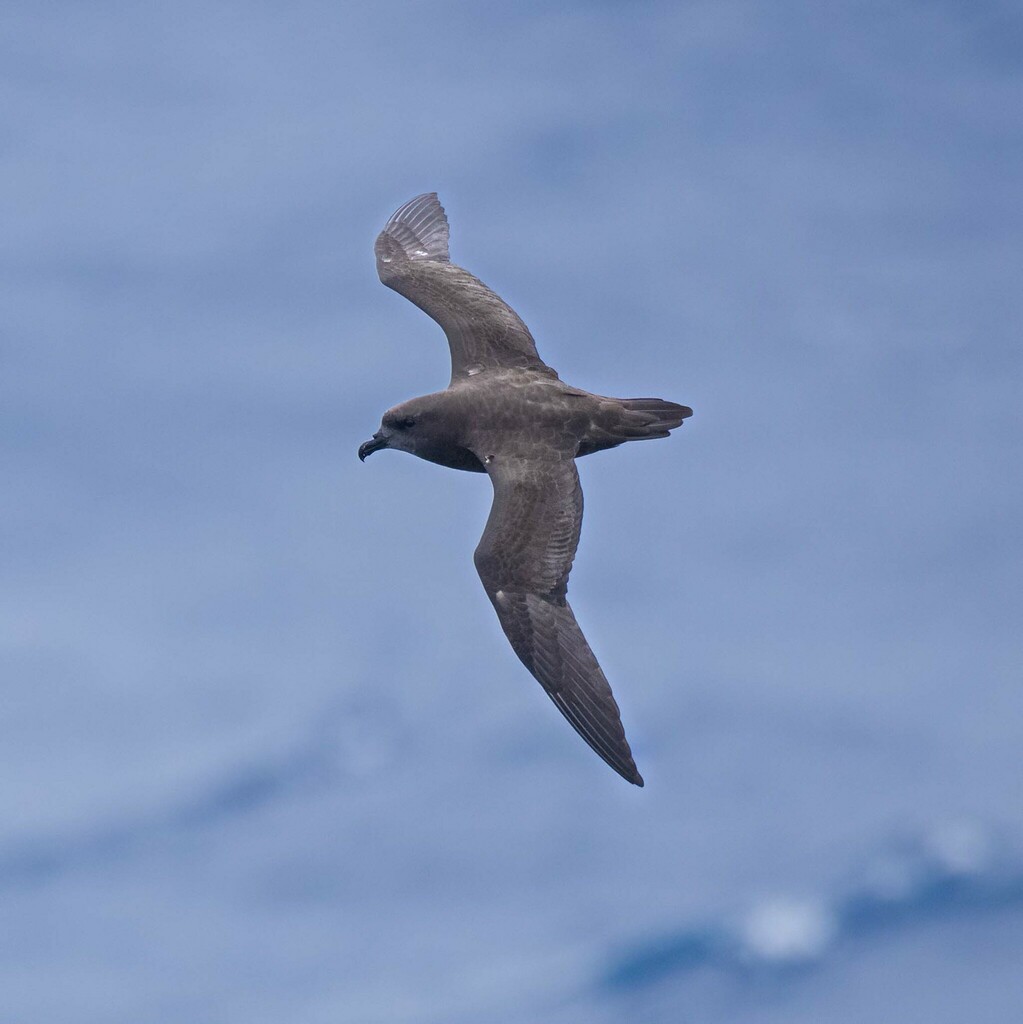
Great-winged Petrel
Photo © Alessia Guggisberg
Photo © Alessia Guggisberg — CC BY-SA 4.0 — Source: iNaturalist #263407284Identification
The great-winged petrel is a large seabird measuring 42–45 cm in body length. It is entirely dark brown in plumage, with a distinctive variable patch of white near the base of its black bill. The all-dark underwing, thick stubby bill, and characteristic flight style separate it from similar species such as the sooty shearwater and short-tailed shearwater. The flesh-footed shearwater, another potential lookalike, can be distinguished by its light, pinkish bill. Larger petrels in the genus Procellaria have a less bounding flight pattern.
Range & Habitat
This Southern Ocean specialist breeds throughout the Southern Hemisphere between 30 and 50 degrees south. Established breeding colonies occur on Tristan da Cunha, Gough Island, the Crozet Islands, the Prince Edward Islands, the Kerguelen Islands, and along the coasts of southern Australia. The species is occasionally recorded as a rare vagrant in the Pacific Ocean off the coast of California, United States.
Behaviour & Diet
Great-winged petrels are primarily nocturnal foragers, feeding mostly on squid, with smaller quantities of fish and crustaceans in their diet. They catch prey by dipping and surface-seizing techniques. These birds may follow whales and associate with other related seabird species to exploit feeding opportunities. Breeding takes place during the southern winter, commencing in April, with nests located either solitarily or in small colonies in burrows or among boulders and low vegetation.
Best Time & Places to See It
The best opportunities to encounter great-winged petrels occur during their breeding season in the southern winter from April onwards at their established colonies. Tristan da Cunha, Gough Island, the Kerguelen Islands, and the Prince Edward Islands represent prime locations for observing this species in its natural habitat. Pelagic seabird trips in southern Australian waters also offer good chances of sightings.
Photography Tips
The all-dark plumage of great-winged petrels presents exposure challenges; meter carefully to retain detail in the brown tones without losing the white bill patch. Their nocturnal feeding habits and burrow-nesting behaviour mean daytime photography at colonies requires patience. Capture their characteristic bounding flight from seabird tours or boat-based expeditions. Early morning light at breeding sites will best render the subtle brown tones and highlight the diagnostic white patch near the bill.
No community photos yet. Log in to add the first one.
No community observations of this species yet.