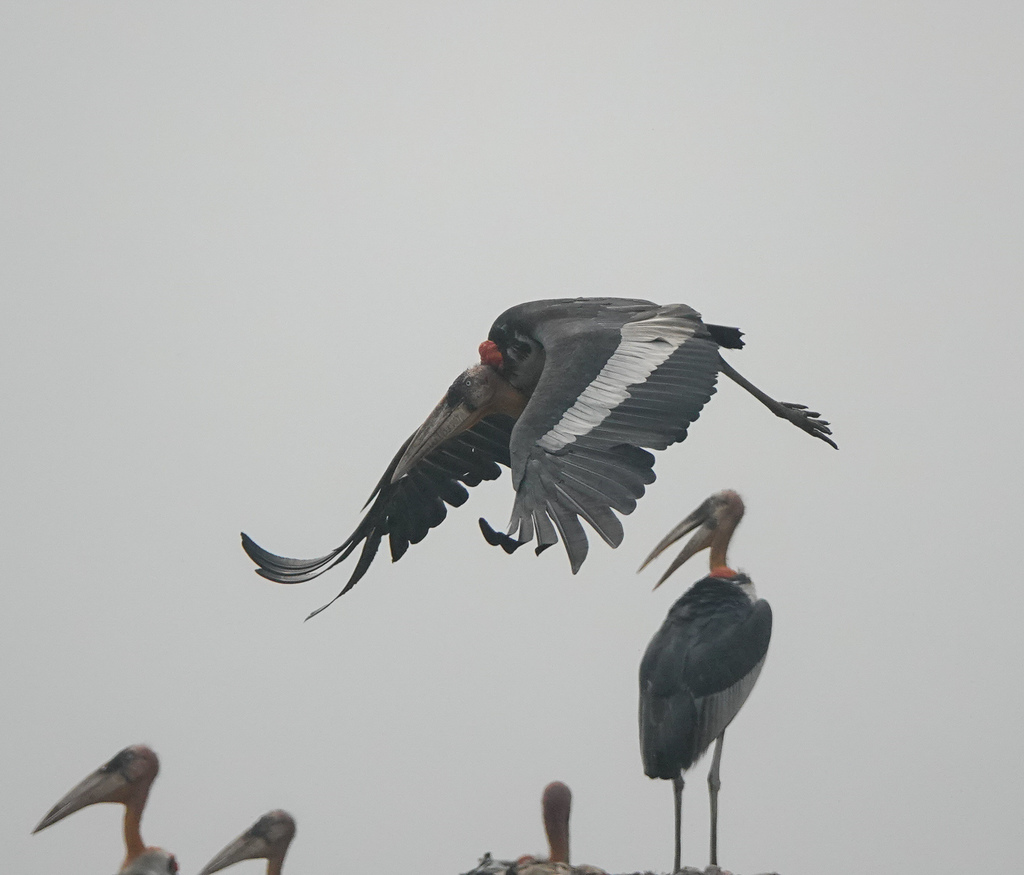
Greater Adjutant
Photo © Rejoice Gassah
Photo © Rejoice Gassah — CC BY 4.0 — Source: iNaturalist #46574250Identification
The greater adjutant is a massive stork standing 145–150 cm tall with an average wingspan of 250 cm, making it one of the largest winged storks alive today. Its most distinctive features are its enormous wedge-shaped bill (averaging 32.2 cm long), which is pale grey with a darker base, and its bare head with a striking white collar ruff at the neck base. During breeding season, the bare neck and inflatable pouch become bright orange, and the upper thighs turn reddish, creating a vulture-like appearance. Adults display dark wings contrasting with light grey secondary coverts, while the underside is whitish. Juveniles are duller versions of adults. Males and females are indistinguishable in the field. The pendant pouch, though inflatable, is not used for food storage but connects to the air passages; its exact function remains unknown.
Range & Habitat
Once widely distributed across southern Asia and mainland southeast Asia, the greater adjutant's range has contracted dramatically. Today it is restricted to just three breeding populations: two in India (one in Assam and a smaller one near Bhagalpur) and one in Cambodia. Birds disperse widely after the breeding season, but the global population has declined to around a thousand individuals as of 2008. Historically, large numbers inhabited Asian cities, particularly Calcutta, where they were so prevalent they earned the nickname "Calcutta adjutant" and were incorporated into the city's coat of arms.
Behaviour & Diet
The greater adjutant's English name derives from its distinctive stiff, military-like gait when walking on the ground. Unlike most storks that fly with outstretched necks, this species retracts its neck during flight, similar to herons—an adaptation likely related to its heavy bill. During the day, these storks soar in thermals alongside vultures, with which they share scavenging habits. They feed primarily on carrion and offal, though they are opportunistic hunters and will occasionally prey on vertebrates. Known locally in Assam as "hargila" (meaning "bone-swallower" in Assamese), they were historically valued as urban scavengers but sometimes hunted for use in folk medicine.
Best Time & Places to See It
The greater adjutant is best observed during and after breeding season when birds disperse widely across their range. Your best chances are in northeastern India, particularly Assam, or in Cambodia, where breeding populations remain. Historical strongholds like Calcutta, though no longer primary populations, may still offer sightings. The species' rarity and endangered status make sightings significant ornithological events. Given their soaring behaviour during daylight hours and association with thermals, scanning open skies during warm parts of the day increases your chances of spotting these impressive birds.
Photography Tips
The greater adjutant's enormous size and striking bare head with orange breeding plumage make it visually compelling. Photograph these birds soaring in thermals during midday when thermal activity peaks, using fast shutter speeds to freeze wing motion. The contrast between dark wings and pale secondary coverts, along with the white underside, provides excellent compositional opportunities. During breeding season, focus on the vibrant orange neck pouch and reddened thighs for maximum visual impact. Its distinctive silhouette in flight, with retracted neck, is characteristic and recognizable—a valuable diagnostic feature for field identification photos. Ground-based shots showcasing the military gait and massive wedge bill will highlight the species' unique character.
Orang National Park
Rangagarapathar, India
+298 birds+1 mammals
Where the Brahmaputra's floodplains meet the foothills of Assam, Orang National Park unfolds across a mosaic of riverine grasslands, forests and wetlands that pulse with the…
VIEW NATIONAL PARKKaziranga National Park
Kohora, India
+422 birds+26 mammals
Dawn breaks over the floodplains of the Brahmaputra, where tall grasslands stretch endlessly beneath monsoon-heavy skies. This sprawling wilderness of northeastern Assam is a mosaic of…
VIEW NATIONAL PARKNo community photos yet. Log in to add the first one.
No community observations of this species yet.