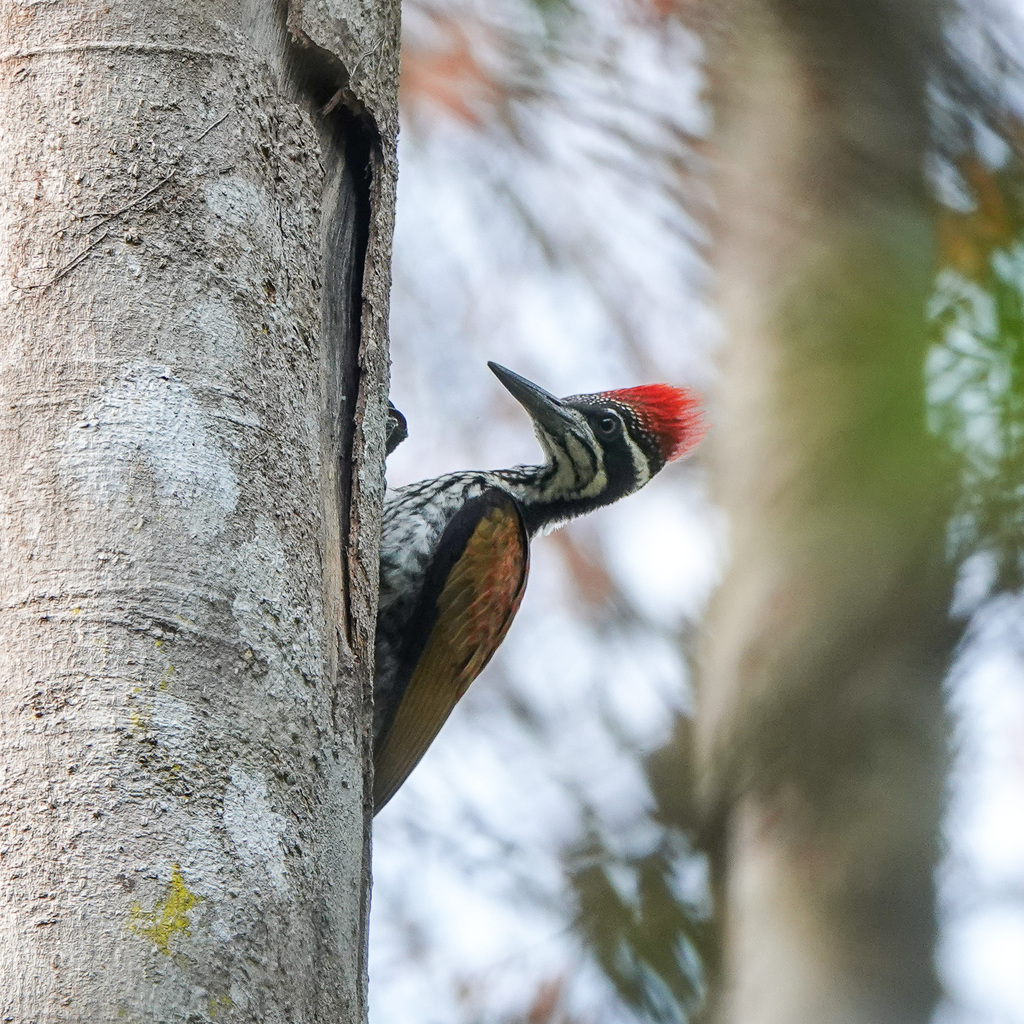
Greater Flameback
Photo © Rejoice Gassah
Photo © Rejoice Gassah — CC BY 4.0 — Source: iNaturalist #225044553Identification
The greater flameback is a large woodpecker measuring 33 cm in length, distinguished by its erect crest, long neck, and striking plumage. Its most characteristic features are an unmarked golden-yellow to dark brown back and wings, a red rump, and a black tail. The underparts are white with dark markings—chevrons, stripes, or bands—or light brown. A straight-pointed bill longer than the head and lead-grey legs with zygodactyl feet (two toes forward, two back) are typical woodpecker adaptations.
Coloration varies considerably between subspecies. The head may be whitish with black patterns, or yellow, brown, or red. Adult males always display a red crown, while females show crown colors ranging from black spotted with white to yellow or brown with lighter dots, depending on subspecies. Young birds resemble females but are duller, with brown irises. Eyes in adults range from whitish to yellow in color.
Range & Habitat
The greater flameback is widely distributed across the northern Indian subcontinent, extending eastward to southern China, the Malay Peninsula, Sumatra, western and central Java, and northeast Borneo. Taxonomy remains complex, with several subspecies and closely related forms distributed across this vast range, from southwestern India through Southeast Asia to the Philippines and Indonesia.
This species favors open forest habitats, particularly those found in foothills and mountainous regions such as the Himalayas and Western Ghats. It also inhabits mangrove forests, where it has been observed preferring tall Avicennia alba trees for foraging. The greater flameback appears well-adapted to specific forest types, showing variable abundance depending on which forest habitats predominate in any given region.
Behaviour & Diet
Like all woodpeckers, the greater flameback uses its powerful bill to excavate food from tree bark and wood, employing its zygodactyl feet and stiff tail for support against tree trunks. Its long, extendable tongue darts forward to extract wood-boring arthropods, the primary component of its diet. Beyond small invertebrates, the species supplements its diet by drinking nectar from flowers.
The greater flameback nests in tree cavities, where pairs lay three or four white eggs. This species is not notably gregarious, and its habitat preferences distinguish it ecologically from the similar-looking common flameback, allowing both species to coexist in regions where their ranges overlap without significant competitive interaction.
Best Time & Places to See It
The greater flameback is widely distributed and common throughout much of its range, making it a rewarding subject for nature travelers and birdwatchers. The species is classified as least concern on the IUCN Red List, ensuring stable populations across its distribution. Your chances of encountering this woodpecker are best in open forest habitats, foothills, and mangrove ecosystems where it is adapted to foraging.
The bird's preference for particular forest types means that abundance varies regionally—it may be more common in some areas like Thailand while less numerous in others like peninsular Malaysia. Focus your efforts on suitable forest habitats in the Indian subcontinent, Southeast Asia, and the Greater Sundas, where open woodland and mangrove forests provide ideal foraging grounds.
Photography Tips
The greater flameback's large size, distinctive golden-backed plumage, and erect crest make it visually striking, but photographing it presents challenges typical of woodpeckers. Position yourself near suitable foraging trees—particularly tall Avicennia alba in mangrove habitats—where the bird is likely to spend extended periods excavating bark. Early morning light will enhance the golden-yellow and red coloration that gives this bird its common names.
Patience is essential when photographing woodpeckers; remain still and quiet near promising habitat, as sudden movement will cause the bird to flush. The long bill, characteristic zygodactyl posture against tree trunks, and variable plumage patterns across subspecies all offer compelling photographic subjects. The white eye-ring and contrasting head patterns provide excellent focal points for close-up portraits.
Orang National Park
Rangagarapathar, India
+298 birds+1 mammals
Where the Brahmaputra's floodplains meet the foothills of Assam, Orang National Park unfolds across a mosaic of riverine grasslands, forests and wetlands that pulse with the…
VIEW NATIONAL PARKKhangchendzonga National Park
Sakkyong, India
+290 birds+1 mammals
Where the eastern Himalayas surge toward their crowning peaks, Khangchendzonga National Park embraces a landscape of almost overwhelming vertical drama. Rising from subtropical river valleys into…
VIEW NATIONAL PARKHat Noppharat Thara-Mu Ko Phi Phi National Park
Ao Nang, Thailand
+253 birds+9 mammals
Where limestone karsts rise dramatically from turquoise waters, Hat Noppharat Thara-Mu Ko Phi Phi National Park unfolds across a mosaic of beach, mangrove forest, and island…
VIEW NATIONAL PARKKhao Yai National Park
Prachantakham District, Thailand
+377 birds+46 mammals
Evergreen dipterocarp forest blankets the rolling terrain of this national park in eastern Thailand, where limestone hills rise abruptly from the forest floor and seasonal streams…
VIEW NATIONAL PARKKhao Laem National Park
Sangkhla Buri District, Thailand
+197 birds
Where the Vajiralongkorn Reservoir sprawls across the forested valleys of Kanchanaburi's northern borderlands, Khao Laem National Park protects a landscape where limestone ridges rise dramatically from…
VIEW NATIONAL PARKKaziranga National Park
Kohora, India
+422 birds+26 mammals
Dawn breaks over the floodplains of the Brahmaputra, where tall grasslands stretch endlessly beneath monsoon-heavy skies. This sprawling wilderness of northeastern Assam is a mosaic of…
VIEW NATIONAL PARKTaman Negara National Park
Kampong Samas, Malaysia
+393 birds+48 mammals
Where ancient rainforest meets limestone peaks, one of Southeast Asia's oldest protected wilderness preserves sprawls across 4,343 square kilometers of primordial landscape. Dipterocarp giants tower overhead,…
VIEW NATIONAL PARKGaoligong Mountain National Nature Reserve
Nujiang Lisu Autonomous Prefecture, China
+443 birds+13 mammals
VIEW NATURE RESERVENo community photos yet. Log in to add the first one.
No community observations of this species yet.