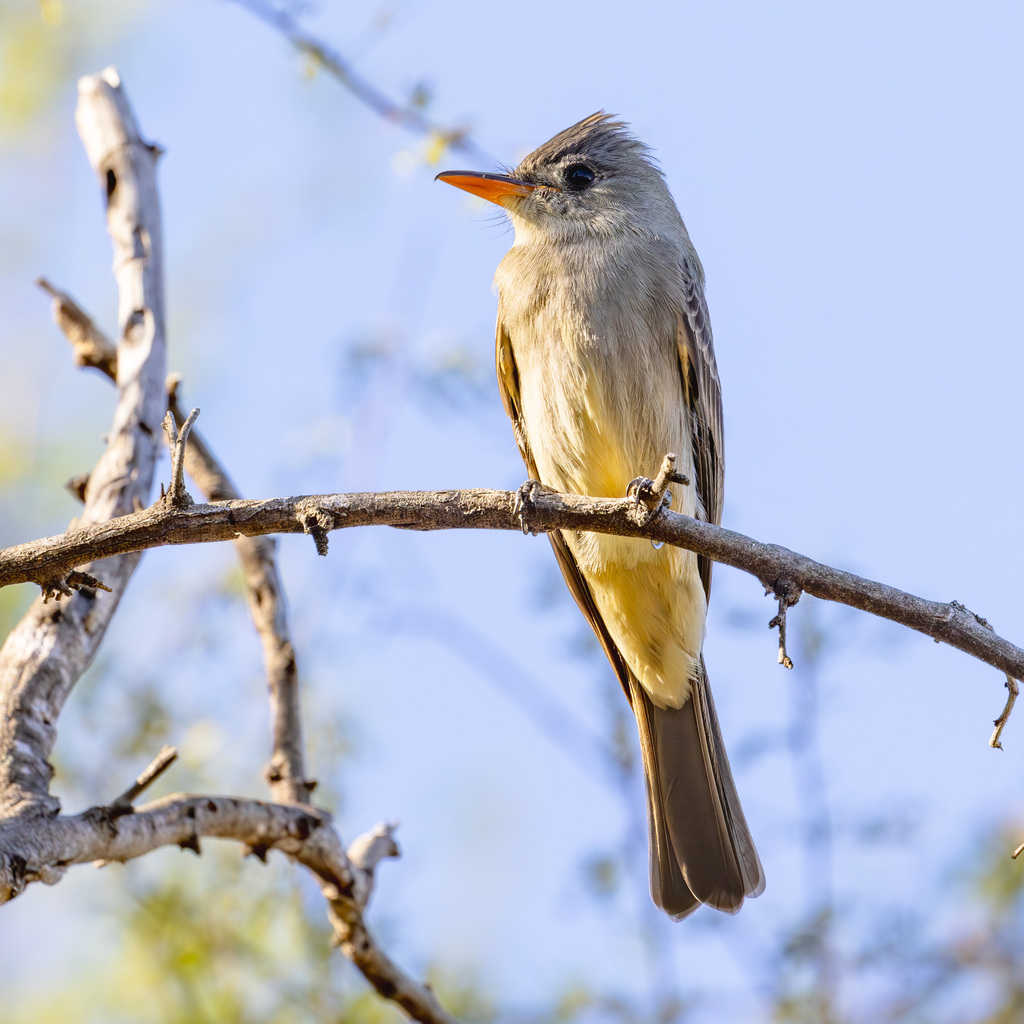
Greater Pewee
Photo © tcantrell52
Photo © tcantrell52 — CC BY 4.0 — Source: iNaturalist #256933657Identification
The greater pewee is a small tyrant flycatcher measuring 18 to 20 cm long and weighing 22 to 36 grams. Both sexes are identical, featuring a distinctive spiky crest and plain olive-gray upperparts with a pale lore and slightly lighter face. The wings are dusky grayish brown with two faint wing bars, while the tail is dusky grayish brown. The chin is dull whitish, and the throat and sides are olive-gray with a buffy yellowish tinge; the breast, belly, and undertail coverts are buffy. The bird has a brown iris, dark maxilla, and yellowish to orange mandible. Plumage fades with wear, becoming less olive over time. Two subspecies exist: the nominate C. p. pertinax found in the north, and the smaller C. p. minor in Central America.
Range & Habitat
The greater pewee is found from central and southeastern Arizona and southwestern New Mexico south through Mexico into Central America, reaching Nicaragua. Its range is disjunct, with some populations separated by river valleys and lowlands. The northern subspecies occurs from the United States through Mexico to the Isthmus of Tehuantepec and migrates into Guatemala, while the southern subspecies is found from Guatemala through Belize, El Salvador, and Honduras into far north-central Nicaragua. The species occasionally appears as a vagrant in California and migrates in small numbers through western Texas.
This bird primarily inhabits pine and pine-oak forests in subtropical and temperate zones, typically between 900 and 3,400 meters elevation. In the northern part of its range, it mostly occurs between 2,100 and 3,000 meters, while in southern Mexico and Central America it favors elevations between 1,300 and 3,350 meters, occasionally descending to 400 meters. During migration and non-breeding seasons, it also uses deciduous riparian forests within pine and pine-oak forest habitats.
Behaviour & Diet
The greater pewee is a specialist flycatcher that feeds mostly on flying insects captured in mid-air through characteristic "hawking" sallies. The bird sits erect on a dead branch near a treetop or high on an edge tree, launching sallies to snatch prey and typically returning to the same perch. During the non-breeding season, it supplements its insect diet with berries and other insects. It often joins mixed-species feeding flocks passing through its territory, making it relatively social outside the breeding season.
The species is migratory in its northern range, with Arizona, New Mexico, and northern Mexican populations moving south into central Mexico and slightly into Guatemala, though some individuals remain year-round in these areas. Southern Mexican populations shift to lower elevations during the non-breeding season, while Central American populations are non-migratory. The greater pewee breeds from early May to late July, constructing open-cup nests high in conifer trees using grasses, bark shreds, and pine needles bound together with spider silk. Clutches typically contain three or four dull white to creamy eggs spotted with brown. Females incubate for approximately eight days, and both parents provision the nestlings.
Best Time & Places to See It
The greater pewee is uncommon in the United States but fairly common in northern Central America. For northern range visitors, the breeding season from May to July offers the best opportunity to locate birds, particularly in pine and pine-oak forests of Arizona and New Mexico at elevations between 2,100 and 3,000 meters. The bird's conspicuous vocalizations during breeding season aid in locating it. In Mexico and Central America, the species is more readily encountered year-round, with Central American populations being non-migratory and thus present throughout the year in their preferred highland forest habitats.
Photography Tips
The greater pewee's habit of perching on exposed dead branches near treetops at mid to upper heights makes it relatively accessible for photography, though its preference for tall conifers requires patience and appropriate positioning. The bird's erect posture and distinctive spiky crest are diagnostic field marks worth capturing. Since the species actively hawks for insects throughout the day, particularly during breeding season, photographers should look for birds in open perching positions rather than concealed in foliage. Early morning hours from dawn onward offer the best activity levels and light conditions. The nominate northern subspecies and southern C. p. minor show subtle differences worth documenting separately, particularly noting the smaller stature of the southern form.
Big Bend National Park
Brewster County, United States
+345 birds+34 mammals
Where the Chisos Mountains rise abruptly from the Sonoran Desert floor, Big Bend National Park spans over 7,300 square kilometers of one of North America's most…
VIEW NATIONAL PARKSaguaro National Park
Rincon Valley, United States
+354 birds+40 mammals
Where the Sonoran Desert meets sky-island mountains, two geographically separated districts of Saguaro National Park sprawl across nearly two thousand square kilometers of Arizona's most iconic…
VIEW NATIONAL PARKLagunas de Montebello National Park
Laguna de Montebello, Mexico
+360 birds+2 mammals
Where turquoise lagoons pierce the limestone plateau of southeastern Chiapas, the Lagunas de Montebello National Park unfolds across roughly 174 square kilometers of spectral water and…
VIEW NATIONAL PARKSierra de Tamaulipas
El Porvenir, Mexico
+98 birds+19 mammals
Where limestone peaks thrust skyward through dense subtropical forest, Mexico's northeastern frontier reveals one of the continent's most biodiverse mountain ranges. Canyons carved by perennial rivers…
VIEW NATURE RESERVEParque Nacional Cerro de la Estrella
Mexico
+126 birds+4 mammals
Where volcanic peaks rise sharply above Mexico City's sprawling metropolis, Parque Nacional Cerro de la Estrella offers a rare glimpse of high-altitude terrain within one of…
VIEW NATIONAL PARKParque Nacional Benito Juárez
San Andrés Huayápam, Mexico
+128 birds+4 mammals
High in the Sierra Madre del Sur of Oaxaca, where cloud forest mingles with pine woodland and the terrain climbs steeply through ravines carved by mountain…
VIEW NATIONAL PARKTutuaca
Tosanachi, Mexico
+147 birds+13 mammals
Where copper canyons plunge deeper than the Grand Canyon itself, Mexico's remote Sierra Madre Occidental unfolds in dramatic vertical relief. Tutuaca anchors this wilderness realm, a…
VIEW PROTECTED LANDSCAPENo community photos yet. Log in to add the first one.
No community observations of this species yet.