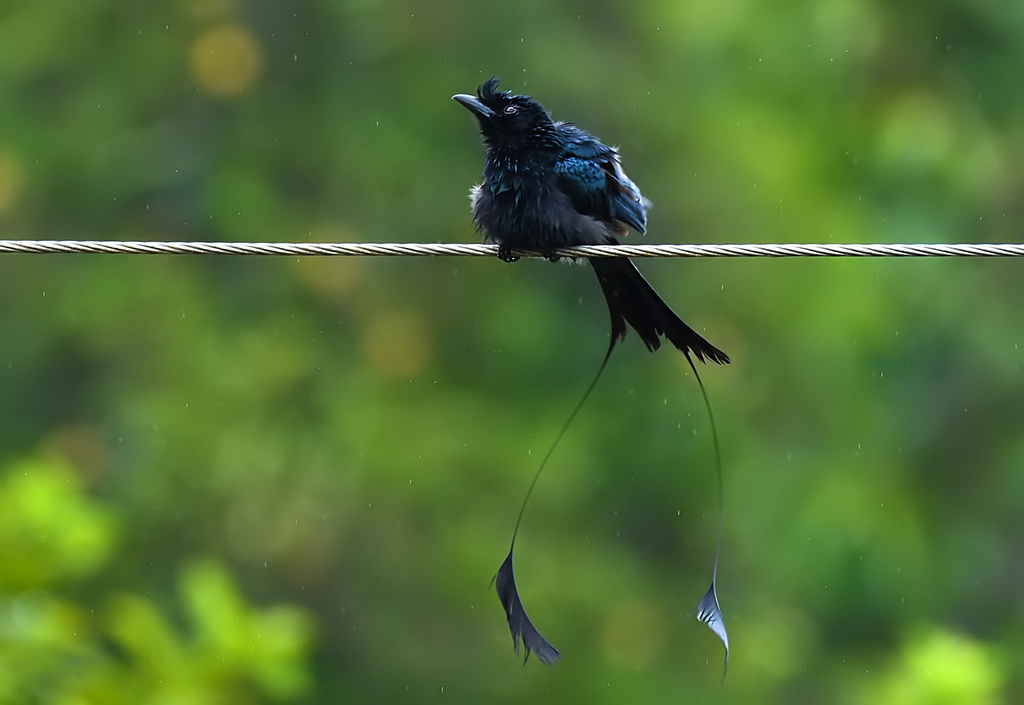
Greater Racket-tailed Drongo
CC BY 4.0
CC BY 4.0 — Source: iNaturalist photo #381289317Identification
The greater racket-tailed drongo is the largest drongo species across most of its Asian range and is instantly recognizable by its most striking feature: elongated outer tail feathers with webbing restricted only to the tips, creating distinctive "rackets" that appear like two large bees chasing a black bird in flight. Equally distinctive is a crest of curled feathers beginning above the beak and extending along the crown, though the extent varies considerably among subspecies. The bird sits upright on high, exposed branches, displaying a glossy black plumage with short legs typical of the drongo family.
Regional variation is substantial across its wide distribution. The Himalayan subspecies grandis is the largest with long, glossy neck hackles, while island populations show considerable differences in bill shape, crest extent, and tail racket development. In the eastern Himalayas, the greater racket-tailed drongo can potentially be confused with the lesser racket-tailed drongo, but the latter has flat rackets and an nearly absent crest. Young birds appear duller and may lack a crest entirely, while moulting birds temporarily lose their elongate tail streamers.
Range & Habitat
This widespread Asian species is found from the western Himalayas through to the eastern Himalayas and Mishmi Hills, inhabiting foothills below 1,200 metres. It occurs throughout the hills of peninsular India and the Western Ghats, extending westward through mainland Southeast Asia to the islands of Borneo and Java in the east. Thirteen recognized subspecies reflect this vast distribution, each showing distinct regional characteristics adapted to their particular localities.
The greater racket-tailed drongo is a forest specialist, preferring forested habitats where it remains conspicuous and frequently perches in the open. This conspicuousness, combined with its remarkable vocal abilities, makes it a notable presence in its woodland environments across the Indian subcontinent, Southeast Asia, and associated island systems.
Behaviour & Diet
Like other drongos, the greater racket-tailed drongo feeds mainly on insects but also consumes fruit and visits flowering trees for nectar. It is diurnal but notably active well before dawn and late into dusk, maximizing feeding opportunities during low-light periods. The bird often participates in mixed-species foraging flocks, a common feature of forest bird communities where multiple insect feeders forage together.
What truly sets this species apart is its extraordinary vocal repertoire. It produces a wide range of loud calls and, remarkably, provides perfect imitations of many other bird species. Scientists hypothesize that these vocal imitations may facilitate the formation and cohesion of mixed-species foraging flocks. Another intriguing theory suggests that vocal mimicry helps divert the attention of smaller birds, aiding the drongo in its piracy—stealing insect prey caught or disturbed by other foragers in the flock. Due to its widespread distribution and distinctive regional variation, the species has become an iconic example of speciation through isolation and genetic drift.
Best Time & Places to See It
The greater racket-tailed drongo can be encountered throughout its extensive range across the Indian subcontinent and Southeast Asia, from the Himalayas to Borneo and Java. Forest habitats from peninsular India and the Western Ghats through Myanmar, Thailand, and the Malaysian peninsula to the island systems of Southeast Asia all support populations. The bird's conspicuous nature and habit of perching openly in forests make it a reasonably reliable sighting for visitors to suitable forested areas.
Being active well before dawn and remaining active into dusk, observers should plan their birdwatching accordingly, with early morning and late afternoon sessions offering the best opportunities. The bird's loud calls and distinctive silhouette make it relatively conspicuous even in dense woodland, particularly when it participates in mixed feeding flocks.
Photography Tips
The greater racket-tailed drongo presents excellent photographic opportunities due to its conspicuous behaviour and habit of perching on high, exposed branches. The distinctive tail rackets are most dramatic in flight, so photographers should be prepared to capture this bird in motion to showcase its most striking feature—the characteristic silhouette of the elongate tail streamers creates a memorable and instantly recognizable image.
The bird's upright posture and preference for open perches mean it is often well-lit and clearly visible against the sky. The elaborate crest and glossy black plumage photograph well in good light. Early morning and late afternoon shooting will provide the best lighting conditions, especially if you time your visit to coincide with the bird's peak activity periods before dawn and at dusk.
Where to stay to see the Greater Racket-tailed Drongo
Lunugamvehera National Park
Sri Lanka
+204 birds+14 mammals
Dry scrubland and shallow wetlands converge in Sri Lanka's southeastern lowlands, where Lunugamvehera National Park anchors one of the island's most ecologically vital landscapes. The park's…
VIEW NATIONAL PARKWasgamuwa National Park
Sri Lanka
+156 birds+8 mammals
Dry deciduous forest and open grassland sweep across the North Central lowlands where Wasgamuwa National Park protects one of Sri Lanka's largest remaining tracts of this…
VIEW NATIONAL PARKOrang National Park
Rangagarapathar, India
+298 birds+1 mammals
Where the Brahmaputra's floodplains meet the foothills of Assam, Orang National Park unfolds across a mosaic of riverine grasslands, forests and wetlands that pulse with the…
VIEW NATIONAL PARKValmiki National Park
Ramnagar, India
+66 birds+6 mammals
Along Bihar's western frontier, where the Gandak River winds through subtropical forest and grassland, Valmiki National Park sprawls across terrain shaped by monsoon rains and seasonal…
VIEW NATIONAL PARKRanthambhore National Park
Sawai Madhopur, India
+294 birds+20 mammals
Granite ridges and ravines carved through the Aravalli Range frame this protected landscape in eastern Rajasthan, where deciduous forest mingles with open scrubland and seasonal water…
VIEW NATIONAL PARKEravikulam National Park
Devikulam, India
+192 birds+7 mammals
High in the Western Ghats of Kerala, where monsoon mists cling to slopes that rise above 2,000 metres, Eravikulam National Park preserves one of South India's…
VIEW NATIONAL PARKPhou Khao Khouay National Protected Area
Thaphabath District, Thailand
+113 birds
Where the Annamite Mountains descend into central Thailand's monsoon forests, Phou Khao Khouay National Protected Area sprawls across rugged limestone terrain interlaced with river valleys and…
VIEW NATIONAL PARKHat Noppharat Thara-Mu Ko Phi Phi National Park
Ao Nang, Thailand
+253 birds+9 mammals
Where limestone karsts rise dramatically from turquoise waters, Hat Noppharat Thara-Mu Ko Phi Phi National Park unfolds across a mosaic of beach, mangrove forest, and island…
VIEW NATIONAL PARKKhao Yai National Park
Prachantakham District, Thailand
+377 birds+46 mammals
Evergreen dipterocarp forest blankets the rolling terrain of this national park in eastern Thailand, where limestone hills rise abruptly from the forest floor and seasonal streams…
VIEW NATIONAL PARKKhao Laem Ya-Mu Ko Samet National Park
Mueang Rayong District, Thailand
+159 birds+3 mammals
Where limestone hills meet the Gulf of Thailand, Khao Laem Ya–Mu Ko Samet National Park stitches together a mosaic of terrestrial and marine worlds that few…
VIEW NATIONAL PARKKhao Laem National Park
Sangkhla Buri District, Thailand
+197 birds
Where the Vajiralongkorn Reservoir sprawls across the forested valleys of Kanchanaburi's northern borderlands, Khao Laem National Park protects a landscape where limestone ridges rise dramatically from…
VIEW NATIONAL PARKKanha Tiger Reserve
Kanha Kisli F.V., India
+321 birds+23 mammals
Where sal forests give way to emerald meadows and crystalline streams carve through ancient valleys, one of India's finest wilderness reserves unfolds across the Maikal Range.…
VIEW NATIONAL PARKTadoba National Park
Palasgaon Singru, India
+270 birds+20 mammals
Where sal forests meet open grasslands and rocky outcrops rise from red laterite soil, central India's landscape unfolds in raw, untamed beauty. Ancient teak woodlands and…
VIEW NATIONAL PARKBandhavgarh National Park
Garhpuri, India
+285 birds+17 mammals
Where granite ridges rise dramatically above sal and bamboo forests, one of India's most pristine tiger reserves unfolds across the Vindhyan plateau. Ancient rock formations tower…
VIEW NATIONAL PARKKaziranga National Park
Kohora, India
+422 birds+26 mammals
Dawn breaks over the floodplains of the Brahmaputra, where tall grasslands stretch endlessly beneath monsoon-heavy skies. This sprawling wilderness of northeastern Assam is a mosaic of…
VIEW NATIONAL PARKPeriyar National Park
Mlappara, India
+232 birds+4 mammals
Dawn breaks over mist-shrouded ridges where the Western Ghats tumble toward Kerala's spice-scented lowlands. Here, ancient tropical forests envelope a glittering artificial lake, creating a mosaic…
VIEW NATIONAL PARKPampadum Shola National Park
Vattavada, India
+258 birds+14 mammals
Where misty shola forests cling to the high plateaus of the Nilgiri Mountains, ancient evergreen remnants create a world apart. This 2,316-hectare reserve protects one of…
VIEW NATIONAL PARKBandipur National Park
Hirehalli, India
+302 birds+19 mammals
Where the Western Ghats descend into the Deccan plateau, ancient deciduous forests blanket a landscape carved by the Nugu River. Bandipur unfolds across 880 square kilometres…
VIEW NATIONAL PARKNagarahole Tiger Reserve
Nalkeri Forest, India
+323 birds+23 mammals
Where granite escarpments rise above dense deciduous forests and the Kabini River carves through pristine wilderness, one of India's most biodiverse landscapes unfolds across the Western…
VIEW NATIONAL PARKBako National Park
Kuching, Malaysia
+210 birds+17 mammals
Weathered sandstone cliffs rise dramatically from the South China Sea, their ochre faces sculpted by millennia of wind and tide into a landscape of extraordinary geological…
VIEW NATIONAL PARKKuching Wetlands National Park
Kuching, Malaysia
+103 birds+4 mammals
Where brackish waters meet mangrove stilts and freshwater swamps blend into coastal mudflats, one of Southeast Asia's most dynamic wetland ecosystems unfolds across Sarawak's northwestern coast.…
VIEW NATIONAL PARKTaman Negara National Park
Kampong Samas, Malaysia
+393 birds+48 mammals
Where ancient rainforest meets limestone peaks, one of Southeast Asia's oldest protected wilderness preserves sprawls across 4,343 square kilometers of primordial landscape. Dipterocarp giants tower overhead,…
VIEW NATIONAL PARKPenang National Park
Balik Pulau, Malaysia
+107 birds+2 mammals
Granite peaks rise abruptly from the Andaman Sea where tropical rainforest clings to steep slopes in one of Malaysia's oldest protected landscapes. Mangrove forests fringe the…
VIEW NATIONAL PARKTaman Negara Bukit Lambir National Park
Miri, Malaysia
+153 birds+7 mammals
Rainforest cascades down sandstone ridges where crystal streams carve through ancient geology, creating a landscape of profound biological richness in Sarawak's interior. This 68-square-kilometre sanctuary protects…
VIEW NATIONAL PARKGunung Mulu National Park
Long Seridan, Malaysia
+280 birds+39 mammals
Where granite monoliths pierce the rainforest canopy of Sarawak, an ancient limestone karst landscape reveals one of Southeast Asia's most biodiverse strongholds. Soaring peaks cloaked in…
VIEW NATIONAL PARKTaman Nasional Baluran
Situbondo, Indonesia
+189 birds+9 mammals
Across the northeastern tip of East Java, where monsoon winds sweep down from the Bali Strait, a landscape of contrasts unfolds within 374 square kilometres of…
VIEW NATIONAL PARKTaman Nasional Meru Betiri
Jember, Indonesia
+93 birds+1 mammals
Across East Java's southeastern coast, where the Indian Ocean meets a landscape of volcanic soils and monsoon-fed forests, sprawls a national park that epitomizes the ecological…
VIEW NATIONAL PARKKerinci Seblat National Park
Kerinci, Indonesia
+228 birds+16 mammals
Across nearly 67,000 square kilometres of Sumatra's spine, a mountainous realm of equatorial rainforest rises from steaming lowlands to volcanic peaks shrouded in cloud. Kerinci Seblat…
VIEW NATIONAL PARKBerbak National Park
Tanjung Jabung Timur, Indonesia
+24 birds
Across the lowland peatswamps and tidal forests of eastern Sumatra's coast, Berbak National Park sprawls over more than 3,000 square kilometres of one of Southeast Asia's…
VIEW NATIONAL PARKGunung Palung National Park
Kayong Utara, Indonesia
+38 birds+1 mammals
Rainforest swells across the steep terrain of West Kalimantan, where ancient volcanic ridges rise abruptly from lowland swamps and weathered plateaus. Gunung Palung National Park encompasses…
VIEW NATIONAL PARKWay Kambas National Park
Lampung Timur, Indonesia
+237 birds+20 mammals
Across the low swamplands of eastern Lampung, where freshwater wetlands merge into tidal mangrove forests along the Sunda Strait, sprawls one of Sumatra's most vital sanctuaries.…
VIEW NATIONAL PARKXishuangbanna National Nature Reserve
Xishuangbanna Dai Autonomous Prefecture, China
+173 birds+2 mammals
Where subtropical monsoon forests meet the margins of the Yunnan plateau, Xishuangbanna National Nature Reserve sprawls across a landscape of dramatic relief—deep river valleys carved by…
VIEW NATURE RESERVEGaoligong Mountain National Nature Reserve
Nujiang Lisu Autonomous Prefecture, China
+443 birds+13 mammals
VIEW NATURE RESERVENo community photos yet. Log in to add the first one.
No community observations of this species yet.