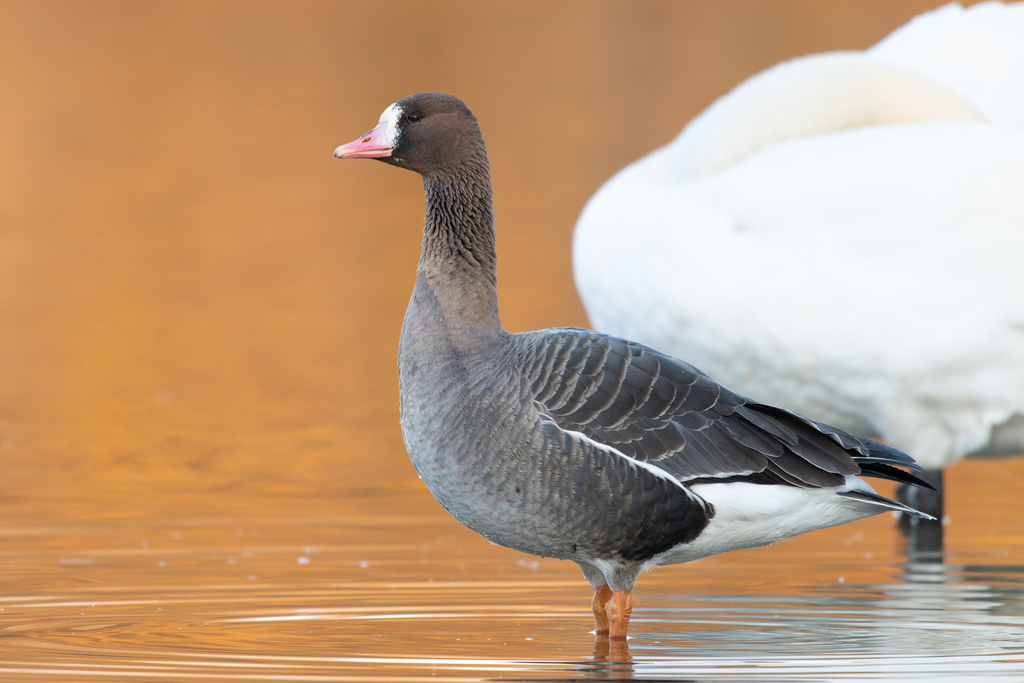
Greater White-fronted Goose
Photo © Tomas Broucek
Photo © Tomas Broucek — CC BY 4.0 — Source: iNaturalist photo #182221770Identification
The greater white-fronted goose is a medium-sized waterfowl, measuring 64–81 cm in length with a wingspan of 130–165 cm and weighing 1.93–3.31 kg. The species is instantly recognizable by the distinctive white patch of feathers bordering the base of its bill, from which it takes its name. Adults are greyish-brown birds with light grey breasts dappled with dark brown to black blotches and bars—markings so prominent that the species is colloquially called the "specklebelly" in North America. Both males and females share similar plumage, though males are typically larger. Additional field marks include bright orange legs, a pinkish bill, and mouse-coloured upper wing coverts. The species is larger than the closely related lesser white-fronted goose and lacks the yellow eye ring characteristic of that species.
Regional subspecies show notable variation. The Greenland white-fronted goose is darker overall with an orange rather than pink bill and more extensive black barring on the belly. European and Russian birds appear darker and more "oily-looking" in flight compared to Greenland birds, with differences in wing bar prominence and tail patterning. The tule goose, found in southwest Alaska, is the largest and longest-billed subspecies of all.
Range & Habitat
The greater white-fronted goose is highly migratory, with breeding populations distributed across the high Arctic. The nominate subspecies breeds in the far north of Russia, while other subspecies breed in northern Canada, Alaska, and Greenland. The species winters farther south across three continents: in North America, Europe, and Asia. Specific wintering locations vary by subspecies, with some populations reaching the Gulf of Mexico coast, California, Japan, and the British Isles and western Scotland for Greenland birds.
Behaviour & Diet
Greater white-fronted geese are vocal birds, producing a variety of calls with their most recognizable sound being a high-pitched cackle that can be imitated by the sounds "he-he," with a distinct breaking of the note occurring between the first and second cackle.
Best Time & Places to See It
The best opportunities to observe greater white-fronted geese depend on which subspecies and wintering population you wish to see. Greenland birds winter in Ireland and western Scotland, while North American subspecies can be found wintering along the Gulf of Mexico coast and in California. The species' migratory nature means sightings are seasonal, with concentrations occurring during migration periods and winter months across their respective ranges.
Photography Tips
Photographers should look for the distinctive white facial blaze and speckled breast markings, which are key identifying features in images. The bright orange legs and contrasting plumage provide good color separation against natural backgrounds. When photographing, note subspecific differences if possible—the darker plumage and orange-yellow bill of Greenland birds differs notably from the pink-billed European forms. Capture the birds in flight to showcase the wing patterns and tail markings, which vary between subspecies and are useful for identification.
Saskatchewan Whooping Crane Tour 2027
Nothing matches these filters.
Tombstone Territorial Park
Alaska Maritime National Wildlife Refuge
Algonquin Provincial Park
Alligator River National Wildlife Refuge
Arctic National Wildlife Refuge
Banff National Park
Bardiya National Park
Bavarian Forest National Park
Bear River Migratory Bird Refuge
Nothing matches these filters.
No community photos yet. Log in to add the first one.
No community observations of this species yet.