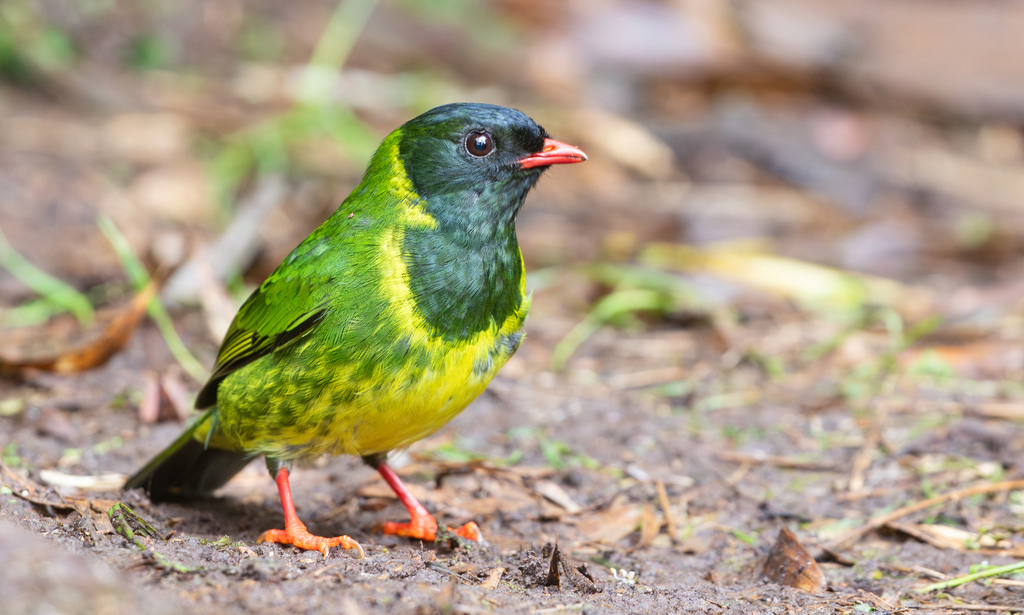
Green-and-black Fruiteater
Photo © RJ Baltierra
Photo © RJ Baltierra — CC BY 4.0 — Source: iNaturalist photo #489431055Identification
The green-and-black fruiteater is a small cotinga measuring 17.5–20 cm in length. Sexual dimorphism is pronounced: males of the nominate subspecies display a striking blackish-green head and upper breast with a bright yellow collar at the base (absent on the nape), green upperparts, and yellow underparts heavily streaked with black on the flanks. Females lack the yellow collar and have a green rather than black head. All birds share distinctive features: a dark red-brown iris, bright red bill, and red or orange-red legs. Six subspecies are recognized, varying subtly in plumage intensity, streaking patterns, and eye color across their respective ranges.
Range & Habitat
This species has a disjunct distribution across the Andes of Colombia, Ecuador, Peru, and Venezuela, with different subspecies occupying specific geographic sectors. It inhabits montane forest edges and interiors, including cloudforest and secondary woodland between 1,500 and 3,200 m elevation, though most populations occur between 1,700 and 2,900 m. The bird is a year-round resident throughout its range, making it a permanent fixture of highland Andean ecosystems.
Behaviour & Diet
The green-and-black fruiteater is believed to be strictly frugivorous, though detailed dietary information remains scarce. It forages singly, in pairs, or occasionally in small flocks, frequently joining mixed-species feeding aggregations. The bird plucks fruit while perched or briefly hovering after short flights, exploiting fruits within the montane canopy. Breeding data are limited but indicate cup-shaped nests constructed primarily from moss and lined with rootlets, placed 1–2 m above ground in small vegetation. Clutches contain two eggs, with egg-laying recorded between February and August in Colombian populations.
Best Time & Places to See It
The green-and-black fruiteater is fairly common to common throughout its range, making it one of the most widespread and abundant of Andean fruiteaters. It is most readily encountered in Colombia and fairly common in Ecuador and Peru. As a year-round resident, it can be found in suitable habitat at any season, though fruiting cycles will influence local abundance. Several protected areas within its range harbor stable populations, making these reserves excellent destinations for viewing this species in its natural montane environment.
Photography Tips
The striking sexual dichromatism and colorful plumage of males make them rewarding photographic subjects. Look for birds in mixed feeding flocks within cloudforest and montane forest edges at dawn and dusk when feeding activity peaks. The bird's habit of perching briefly while foraging provides opportunities for photography, though the montane forest habitat often presents challenging lighting conditions. Focus on males to capture the brilliant yellow collar and contrasting blackish-green hood. Patient observation along fruiting trees will yield the best opportunities for extended viewing and photography.
Sangay National Park
Cebadas, Ecuador
+320 birds+10 mammals
High in Ecuador's Andean spine, where the Western Cordillera rises to touch perpetual snow, a landscape of volcanic drama and ecological intensity unfolds across Sangay National…
VIEW NATIONAL PARKRío Negro-Sopladora National Park
Chontal, Ecuador
+84 birds
Where the eastern cordillera of Ecuador descends toward the Amazon basin, the Río Negro-Sopladora National Park sprawls across 615 square kilometers of montane forest and riverine…
VIEW NATIONAL PARKPodocarpus National Park
Zamora, Ecuador
+496 birds+6 mammals
Where the Andes descend toward the Amazon basin, Podocarpus National Park sprawls across nearly 2,800 square kilometres of the most biodiverse terrain in Ecuador's southern highlands.…
VIEW NATIONAL PARKSumaco Napo-Galeras National Park
Loreto, Ecuador
+563 birds+4 mammals
Where Ecuador's Amazon transitions into cloud forest, a massive shield volcano rises from the emerald lowlands of Orellana Province, anchoring one of the continent's most biodiverse…
VIEW NATIONAL PARKAntisana National Park
Quijos, Ecuador
+432 birds+21 mammals
Where the eastern Andean slopes descend into the Amazon basin, Antisana National Park sprawls across roughly 2,500 square kilometers of some of South America's most dramatic…
VIEW NATIONAL PARKLlanganates National Park
Tena, Ecuador
+239 birds+8 mammals
Where the eastern slopes of the Andes plunge toward the Amazon basin, Llanganates National Park sprawls across nearly 3,500 square kilometers of montane wilderness, its terrain…
VIEW NATIONAL PARKNatural Munchique National Park
El Tambo, Colombia
+194 birds
Where the Western Cordillera rises steeply from the Pacific plains of southwestern Colombia, Natural Munchique National Park sprawls across 1,078 square kilometers of montane forest that…
VIEW NATIONAL PARKNatural Serranía de los Churumbelos National Park
Santa Rosa, Colombia
+70 birds+2 mammals
Where the western cordillera of Colombia rises toward the Pacific watershed, the Serranía de los Churumbelos unfolds across more than 3,200 square kilometers of some of…
VIEW NATIONAL PARKNatural Serranía de los Yariguíes National Park
El Carmen de Chucurí, Colombia
+320 birds+3 mammals
Where the northern cordilleras of Colombia rise toward cloud forest, the Serranía de los Yariguíes unfolds across nearly 1,820 square kilometers of some of the most…
VIEW NATIONAL PARKNatural Farallones de Cali National Park
Buenaventura, Colombia
+733 birds+27 mammals
Where the Pacific coastal plain meets the western slopes of the Andes, Farallones de Cali National Park sprawls across nearly 3,500 square kilometers of dramatic topography…
VIEW NATIONAL PARKNatural Chingaza National Park
Junín, Colombia
+285 birds+6 mammals
Where the Andes rise above three thousand metres in the Cundinamarca region, high-altitude grasslands and cloud forests converge in a landscape shaped by both geology and…
VIEW NATIONAL PARKNatural Pisba National Park
Socotá, Colombia
+95 birds
High-altitude grasslands and páramo ecosystems sweep across the Andean terrain of this national park, where thin soils and cool, windswept conditions define a landscape shaped by…
VIEW NATIONAL PARKPuracé National Natural Park
Puracé, Colombia
+327 birds+2 mammals
Where the Andes thrust upward across southwestern Colombia, Puracé National Natural Park spans nearly 2,631 square kilometers of some of South America's most dramatic montane terrain.…
VIEW NATIONAL PARKGuácharos Cave National Natural Park
Acevedo, Colombia
+359 birds
High in the Andean foothills of southern Huila, where mist-laden slopes rise above 1,600 metres, lies a landscape carved by underground rivers and crowned by karst…
VIEW NATIONAL PARKNatural Sumapaz National Park
Cubarral, Colombia
+368 birds+1 mammals
Where the Andes descend toward the Amazon basin, the high páramo grasslands of Sumapaz National Park sprawl across more than five thousand square kilometers of Meta…
VIEW NATIONAL PARKEl Tamá National Park
Toledo, Colombia
+435 birds
Where the Andes descend toward the Caribbean coastal lowlands of northern Colombia, El Tamá National Park sprawls across nearly 3,800 square kilometres of montane forest, cloud…
VIEW NATIONAL PARKCordillera Azul National Park
Pampa Hermosa, Peru
+322 birds+1 mammals
Where the eastern Andes descend into the western Amazon basin, Cordillera Azul National Park sprawls across nearly 38,000 square kilometres of some of Peru's most pristine…
VIEW NATIONAL PARKNo community photos yet. Log in to add the first one.
No community observations of this species yet.