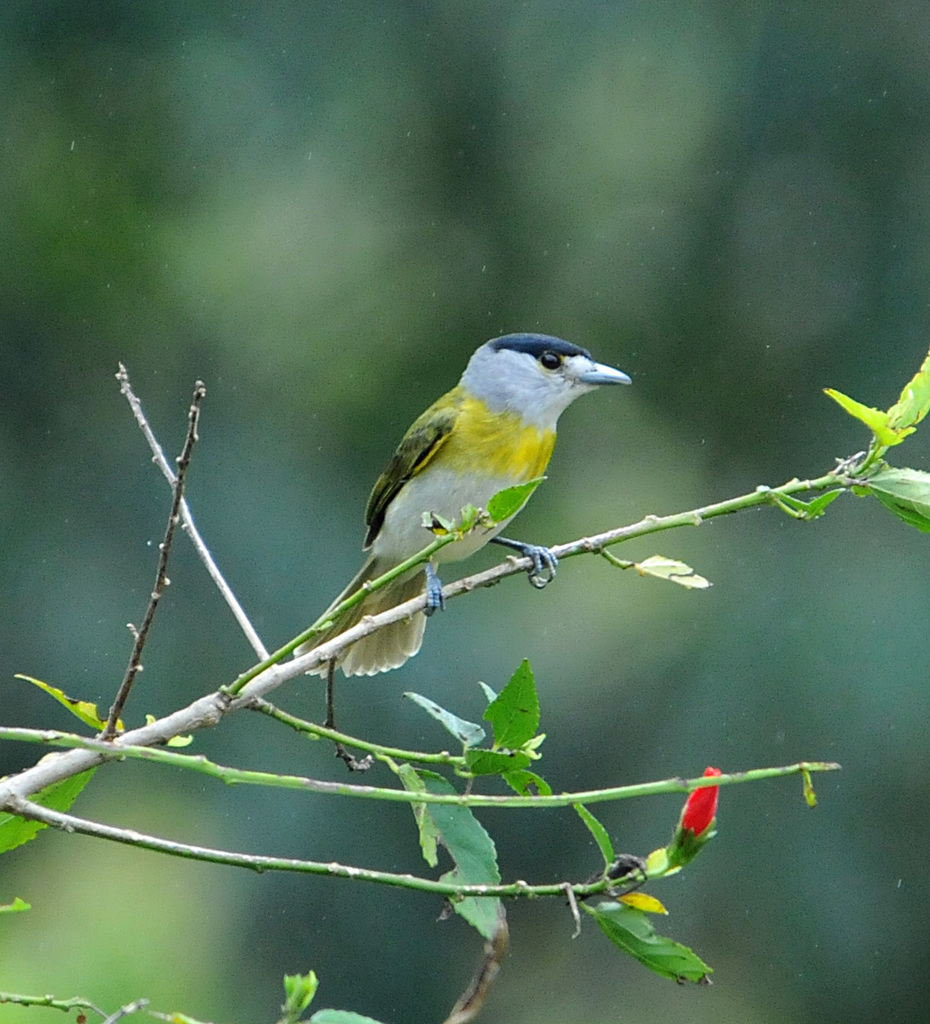
Green-backed Becard
Photo © Todd Boland
Photo © Todd Boland — CC BY 4.0 — Source: iNaturalist photo #109225893Identification
The green-backed becard is a small passerine, measuring 14.5 to 16 cm in length with a delicate build. Adult males of the nominate subspecies are striking birds, featuring a glossy black crown, whitish lores, and a thin yellowish eye-ring. Their face and nape are pale gray, while their upperparts display bright olive plumage with dusky flight feathers and tail. The throat is whitish, the breast bright yellow to olive yellow, and the underparts grayish white with a buffy tinge. Females are similarly patterned but duller: their crown is dull olive rather than black, their upperparts paler olive, and their wing coverts rufous-chestnut. The female's breast is a more muted yellow and overall plumage more subdued than the male's. Both sexes share a dark iris, pale bluish horn bill, and dusky grayish legs and feet.
Geographic variation exists across subspecies. The griseigularis subspecies has a grayish olive face and nape with mostly grayish white underparts. The xanthogenys and peruanus subspecies are notable for bright yellow cheeks, sides of neck, and throat, earning them the former common name "yellow-cheeked becard"—now considered a subspecies of the green-backed becard based on genetic and vocal similarities.
Range & Habitat
The green-backed becard has a disjunct distribution across South America, found in Argentina, Bolivia, Brazil, Guyana, Paraguay, Uruguay, and Venezuela. The nominate subspecies occupies the largest range, extending through eastern and southern Brazil south from a line roughly southwest from Ceará and Rio Grande do Norte to west-central Mato Grosso. From there it continues as a year-round resident through Paraguay and into northeastern Argentina (Santa Fe and Entre Ríos provinces) and northern Uruguay, with populations also present in central Bolivia. The griseigularis subspecies occupies eastern Venezuelan states (Delta Amacuro and Bolívar) and extends slightly into western Guyana and along Brazil's lower Amazon River. The xanthogenys subspecies is found along the eastern Andean base in Ecuador and northern Peru.
This species primarily inhabits humid to moist forest in tropical and lower montane zones, showing a preference for broken and somewhat open areas. It also frequents riparian forest and terra firme forest, as well as ecotones between different forest types. Elevations range from sea level to 1,000 metres in both Brazil and Venezuela.
Behaviour & Diet
The green-backed becard's diet remains incompletely studied but is believed to comprise mostly insects supplemented with fruit. Individuals forage at all levels of the forest canopy, typically obtaining food by reaching from a perch, snatching it during a short flight, or while briefly hovering. They often join mixed-species feeding flocks, moving through the forest in pairs as they search for food.
Breeding occurs seasonally, with clutches of two to four ochre or brownish gray eggs marked with brown. Nests are distinctive messy globes constructed from dead leaves, plant fibers, and moss, typically wedged in branch forks between approximately 4 and 25 metres above the ground. The female alone incubates the eggs for about 18 to 21 days, while both parents provision the nestlings, which fledge approximately 20 to 30 days after hatching. The bird's song is striking: it starts abruptly and consists of an ascending, slightly decelerating series of 10 to 15 "dee-dee" notes or ascending "jeh-weeé" calls repeated 6 to 20 times. Its usual call is a fast, thin, nasal "q-wink" repeated up to 12 times and rising in pitch.
Best Time & Places to See It
The green-backed becard's breeding season varies by region: October to December in Argentina, October in Paraguay, and September to December in Brazil. These months offer the best opportunities to locate birds through their distinctive vocalizations and breeding activity. The species is found year-round throughout its range, so it can be encountered during any season, though breeding season activity makes detection easier.
Look for this species in humid lowland and foothill forests across its range, particularly in areas with broken canopy and riparian zones. In Brazil, check suitable habitat from sea level to 1,000 metres elevation. The species' preference for mixed-species feeding flocks means joining or following these assemblies increases the likelihood of an encounter.
Photography Tips
The green-backed becard's small size and habit of foraging at various canopy levels present moderate photographic challenges. The bright yellow breast and olive-green upperparts of males are relatively distinctive and photograph well in good light. Focus on areas with broken canopy where the bird forages openly, as these locations offer clearer sightlines than dense forest interior. Early morning when birds are most vocally active offers the best opportunity to locate individuals for photography.
Patient observation of mixed-species feeding flocks may yield closer encounters than searching for solitary birds. The bird's habit of reaching from perches or briefly hovering provides moments of relative stillness suitable for photography. Be prepared for the small size and muted plumage of females and some subspecies, which require careful exposure metering to render detail and color accurately.
Serra do Cipó National Park
Brazil
+379 birds+5 mammals
Where granite escarpments rise above the Atlantic Forest transition zone in southeastern Brazil, Serra do Cipó National Park unfolds across a landscape of dramatic ridges, cascading…
VIEW NATIONAL PARKSangay National Park
Cebadas, Ecuador
+320 birds+10 mammals
High in Ecuador's Andean spine, where the Western Cordillera rises to touch perpetual snow, a landscape of volcanic drama and ecological intensity unfolds across Sangay National…
VIEW NATIONAL PARKSumaco Napo-Galeras National Park
Loreto, Ecuador
+563 birds+4 mammals
Where Ecuador's Amazon transitions into cloud forest, a massive shield volcano rises from the emerald lowlands of Orellana Province, anchoring one of the continent's most biodiverse…
VIEW NATIONAL PARKLlanganates National Park
Tena, Ecuador
+239 birds+8 mammals
Where the eastern slopes of the Andes plunge toward the Amazon basin, Llanganates National Park sprawls across nearly 3,500 square kilometers of montane wilderness, its terrain…
VIEW NATIONAL PARKItatiaia National Park
Brazil
+519 birds+12 mammals
Where granite peaks pierce the Atlantic rainforest canopy in southeastern Brazil, Itatiaia National Park rises as one of the country's oldest and most ecologically vital protected…
VIEW NATIONAL PARKUbajara National Park
Brazil
+122 birds+1 mammals
Granite peaks rise sharply from the humid tropical forests of northeastern Brazil, where Ubajara's 234 square kilometres straddle the transition between Atlantic rainforest and drier cerrado…
VIEW NATIONAL PARKSuperagui National Park
Brazil
+246 birds+2 mammals
Where the Atlantic rainforest meets the subtropical coast of Paraná, Superagui National Park sprawls across more than 1,000 square kilometres of one of Brazil's most biodiverse…
VIEW NATIONAL PARKSerra da Bocaina National Park
Brazil
+441 birds+5 mammals
Where the escarpment of the Serra da Bocaina rises sharply from the Atlantic coastal plain, tropical rainforest cloaks steep mountainsides that climb toward peaks exceeding 2,000…
VIEW NATIONAL PARKIguaçu National Park
Brazil
+387 birds+17 mammals
Where the Paraná Plateau plunges toward the Atlantic watershed, six thousand square kilometers of subtropical rainforest cling to steep gorges and river valleys in this corner…
VIEW NATIONAL PARKSerra do Teixeira National Park
Brazil
+160 birds+5 mammals
Rugged plateaus and deep escarpments define this 3,112-square-kilometre sweep of the Brazilian Northeast, where the crystalline bedrock of the Borborema Plateau rises abruptly from the surrounding…
VIEW NATIONAL PARKSerra dos Órgãos National Park
Brazil
+446 birds+13 mammals
Granite peaks thrust skyward through the Atlantic Forest canopy in the mountains immediately north of Rio de Janeiro, their bare rock faces rising above a landscape…
VIEW NATIONAL PARKChapada dos Guimarães National Park
Brazil
+450 birds+1 mammals
Where weathered sandstone plateaus rise above the cerrado grasslands of central Brazil, Chapada dos Guimarães National Park protects 624 square kilometres of ecological transition zone that…
VIEW NATIONAL PARKPantanal Matogrossense National Park
Brazil
+322 birds+17 mammals
Where the flooded forests of central Brazil meet vast seasonally inundated grasslands, Pantanal Matogrossense National Park sprawls across nearly 2,900 square kilometers of one of the…
VIEW NATIONAL PARKChapada Diamantina National Park
Brazil
+346 birds+5 mammals
Where granite peaks and sandstone cliffs rise abruptly from the Brazilian interior, Chapada Diamantina National Park sprawls across 4,215 square kilometers of some of Brazil's most…
VIEW NATIONAL PARKSerra do Gandarela National Park
Brazil
+333 birds+3 mammals
Where granite massifs rise through Atlantic Forest in southeastern Brazil's highlands, Serra do Gandarela National Park protects nearly 1,000 square kilometres of montane terrain that few…
VIEW NATIONAL PARKAraucárias National Park
Brazil
+231 birds+3 mammals
Where the southern Brazilian highlands rise into cool temperate forest, Araucárias National Park protects one of the Atlantic Forest's most distinctive ecosystems across 506 square kilometres…
VIEW NATIONAL PARKYanachaga–chemillén National Park
Palcazu, Peru
+639 birds+6 mammals
Where the eastern slopes of Peru's central cordillera plunge into cloud forest, Yanachaga–Chemillén National Park protects nearly three thousand square kilometres of montane wilderness that few…
VIEW NATIONAL PARKEl Palmar National Park
Distrito Sexto, Argentina
+244 birds+14 mammals
Across the Paraná River floodplain in northeastern Argentina, palms rise from wetland and grassland in a landscape shaped by water and time. El Palmar National Park…
VIEW NATIONAL PARKRío Pilcomayo National Park
Argentina
+271 birds+13 mammals
Where the Río Pilcomayo cuts through northeastern Argentina's subtropical lowlands, a sprawling mosaic of wetlands, grasslands, and seasonally flooded forests creates one of South America's most…
VIEW NATIONAL PARKIguazú National Park
Puerto Iguazú, Argentina
+346 birds+15 mammals
Where the Paraná Plateau plunges toward the Atlantic watershed, nearly 800 square kilometers of subtropical rainforest drape across Misiones Province in a landscape carved by millennia…
VIEW NATIONAL PARKEl Rey National Park
Municipio de Las Lajitas, Argentina
+317 birds+4 mammals
Where the eastern slopes of the Andes descend into northwestern Argentina's subtropical transition zone, El Rey National Park unfolds across 841 square kilometers of dramatically varied…
VIEW NATIONAL PARKCalilegua National Park
Municipio de Calilegua, Argentina
+288 birds+8 mammals
Where the eastern Andean slopes plunge into northwestern Argentina's humid subtropics, nearly 2,645 square kilometers of steep terrain and luxuriant forest compose one of South America's…
VIEW NATIONAL PARKParque Provincial Pampa del Indio
Laguna Limpia, Argentina
+231 birds+4 mammals
Across the flat horizons of Chaco Province, where the Paraná River system spills into vast wetlands and grasslands, Parque Provincial Pampa del Indio protects one of…
VIEW NATURE RESERVEChaco National Park
Municipio de Presidencia de la Plaza, Argentina
+258 birds+7 mammals
Across the humid subtropical lowlands of northeastern Argentina, where the Paraná River basin feeds vast seasonal wetlands and gallery forests, Chaco National Park protects one of…
VIEW NATIONAL PARKNo community photos yet. Log in to add the first one.
No community observations of this species yet.