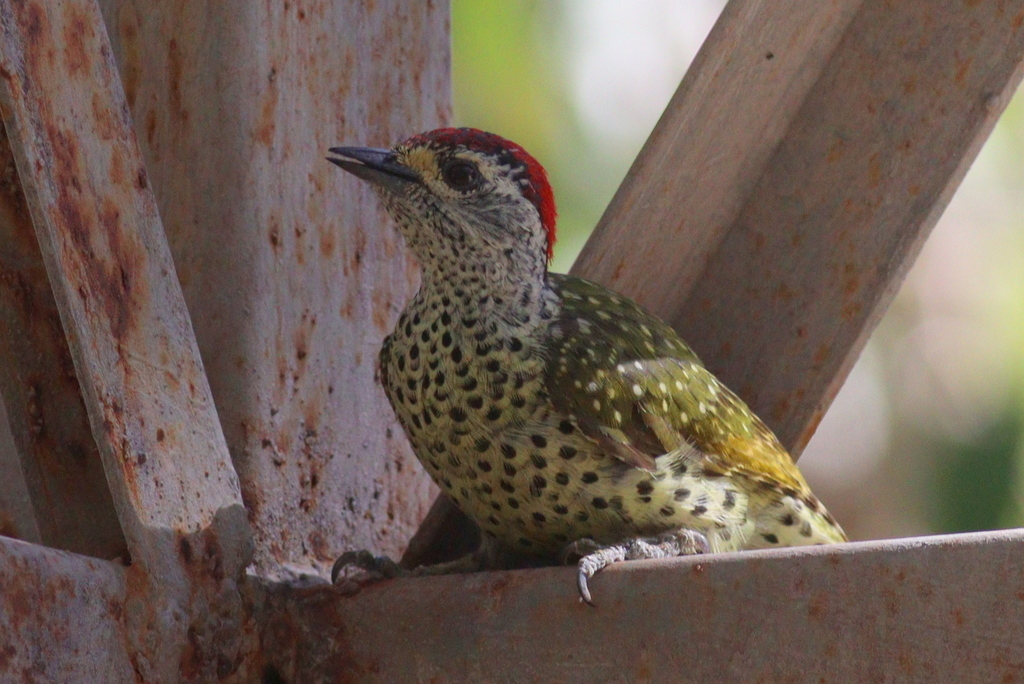
Green-backed Woodpecker
Photo © Jan Ebr & Ivana Ebrová
Photo © Jan Ebr & Ivana Ebrová — CC BY 4.0 — Source: iNaturalist #112651589Identification
The Green-backed Woodpecker is a small woodpecker, measuring about 16 cm (6.3 in) long and weighing approximately 54 g (1.9 oz). Males are distinctive, with an olive-blackish crown tinged with indistinct reddish colouration and a bright red nape. Both sexes display a buff head, neck, and throat with characteristic brown spotting. The upperparts are yellowish-green or bronze-green, while the flight feathers are brown with buffish barring. The tail is blackish with yellow and green markings. The underparts transition from buff on the throat and breast to greenish-white below, with deep olive barring throughout. Females lack the red head colouration, instead showing buff spots on the crown and nape. Juveniles appear greener above with pale streaks and paler underparts overall.
Range & Habitat
This species is widely distributed across tropical Africa, occupying a substantial geographic range. The Green-backed Woodpecker favours forest edges, clearings, and mosaic habitats combining forest and shrub vegetation, typically at elevations up to 1,000 m (3,300 ft). The species readily adapts to both primary and secondary forest edges, making it more abundant in areas where natural habitat transitions create ideal hunting grounds.
Behaviour & Diet
The Green-backed Woodpecker specializes in foraging for arboreal ants, which form the basis of its diet. This species is notably vocal, producing a range of distinctive calls including a plaintive huweeeeh, a harsh whee, sharp kewik notes, three to four teeay sequences, and a teerweet call. Uniquely, these woodpeckers excavate their nesting cavities within existing nests of ants and termites, an adaptation that provides structural support and protection. Breeding occurs in August, with possible additional breeding activity in March and April.
Best Time & Places to See It
August is the primary breeding season for the Green-backed Woodpecker, making it potentially more active and vocal during this period. The species is most likely to be encountered in forest-edge habitats and forest-shrub mosaics across its wide tropical African range. Its preference for open habitats and clearing edges makes it more accessible to observers than strictly forest-interior species. Listen for its distinctive calls to locate birds in suitable habitat.
Photography Tips
The Green-backed Woodpecker's small size and preference for edge and mosaic habitats offer good opportunities for patient photographers. Focus on capturing the male's distinctive red nape and the bird's characteristic spotted underparts. Early morning sessions when these woodpeckers are most vocally active may increase your chances of locating and photographing them. The species' adaptation to more open habitats than many woodpeckers means better lighting and visibility in forest-edge locations. Watch for birds foraging on lower branches and trunks where they search for arboreal ants.
Serengeti National Park
Tanzania
+558 birds+57 mammals
Across Tanzania's northern plateau, where volcanic soils meet acacia woodland and open grassland, unfolds one of Earth's most dynamic ecosystems. The Serengeti National Park sprawls across…
VIEW NATIONAL PARKRubondo Island National Park
Tanzania
+99 birds+8 mammals
Across the waters of Lake Victoria's northeastern arm, Rubondo Island rises as a freshwater wilderness where papyrus swamps grade into acacia woodlands and dense thickets of…
VIEW NATIONAL PARKVirunga National Park
Uganda
+418 birds+13 mammals
Where the Western Rift Valley fractures the landscape of North Kivu, Virunga National Park sprawls across terrain as geologically dramatic as it is ecologically vital. Volcanic…
VIEW NATIONAL PARKBwindi Impenetrable National Park
Kanyashogi, Uganda
+603 birds+26 mammals
Steep ridges cloaked in montane forest rise from Uganda's southwestern borderlands, where the landscape grows so dense and tangled that early explorers named it impenetrable. At…
VIEW NATIONAL PARKLake Mburo National Park
Uganda
+505 birds+24 mammals
Rolling acacia woodland and scattered lakes define this intimate savanna preserve in southwestern Uganda, where the rift valley's geological drama shapes every water source and grassland.…
VIEW NATIONAL PARKTarangire National Park
Tanzania
+527 birds+50 mammals
Acacia woodland and grassland sweep across the Manyara Region where the Tarangire River carves through low hills and volcanic soils, creating one of East Africa's most…
VIEW NATIONAL PARKNgorongoro Conservation Area
Tanzania
+626 birds+55 mammals
Volcanic calderas and open grassland dominate this high plateau in northern Tanzania, where the landscape rises above 2,000 metres and ancient geological forces have shaped both…
VIEW WILDLIFE MANAGEMENT AREAQueen Elizabeth National Park
Uganda
+672 birds+30 mammals
Across the southwestern escarpment of Uganda, where the Western Rift Valley descends through ancient volcanic terrain, Queen Elizabeth National Park sprawls across more than 8,300 square…
VIEW NATIONAL PARKArabuko Sokoke Forest Reserve
Kilifi, Kenya
+383 birds+29 mammals
Coastal forest rises from the Indian Ocean plains of Kilifi County, where sandy soils and seasonal rainfall have sculpted a woodland ecosystem unlike anywhere else on…
VIEW NATURE RESERVEWatamu Marine National Park
Dabaso ward, Kenya
+328 birds+12 mammals
Where mangrove channels meet coral gardens and sandy shallows blend into the warm waters of the Indian Ocean, Watamu Marine National Park unfolds across the Kilifi…
VIEW NATIONAL PARKNo community photos yet. Log in to add the first one.
No community observations of this species yet.