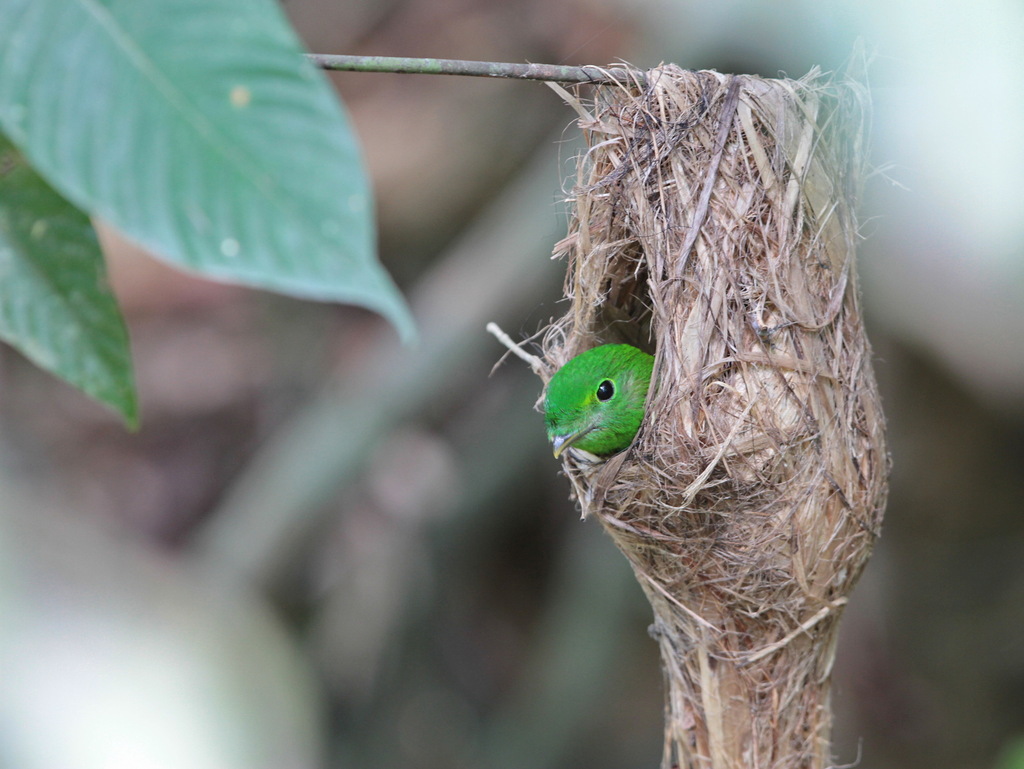
Green Broadbill
Photo © Ian Dugdale
Photo © Ian Dugdale — CC BY 4.0 — Source: iNaturalist #303073761Identification
The Green Broadbill is a small bird, measuring about 17 cm in length, adorned in brilliant green plumage that provides excellent camouflage within the forest canopy. Its most distinctive features include a black ear patch, a characteristically wide gape, rounded head, and short tail. Look for three black bars on each wing—a key field mark when the bird is visible. The beak is notably weak and almost hidden beneath the crest above it, giving the bird a distinctive profile.
Sexual dimorphism is subtle in this species: while both sexes share the overall green coloration, females are duller and lack the bold black markings on the ear patch and wing coverts that characterize males. This difference can be helpful when identifying individuals in the field.
Range & Habitat
The Green Broadbill is distributed across the broadleaved evergreen forests of Borneo, Sumatra, and the Malay Peninsula. Three subspecies are recognized, occupying different regions: the nominate subspecies inhabits the Malay Peninsula (though it has been extirpated from Singapore), while the subspecies gloriosa occurs in Sumatra, Borneo, Nias, the Lingga Islands, and the Natuna Islands. The subspecies siberu is found on the Mentawai Islands.
This species favors lowland and lower montane rainforest, where it remains dependent on pristine or near-pristine forest habitats. Its sensitivity to habitat loss and degradation makes it vulnerable to forest fragmentation and conversion throughout its range.
Behaviour & Diet
The Green Broadbill is often overlooked in the field because it tends to sit motionless within the canopy or just below it, relying on its foliage-green coloration for concealment. When disturbed, it quickly flies to a new location, making prolonged observation challenging. This secretive nature means that patience and careful scanning are essential for seeing this species.
The broadbill feeds largely on soft figs, and its feeding habits play an important ecological role in dispersing fig seeds throughout the forest floor. Breeding females typically lay between two and three whitish eggs, with young fledging after twenty-two to twenty-three days of development.
Best Time & Places to See It
Travelers seeking the Green Broadbill should focus on lowland and lower montane rainforest areas in Borneo, Sumatra, and the Malay Peninsula. The species remains common in many parts of its large range, making it a realistic sighting for visitors to primary and well-preserved secondary rainforests in these regions. National parks and protected forest reserves within its range offer the best opportunities.
Although no specific seasonal variation in visibility is documented, the bird's cryptic behavior means that visitors should search methodically through the canopy, particularly in areas with fruiting figs. Early morning hours, when the forest is most active, may offer the best chances for encounters.
Photography Tips
Photographing the Green Broadbill presents unique challenges due to its canopy-dwelling habits and excellent camouflage. Patience is essential—scan the higher branches systematically and listen for movement. The bird's rounded silhouette and brilliant green plumage should be your visual targets.
Given that the broadbill feeds on figs, positioning yourself near fruiting fig trees may increase your chances of encounters. A telephoto lens is advisable for capturing detail from a distance without disturbing the bird. Early morning light filtering through the canopy will best reveal the bird's vibrant green coloration and distinctive black markings on males, which provide the strongest photographic subjects.
Taman Negara National Park
Kampong Samas, Malaysia
+393 birds+48 mammals
Where ancient rainforest meets limestone peaks, one of Southeast Asia's oldest protected wilderness preserves sprawls across 4,343 square kilometers of primordial landscape. Dipterocarp giants tower overhead,…
VIEW NATIONAL PARKTaman Negara Bukit Lambir National Park
Miri, Malaysia
+153 birds+7 mammals
Rainforest cascades down sandstone ridges where crystal streams carve through ancient geology, creating a landscape of profound biological richness in Sarawak's interior. This 68-square-kilometre sanctuary protects…
VIEW NATIONAL PARKGunung Mulu National Park
Long Seridan, Malaysia
+280 birds+39 mammals
Where granite monoliths pierce the rainforest canopy of Sarawak, an ancient limestone karst landscape reveals one of Southeast Asia's most biodiverse strongholds. Soaring peaks cloaked in…
VIEW NATIONAL PARKGunung Palung National Park
Kayong Utara, Indonesia
+38 birds+1 mammals
Rainforest swells across the steep terrain of West Kalimantan, where ancient volcanic ridges rise abruptly from lowland swamps and weathered plateaus. Gunung Palung National Park encompasses…
VIEW NATIONAL PARKWay Kambas National Park
Lampung Timur, Indonesia
+237 birds+20 mammals
Across the low swamplands of eastern Lampung, where freshwater wetlands merge into tidal mangrove forests along the Sunda Strait, sprawls one of Sumatra's most vital sanctuaries.…
VIEW NATIONAL PARKNo community photos yet. Log in to add the first one.
No community observations of this species yet.