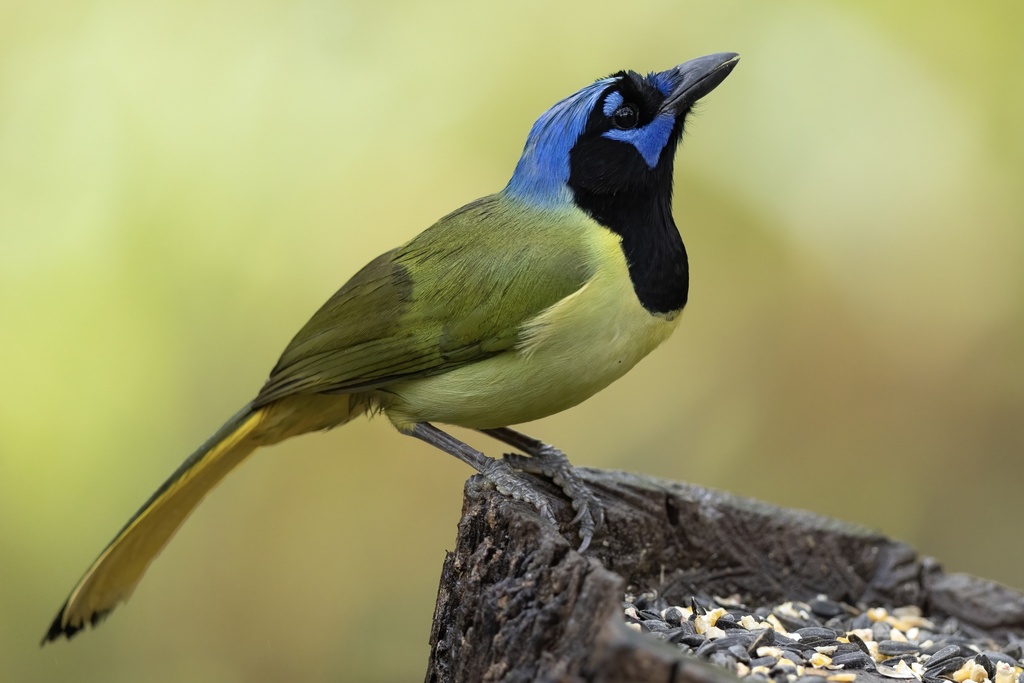
Green Jay
Photo © Matt Felperin
Photo © Matt Felperin — CC BY 4.0 — Source: iNaturalist photo #349913631Identification
The Inca jay is a striking member of the crow family, measuring 29.5–30.5 cm in length. Its most distinctive features include a mostly white crown with blue limited to the frontal crest and nape, creating an elegant head pattern. A bold black bib forms a broad band extending up the sides of the head, with additional black stripes through and above the eye line. The breast and underparts are bright yellow, contrasting beautifully with rich green upperparts. The bird's bright yellow iris adds another distinguishing feature. This colorful plumage makes the Inca jay unmistakable in its range.
Range & Habitat
The Inca jay is native to the Andes of South America, with its range extending southward through Colombia and Venezuela, continuing through Ecuador, Peru, and Bolivia. The species occupies mountainous regions throughout this extensive territory, adapting to various elevations within the Andean chain. Five recognized subspecies show subtle variations across this range, with differences in crest size, coloration intensity, and slight morphological features depending on their specific geographic locations.
Behaviour & Diet
Like other jays, the Inca jay possesses a remarkably extensive voice repertoire. Its most common call produces a distinctive rassh-rassh-rassh sound, though the species produces many other unusual notes. One of its most recognizable vocalizations sounds like an alarm bell, earning it the Spanish name querrequerre—an onomatopoeic reference to its characteristic calls. Inca jays are social birds that typically build nests in trees, thorny bushes, or thickets. Females lay three to five eggs and alone incubate them, though both parents care for the young. Their diet consists of arthropods, vertebrates, seeds, and fruit, making them opportunistic foragers.
Best Time & Places to See It
The Inca jay can be encountered year-round throughout the Andean mountains of its range. Birders and nature travelers should focus on mountainous regions in Colombia, Venezuela, Ecuador, Peru, and Bolivia. The species is generally resident and not migratory, so sightings are possible in suitable habitat at any time of year. Their vocal nature often makes them easier to locate by sound than by sight, particularly during breeding season.
Photography Tips
The Inca jay's vibrant colors—particularly the bright yellow underparts, blue crest, and rich green back—photograph exceptionally well in clear mountain light. The bird's striking head pattern with its black bib and eye stripes provides excellent compositional opportunities. Since these are vocal, active birds, patience and positioning near fruiting trees or dense vegetation where they forage will increase your chances of photography. Early morning hours typically offer the best light and increased activity levels for capturing this beautiful jay in its natural Andean habitat.
Ecuador Bird Photography
Guided Birding Tour
Nothing matches these filters.
Antisana National Park
Bahuaja Sonene National Park
Dzibilchantún National Park
El Tamá National Park
Guácharos Cave National Natural Park
Laguna Atascosa National Wildlife Refuge
Laguna del Tigre National Park
Lagunas de Montebello National Park
Llanganates National Park
Nothing matches these filters.
No community photos yet. Log in to add the first one.
No community observations of this species yet.