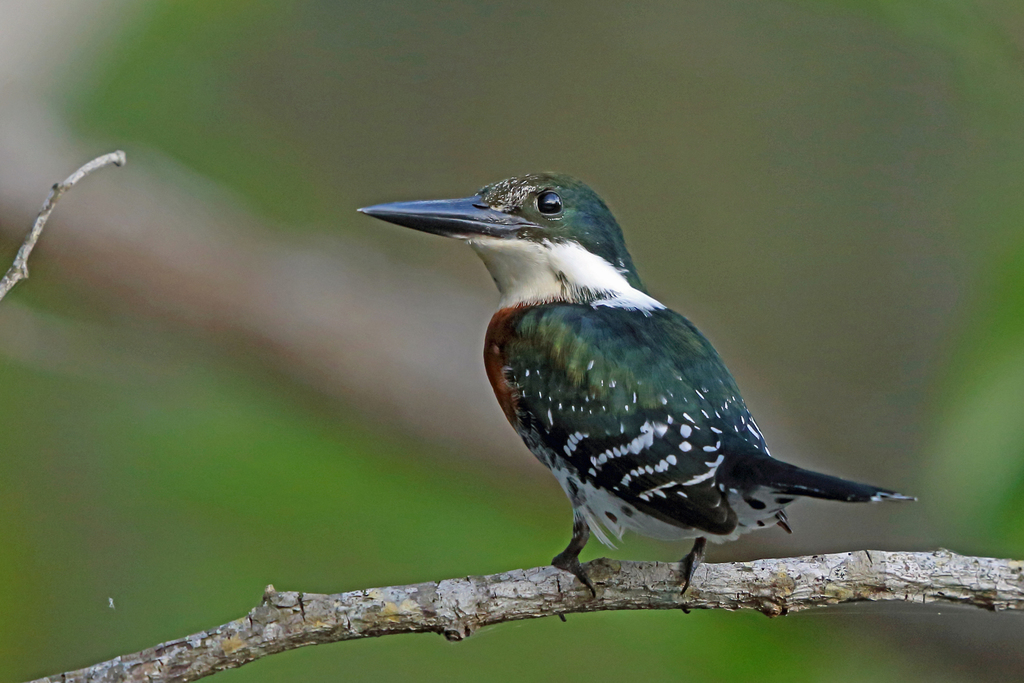
Green Kingfisher
Photo © Nigel Voaden
Photo © Nigel Voaden — CC BY 4.0 — Source: iNaturalist photo #2201986Identification
The green kingfisher is a small kingfisher, about 20 cm (8 in) long, with the typical upright posture and heavy bill characteristic of its family, though notably lacking the prominent crest of many other kingfisher species. The bird displays striking plumage: green upperparts with white spotting on the flight feathers, mostly white underparts with green spots on the sides and flanks, and a green tail with prominent white on the outer feathers—a marking especially visible in flight. Males are smaller and lighter than females, weighing around 35 to 40 grams. Adult males are distinctly marked with a white collar and rufous breast, while females display a white collar, buffy throat and breast, and a characteristic band of green speckles across the breast and upper belly. Juveniles resemble females but are duller, with small buff spots on the crown and wing coverts. The bill is black with a horn-colored base, and legs and feet are dark gray.
Range & habitat
The green kingfisher's range extends from southern Texas through Central America and into every mainland South American country except Chile. It is a year-round resident throughout its range, though it roams territories that may span 1 km (0.6 mi) or more of river. The species inhabits wooded shorelines of streams and freshwater ponds and lakes, showing a clear preference for still or slow-moving water. While it requires low vegetation for hunting perches, it generally favors relatively open habitat rather than dense forest, making it more accessible to birdwatchers than many forest-dwelling species.
Behaviour & diet
The green kingfisher hunts by diving from perches typically positioned 1 to 1.5 m above the water, either directly over it or within a few meters of the edge. The bird usually shifts perches after each hunting attempt and occasionally hovers before diving, sometimes from heights of up to 6 m. Its diet consists primarily of small fish, typically ranging from 8 to 80 mm in length, supplemented by crustaceans such as shrimp and both aquatic and terrestrial insects. Pairs actively defend feeding territories from other green kingfishers, though they seldom compete with other kingfisher species.
Best time & places to see it
The green kingfisher's breeding season varies geographically: in Central America it occurs during the dry season of spring and early summer, while in Suriname and Guyana it typically extends through August and occasionally beyond. The bird's large range and preference for open waterside habitats make it relatively accessible across its distribution. Look for it perched on low branches overhanging streams and still-water ponds throughout its year-round range in Central and South America and southern Texas.
Photography tips
The green kingfisher's habit of hunting from fixed perches and shifting between them offers photographers predictable opportunities. Position yourself with a clear view of likely perches above water, keeping a low profile to avoid disturbing the bird. The white markings on the tail and wings are most striking in flight, so be ready to capture the bird in motion as it dives or flies between perches. Early morning and late afternoon typically offer the best light for highlighting the iridescent green plumage. The bird's small size and quick movements demand a fast shutter speed and good autofocus capabilities.
Nothing matches these filters.
Amacayacu National Park
Amazônia National Park
Anavilhanas National Park
Antisana National Park
Araucárias National Park
Arenal Volcano National Park
Bahuaja Sonene National Park
Barbilla National Park
Barra del Colorado National Wildlife Refuge
Nothing matches these filters.
No community photos yet. Log in to add the first one.
No community observations of this species yet.