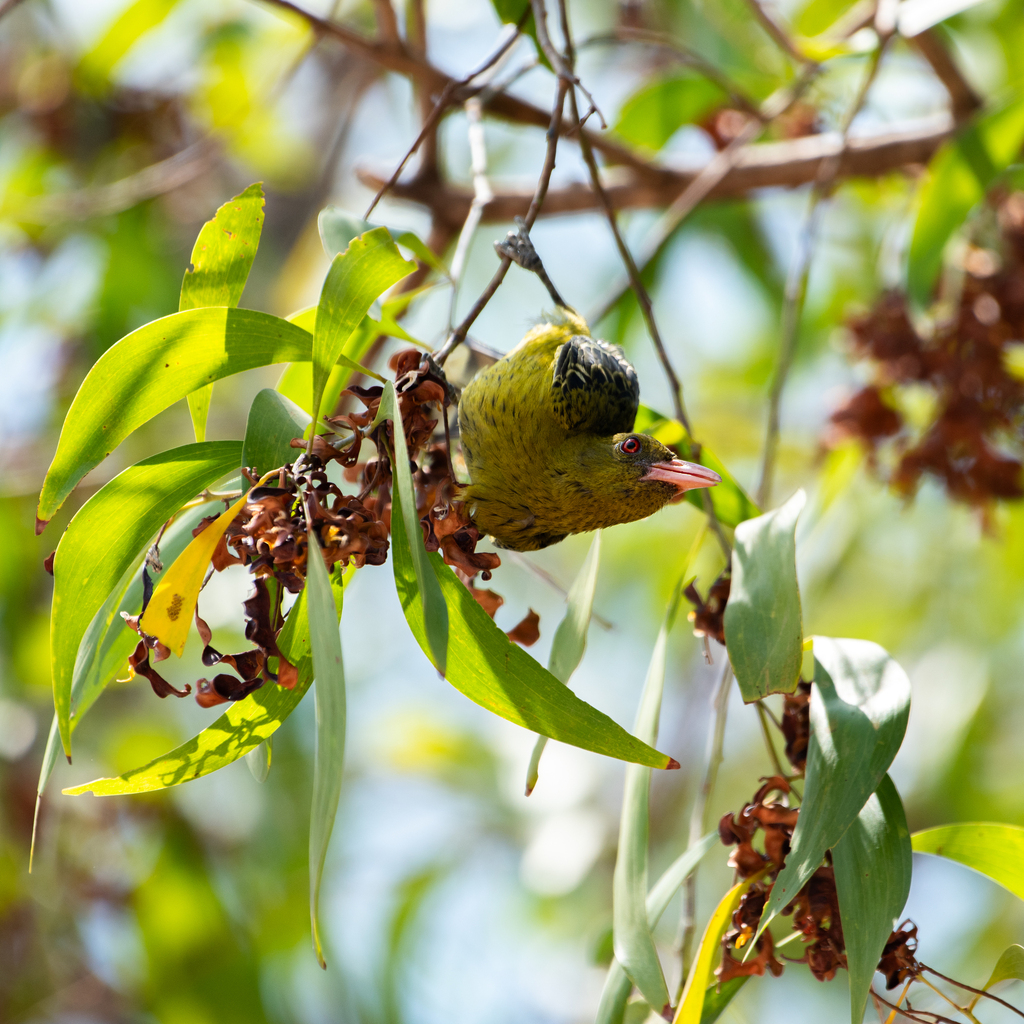
Green Oriole
Photo © Austen Armstrong
Photo © Austen Armstrong — CC BY 4.0 — Source: iNaturalist #247062168Identification
The Green Oriole is an inconspicuous bird, a trait that has earned it the alternate names Australian yellow oriole, yellow oriole, and yellow-bellied oriole. Its yellow-green plumage is expertly adapted for concealment, blending seamlessly with tropical foliage. This cryptic colouration makes visual identification challenging, and birdwatchers are often alerted to the bird's presence by its distinctive vocalisation rather than by sight. The species' most reliable diagnostic feature is its deep, bubbling, musical call—a sound that carries through dense vegetation far more effectively than any attempt to spot the bird itself.
Range & Habitat
The Green Oriole is distributed across Australia and New Guinea, with six recognised subspecies occupying different regions. In Australia, populations occur across the north and northeast, including the Lesser Sundas, Cape York Peninsula, north-eastern Queensland, and the offshore Bathurst and Melville Islands. South-central New Guinea supports a separate subspecies. Despite their wide range, Green Orioles remain common only in suitable habitat, where they favour lush tropical environments including rainforests, mangroves, thickets along watercourses, swamps, and well-vegetated gardens.
Behaviour & Diet
Green Orioles are primarily frugivorous, foraging slowly and methodically through the middle and upper strata of dense forests in search of fruit. They are typically encountered alone or in pairs, though they may form small flocks outside the breeding season. Breeding occurs during the wet season from October to March, when pairs construct neat, deep cup-shaped nests from strips of bark and vines, lined with rootlets and suspended between leafy branches usually 5–15 metres above ground. They typically lay two eggs per clutch.
Best Time & Places to See It
Finding Green Orioles requires patience and a willingness to listen more than to look. Birdwatchers should focus their efforts in rainforests, mangrove swamps, and riverside thickets throughout their range in northern and north-eastern Australia and New Guinea. The breeding season (October to March) is when birds are most vocal and territorial, making this the optimum time for locating them. Listening carefully for their distinctive deep, bubbling calls will reward you far more reliably than visual scanning, as their yellow-green colouration renders them nearly invisible among dense canopy foliage.
Photography Tips
Photographing Green Orioles presents a significant challenge due to their cryptic plumage and preference for remaining within dense vegetation. Success requires patience, good hearing, and an ability to locate birds by sound before attempting to photograph them. Position yourself in suitable habitat—particularly mangrove swamps and riverside thickets—during the wet season when birds are most active vocally. Once you have located a bird by its call, move slowly and deliberately to avoid flushing it. Focus on the middle and upper strata of the forest canopy where these birds forage. Early morning light and overcast conditions will help reveal the subtle yellow-green tones of the plumage against the inevitable background of dense green foliage.
Kakadu National Park
Kakadu, Australia
+273 birds+46 mammals
Kakadu National Park is Australia’s largest national park and one of the world’s most remarkable protected areas, covering nearly 20,000 square kilometres in the tropical north…
VIEW NATIONAL PARKDaintree National Park
Dedin, Australia
+362 birds+37 mammals
Daintree National Park is one of the world’s oldest and most biologically diverse tropical rainforests, protecting an extraordinary landscape where ancient forests meet the Great Barrier…
VIEW NATIONAL PARKAnnan River (Yuku Baja-Muliku) National Park
Australia
+78 birds
Where the Annan River winds through northeastern Queensland's coastal hinterland, a compact national park of roughly 246 square kilometers protects a mosaic of subtropical rainforest, eucalypt…
VIEW NATIONAL PARKEndeavour River National Park
Philadelphia, Australia
+203 birds+1 mammals
Where the Endeavour River winds through northeastern Queensland's tropical lowlands, a compact mosaic of rainforest, open woodland, and riverine corridor creates one of Australia's most ecologically…
VIEW NATIONAL PARKRinyirru National Park
Lakefield, Australia
+258 birds+7 mammals
Where the savanna grasslands of far north Queensland meet seasonal wetlands and eucalypt woodlands, Rinyirru National Park sprawls across more than 12,500 square kilometres of rugged,…
VIEW NATIONAL PARKKulla National Park
Coen, Australia
+11 birds
Across the tablelands and coastal lowlands of far north Queensland, where the landscape transitions from eucalypt woodland to open grassland and remnant rainforest pockets, Kulla National…
VIEW NATIONAL PARKLitchfield National Park
Australia
+175 birds+15 mammals
Where weathered sandstone plateaus rise above the savanna woodlands of Australia's Top End, Litchfield National Park unfolds as a landscape of dramatic contrasts shaped by a…
VIEW NATIONAL PARKNitmiluk National Park
Australia
+186 birds+27 mammals
Dramatic sandstone gorges carved by the Katherine River slice through the tropical savanna of Australia's Top End, creating a landscape where escarpments tower above crystalline pools…
VIEW NATIONAL PARKGirringun National Park
Australia
+231 birds+10 mammals
Where granite gorges cleave through subtropical woodland in North Queensland, Girringun National Park unfolds across rugged terrain shaped by millions of years of weathering and erosion.…
VIEW NATIONAL PARKWooroonooran National Park
Australia
+240 birds+28 mammals
Where the Great Dividing Range rises sharply inland from Queensland's tropical coast, Wooroonooran National Park encompasses a landscape of steep, forested gorges and cascading waterways carved…
VIEW NATIONAL PARKBoodjamulla National Park
Australia
+142 birds+3 mammals
Where red sandstone gorges carve through the semi-arid interior of far north Queensland, Boodjamulla National Park reveals a landscape shaped by seasonal water availability and ancient…
VIEW NATIONAL PARKNo community photos yet. Log in to add the first one.
No community observations of this species yet.