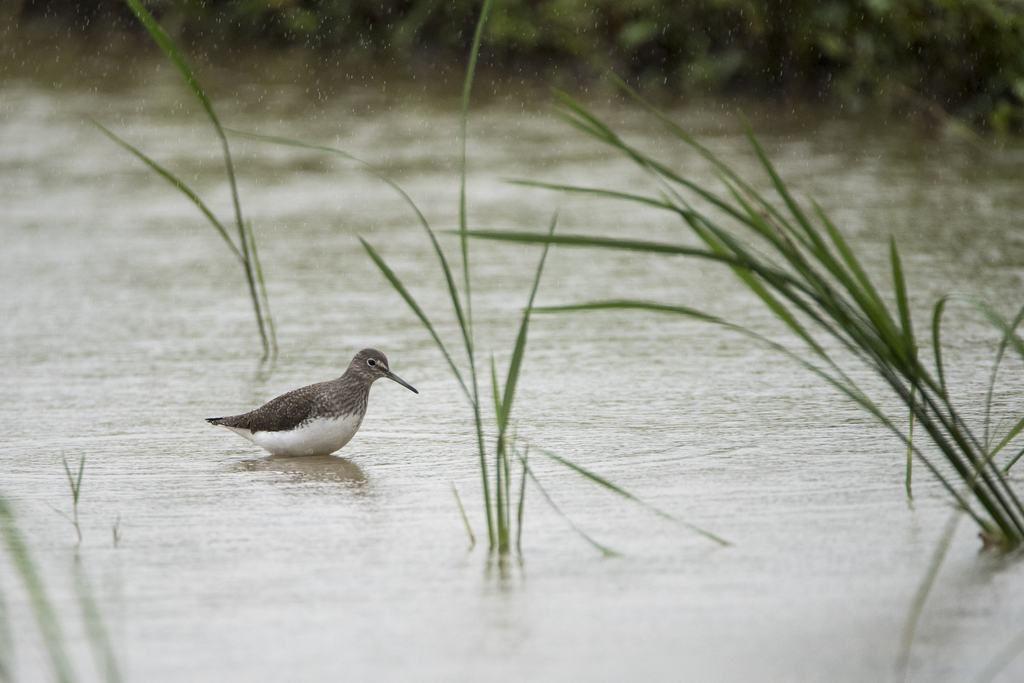
Green Sandpiper
Photo © Licheng Shih
Photo © Licheng Shih — CC BY 4.0 — Source: iNaturalist photo #249079562Identification
The green sandpiper is a somewhat plump wader with distinctive plumage that makes it recognizable in the field. It features a dark greenish-brown back and wings with white spotting that varies seasonally—most extensive in breeding adults and less pronounced in winter and young birds. The head and breast are greyish, contrasting with otherwise white underparts, while both the legs and short bill are dark green. This species represents an ancient lineage within the genus Tringa, sharing its closest relationship with the North American solitary sandpiper, another tree-nesting wader with similar brown-winged plumage and delicate neck and chest patterning.
In flight, the green sandpiper is particularly striking and easy to identify. The wings appear dark both above and below, but the most reliable field mark is the brilliant white rump, which distinguishes it clearly from the slightly smaller solitary sandpiper. The species also produces a characteristic three-note whistle in flight, adding an auditory identifier to aid observers in locating and confirming sightings.
Range & Habitat
The green sandpiper breeds across subarctic Europe and eastward throughout the Palearctic region. As a migratory species, it winters across a vast range including southern Europe, the Indian subcontinent, Southeast Asia, and tropical Africa, making it a truly cosmopolitan traveller between continents.
Unlike many other waders, this species is very much a bird of freshwater habitats and shows a marked preference for restricted sites such as small ponds and water edges where other waders would struggle due to limited all-around visibility. It is not a gregarious bird by nature, though small numbers may occasionally congregate in particularly suitable feeding areas.
Behaviour & Diet
The green sandpiper feeds by working steadily around the edges of its chosen freshwater site, picking small invertebrate items off the mud with methodical patience. Its solitary habits and preference for confined spaces distinguish it from more gregarious wader species, making it a specialist of intimate wetland habitats rather than open expanses.
During the breeding season, this species exhibits the remarkable behaviour of nesting in trees—a trait shared with its close relative the solitary sandpiper and unusual among sandpipers. It lays a clutch of 2–4 eggs in old tree nests abandoned by other species, such as those of fieldfares, with eggs hatching after approximately three weeks of incubation.
Best Time & Places to See It
The green sandpiper is widely distributed and not uncommon across its range, making it a achievable sighting for patient observers. Migration periods offer particularly good opportunities, as birds move between breeding grounds in the Palearctic and wintering areas across Africa, Asia, and southern Europe. Look for this species in spring and autumn at small freshwater sites such as pond edges, ditches, and streamside margins where it can feed undisturbed.
Focus your search on restricted freshwater habitats rather than open mudflats or beaches. Small, sheltered wetlands with muddy margins and minimal disturbance offer the best chances of encountering this solitary wader as it methodically feeds along the water's edge.
Photography Tips
Patience and stealth are essential when photographing the green sandpiper, as its solitary nature and preference for confined spaces mean birds can be easily disturbed. Approach quietly and use available vegetation for cover. Early morning and late evening often provide the best light and least disturbance at wetland sites.
In-flight photography captures this species' most striking features—the brilliant white rump against dark wings creates excellent contrast. Listen for the characteristic three-note whistle to alert you to approaching birds. The bird's preference for small ponds and ditches means you may need to work with closer distances and limited sight lines; a telephoto lens and patient positioning near known feeding sites will yield the best results.
Private Full-Day Birdwatching Tour from Lisbon to the Tagus Estuary
Nothing matches these filters.
Bwindi Impenetrable National Park
Kanha Tiger Reserve
Lake Mburo National Park
Mabamba Swamp
Minneriya National Park
Murchison Falls National Park
Queen Elizabeth National Park
Aberdare National Park
Abijata-Shalla Lakes National Park
Nothing matches these filters.
No community photos yet. Log in to add the first one.
No community observations of this species yet.