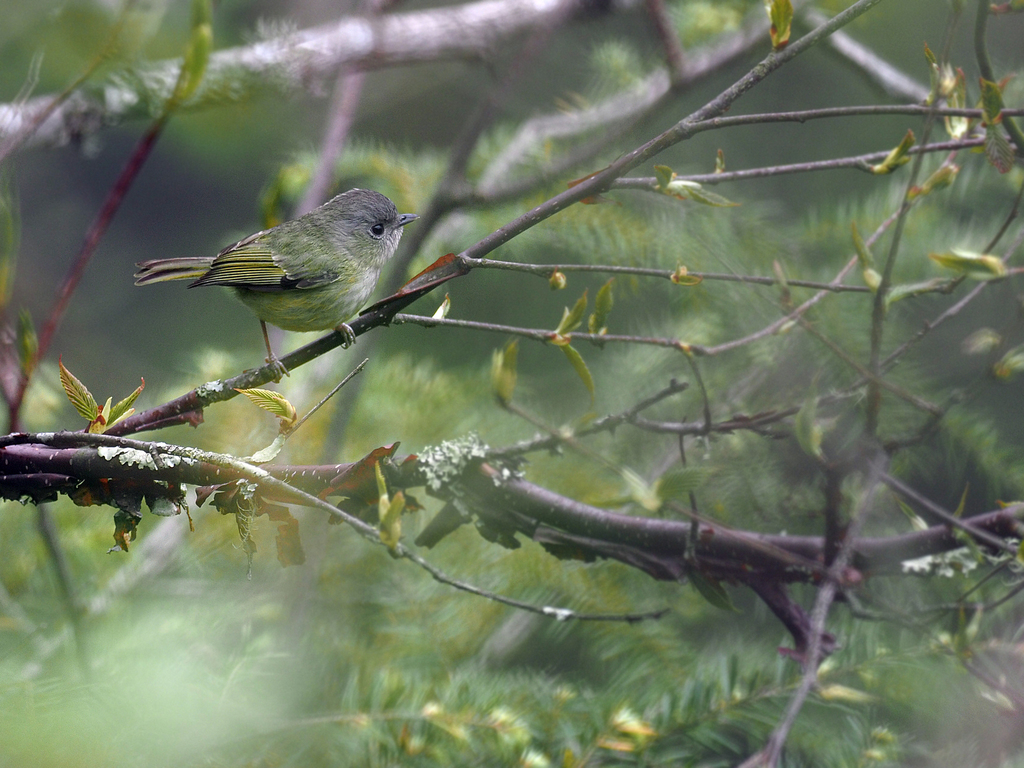
Green Shrike-babbler
Photo © James Eaton
Photo © James Eaton — CC0 1.0 — Source: iNaturalist #223305508Identification
The Green Shrike-babbler is a compact bird, measuring approximately 13 centimeters in length. Males are distinctively marked with a grey head and blackish crown, olive-green back, pale ashy-grey throat and breast, and a striking yellow belly. Females are slightly duller overall, with a greyish rather than blackish crown, making them useful field marks for distinguishing the sexes in the field.
Range & Habitat
This Asian species has a wide distribution across the eastern Himalayas and Southeast Asia, occurring in Bhutan, China, India, Myanmar, Nepal, Pakistan, and Vietnam. The Green Shrike-babbler favors subtropical and tropical moist montane forests, typically in deciduous and coniferous woodland between 2,100 and 3,000 meters elevation. During winter months, birds may descend to lower altitudes, and within India the species is particularly associated with the hill stations of Darjeeling, Sikkim, Uttarakhand, and Arunachal Pradesh.
Behaviour & Diet
An insectivorous forager, the Green Shrike-babbler hunts for ants, beetles, and other small invertebrates, supplementing its diet with berries and seeds. The breeding season peaks in May and June, with pairs constructing nests typically placed between three and eight meters above the ground in the forest canopy.
Best Time & Places to See It
Target montane forests during the breeding season (May and June) for the best chance of observation. The species is most reliably encountered at mid-elevation sites in Sikkim and Darjeeling, where sustained visits to appropriate habitat in deciduous and coniferous mixed forest will yield sightings. Winter visitors may find birds at lower altitudes than their typical range.
Photography Tips
The Green Shrike-babbler's small size and tendency to forage in mid-canopy foliage demand patience and a sturdy telephoto lens. Early morning light in montane forests will best reveal the subtle yellow belly and grey head coloring. Look for movement in flowering or fruiting trees where the species congregates seasonally, and consider that females' duller plumage may require slightly longer exposures than males for optimal results.
Langtang National Park
Helambu, Nepal
+364 birds+14 mammals
Where the southern slopes of the Himalayan highlands descend toward the subtropical valleys of central Nepal, Langtang National Park sprawls across one of the subcontinent's most…
VIEW NATIONAL PARKSagarmatha National Park
Khumjung, Nepal
+219 birds+7 mammals
Soaring peaks and deep glacial valleys define this alpine wilderness in northeastern Nepal, where the terrain rises from forested foothills into a realm of high-altitude tundra…
VIEW NATIONAL PARKKhangchendzonga National Park
Sakkyong, India
+290 birds+1 mammals
Where the eastern Himalayas surge toward their crowning peaks, Khangchendzonga National Park embraces a landscape of almost overwhelming vertical drama. Rising from subtropical river valleys into…
VIEW NATIONAL PARKWulingyuan
Jundiping, China
+97 birds+3 mammals
Sandstone peaks erupting from forested valleys define this sprawling 993-square-kilometre national park in Hunan Province, where vertical cliffs rise dramatically above lush subtropical woodland. The landscape—a…
VIEW NATURAL MONUMENTGiant Panda National Park
Mianyang, China
+447 birds+47 mammals
Where the eastern slopes of China's Sichuan plateau descend into cloud-wrapped valleys, one of Asia's most biodiverse landscapes unfolds across more than 350,000 square kilometres. This…
VIEW NATIONAL PARKNanda Devi National Park
Garpak, India
+218 birds+5 mammals
Where the Himalayas surge into their most dramatic alpine amphitheater, a wilderness of raw geological power unfolds across 624 square kilometers of pristine terrain. Nanda Devi,…
VIEW NATIONAL PARKWuyishan National Park
Yanshan County, China
+141 birds+2 mammals
Where subtropical monsoon rains sustain a perpetually humid landscape, Wuyishan National Park rises from Fujian's eastern plateau as a realm of forested ridges, cascading streams, and…
VIEW NATIONAL PARKWolong National Nature Reserve
Wenchuan County, China
+333 birds+17 mammals
Where the Qingyi River cuts through the eastern flanks of the Minshan Range, a temperate montane forest cloaks steep valleys in dense canopy that thins dramatically…
VIEW NATURE RESERVEGaoligong Mountain National Nature Reserve
Nujiang Lisu Autonomous Prefecture, China
+443 birds+13 mammals
VIEW NATURE RESERVEBaima Snow Mountain National Nature Reserve
Diqing Tibetan Autonomous Prefecture, China
+204 birds+3 mammals
High-altitude ridges and steep-sided valleys define this reserve in northwestern Yunnan, where elevations surge from around 3,000 metres to peaks above 4,100 metres. The terrain supports…
VIEW NATURE RESERVENo community photos yet. Log in to add the first one.
No community observations of this species yet.