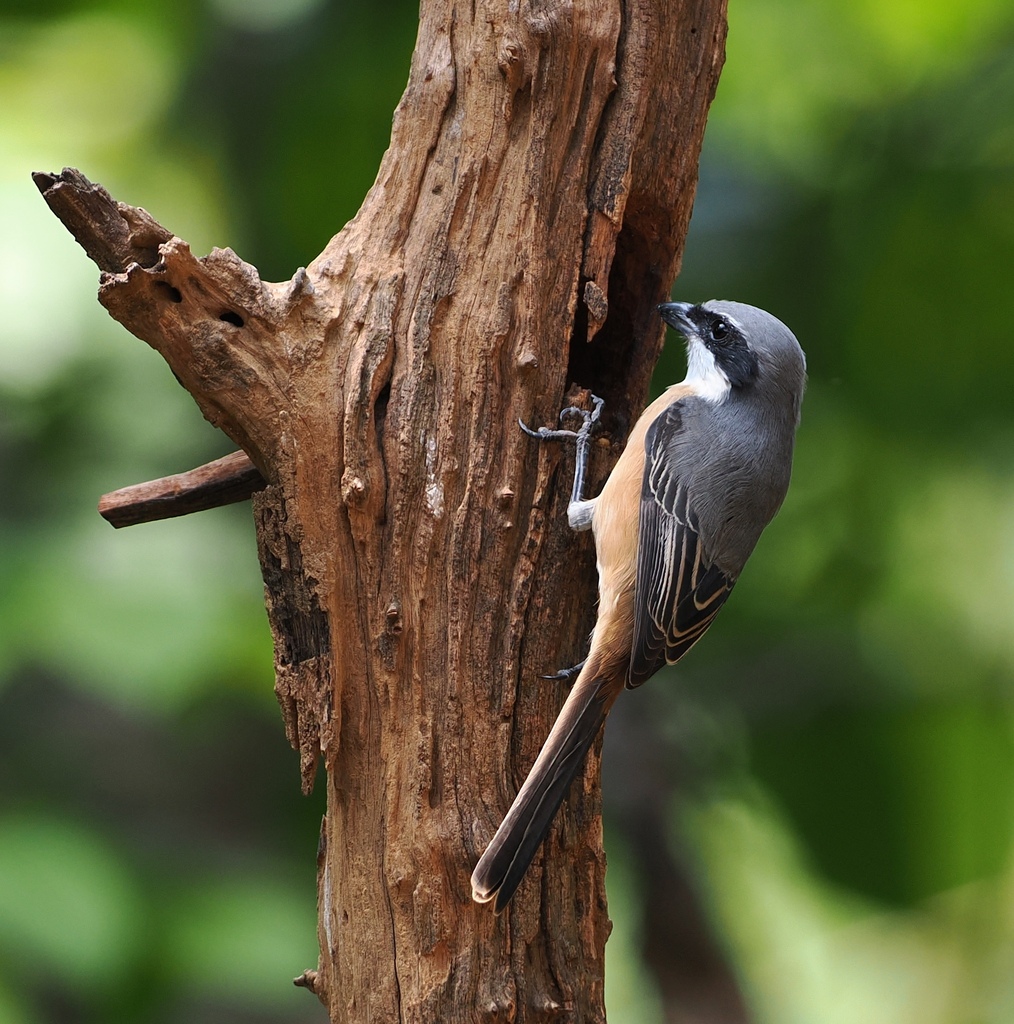
Grey-backed Shrike
Photo © desertnaturalist
Photo © desertnaturalist — CC BY 4.0 — Source: iNaturalist #290473164Identification
The grey-backed shrike is a medium-sized shrike measuring 21–25 cm long and weighing 39–54 g, characterized by its notably long tail. The nominate race displays a striking black facial mask extending from the lowermost forehead through the lores and eye to the rear ear-coverts, contrasting with a dark grey crown and upperparts. A small rufous rump patch provides a distinctive field mark, while the upperwing is black with pale rufous to whitish fringes on the wing-coverts, secondaries, and tertials. The tail is chestnut-brown with a buffish tip, and the throat and undertail are brownish-grey. The iris is dark brown, and the bill is black or dark green. Sexes are very similar in appearance. The paler subspecies lahulensis has a brownish-grey back, more visible white primary patch, and sometimes a blackish tail. Juveniles are browner overall with a less-marked facial mask and heavily barred plumage.
Range & Habitat
The grey-backed shrike inhabits South-east Asia across two subspecies. The nominate race breeds from Nepal east to northeast India and central and southern China, while the smaller race lahulensis breeds from north Kashmir to central India and southwest China. Post-breeding, birds range south to Bangladesh, Myanmar, Thailand, and Indochina. This species favours high-elevation habitats including forest clearings, plateau plains, and mountain meadows dotted with small trees or bushes, occurring from at least 2700 m upwards to 4500 m in Nepal and south China. On non-breeding grounds, they inhabit valleys and plains in gardens, abandoned cultivation, young coniferous stands, and pastures at various elevations.
Behaviour & Diet
Grey-backed shrikes are primarily sit-and-wait predators, perching atop high grasses, bushes, or trees while scanning for prey. They feed mainly on insects—moths, crickets, grasshoppers, beetles, and caterpillars—supplemented by small vertebrates including lizards, frogs, birds, and rodents. Like other shrikes, they characteristically impale prey and maintain larders. During breeding season, hunting remains concentrated within 150 metres of the nest. They breed between June and July in India and April to August in south China, nesting territorially at elevations of 4010–4540 m. Nests are bulky structures placed 0.7–3 m above ground in bushes or small trees. Clutches contain 3–6 eggs, with incubation lasting 15–18 days and nestlings fledging after 14–15 days of parental care from both sexes.
Best Time & Places to See It
The grey-backed shrike is best observed during the breeding season from June to July in Indian highlands and May to June in south China. Birdwatchers should focus on high-elevation habitats in Nepal, northeast India (particularly Arunachal Pradesh), and south China (especially Yunnan, Xizang, and surrounding regions) where the species frequents open plateaus, mountain meadows, and forest clearings. During winter months, lower-altitude locations become accessible as birds descend to foothills and plains across Bangladesh, Myanmar, and Thailand.
Photography Tips
Photographers should position themselves to capture the distinctive black facial mask and contrasting grey upperparts that define this species. The long tail and rufous rump patch are key field marks worth emphasising in images. Since grey-backed shrikes are sit-and-wait predators, patience near suitable perching sites—tall grasses, isolated bushes, and trees in open habitat—offers the best opportunities for action shots. Early morning light will best reveal the subtle plumage details and highlight the bird's characteristic upright posture when perching. In breeding habitat, photographing territorial males defending nests may yield dramatic behavioural sequences.
Langtang National Park
Helambu, Nepal
+364 birds+14 mammals
Where the southern slopes of the Himalayan highlands descend toward the subtropical valleys of central Nepal, Langtang National Park sprawls across one of the subcontinent's most…
VIEW NATIONAL PARKOrang National Park
Rangagarapathar, India
+298 birds+1 mammals
Where the Brahmaputra's floodplains meet the foothills of Assam, Orang National Park unfolds across a mosaic of riverine grasslands, forests and wetlands that pulse with the…
VIEW NATIONAL PARKGangotri National Park
Bhatwari, India
+119 birds+1 mammals
Where the Bhagirathi River carves through the western Himalayas in northern Uttarakhand, Gangotri National Park rises across steep alpine terrain that defines the boundary between temperate…
VIEW NATIONAL PARKSagarmatha National Park
Khumjung, Nepal
+219 birds+7 mammals
Soaring peaks and deep glacial valleys define this alpine wilderness in northeastern Nepal, where the terrain rises from forested foothills into a realm of high-altitude tundra…
VIEW NATIONAL PARKKhangchendzonga National Park
Sakkyong, India
+290 birds+1 mammals
Where the eastern Himalayas surge toward their crowning peaks, Khangchendzonga National Park embraces a landscape of almost overwhelming vertical drama. Rising from subtropical river valleys into…
VIEW NATIONAL PARKKhao Yai National Park
Prachantakham District, Thailand
+377 birds+46 mammals
Evergreen dipterocarp forest blankets the rolling terrain of this national park in eastern Thailand, where limestone hills rise abruptly from the forest floor and seasonal streams…
VIEW NATIONAL PARKKhao Laem National Park
Sangkhla Buri District, Thailand
+197 birds
Where the Vajiralongkorn Reservoir sprawls across the forested valleys of Kanchanaburi's northern borderlands, Khao Laem National Park protects a landscape where limestone ridges rise dramatically from…
VIEW NATIONAL PARKGiant Panda National Park
Mianyang, China
+447 birds+47 mammals
Where the eastern slopes of China's Sichuan plateau descend into cloud-wrapped valleys, one of Asia's most biodiverse landscapes unfolds across more than 350,000 square kilometres. This…
VIEW NATIONAL PARKJiuzhai Valley
Jiuzhaigou County, China
+226 birds+7 mammals
Where crystalline alpine streams cascade through limestone gorges and karst terrain rises in dramatic vertical walls, Jiuzhai Valley unfolds across nearly 1,300 square kilometers of southwestern…
VIEW NATURAL MONUMENTHuanglong Scenic and Historic Interest Area
Ngawa Tibetan and Qiang Autonomous Prefecture, China
+194 birds+7 mammals
Across the high plateau of northwestern Sichuan, a geological wonder unfolds where limestone terraces and mineral-rich springs have sculpted one of China's most distinctive natural monuments.…
VIEW NATURAL MONUMENTKaziranga National Park
Kohora, India
+422 birds+26 mammals
Dawn breaks over the floodplains of the Brahmaputra, where tall grasslands stretch endlessly beneath monsoon-heavy skies. This sprawling wilderness of northeastern Assam is a mosaic of…
VIEW NATIONAL PARKNanda Devi National Park
Garpak, India
+218 birds+5 mammals
Where the Himalayas surge into their most dramatic alpine amphitheater, a wilderness of raw geological power unfolds across 624 square kilometers of pristine terrain. Nanda Devi,…
VIEW NATIONAL PARKValley of Flowers National Park
Ghangaria, India
+117 birds+1 mammals
Where alpine meadows explode with color each monsoon season, the Himalayan slopes of Uttarakhand rise to create one of Earth's most extraordinary floral displays. Perched between…
VIEW NATIONAL PARKSanjiangyuan National Park
Nagqu, China
+187 birds+25 mammals
Where the headwaters of three great Asian rivers emerge from a high alpine plateau, the landscape unfolds in tundra and dwarf shrubland—a world of austere beauty…
VIEW NATIONAL PARKWolong National Nature Reserve
Wenchuan County, China
+333 birds+17 mammals
Where the Qingyi River cuts through the eastern flanks of the Minshan Range, a temperate montane forest cloaks steep valleys in dense canopy that thins dramatically…
VIEW NATURE RESERVEXishuangbanna National Nature Reserve
Xishuangbanna Dai Autonomous Prefecture, China
+173 birds+2 mammals
Where subtropical monsoon forests meet the margins of the Yunnan plateau, Xishuangbanna National Nature Reserve sprawls across a landscape of dramatic relief—deep river valleys carved by…
VIEW NATURE RESERVEGaoligong Mountain National Nature Reserve
Nujiang Lisu Autonomous Prefecture, China
+443 birds+13 mammals
VIEW NATURE RESERVEBaima Snow Mountain National Nature Reserve
Diqing Tibetan Autonomous Prefecture, China
+204 birds+3 mammals
High-altitude ridges and steep-sided valleys define this reserve in northwestern Yunnan, where elevations surge from around 3,000 metres to peaks above 4,100 metres. The terrain supports…
VIEW NATURE RESERVENo community photos yet. Log in to add the first one.
No community observations of this species yet.