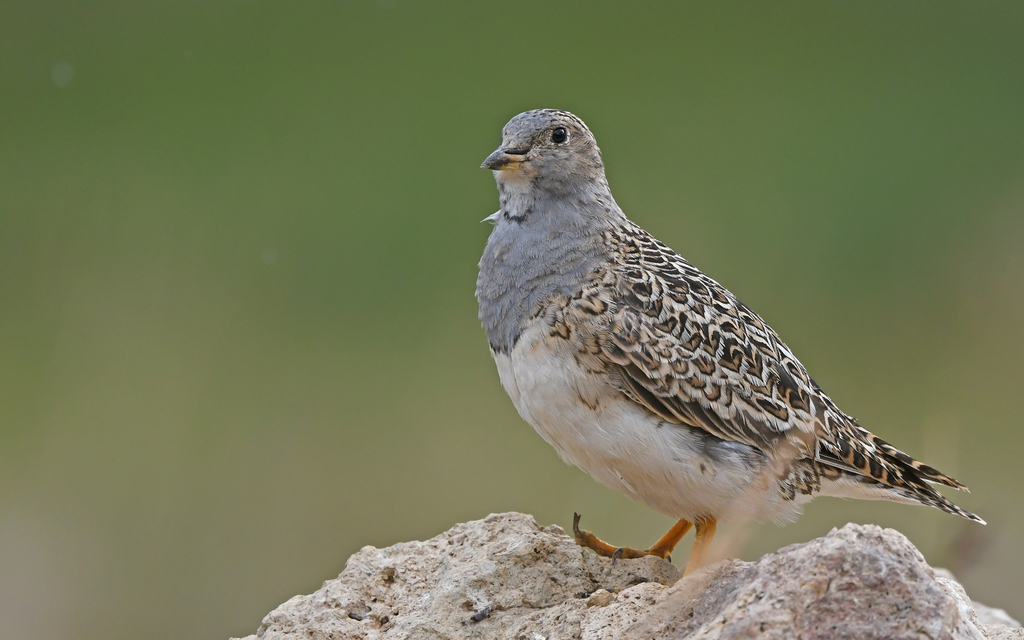
Grey-breasted Seedsnipe
Photo © Christoph Moning
Photo © Christoph Moning — CC BY 4.0 — Source: iNaturalist photo #382195512Identification
The grey-breasted seedsnipe is a small wader, measuring 19 to 24 cm in length and weighing 96 to 140 g. Males are distinctive with their grey head, neck, and upper breast, contrasting sharply with a white throat bordered in black. The upperparts display cinnamon-buff plumage in a vermiculate pattern, while white bars are visible on the wings in flight. The lower breast and belly are white, separated from the upper breast by a narrow black band. Females are more subtle, with pale buff heads and breasts heavily streaked with dark markings, making them less conspicuous in their grassland habitat.
Range & Habitat
This species is endemic to the Andes, occurring in Argentina, Bolivia, Chile, and Peru across two subspecies with slightly different ranges and wing proportions. The grey-breasted seedsnipe inhabits high-altitude puna grasslands, typically in areas with low matted vegetation or short grass adjacent to bogs. In Peru, it is common between 3,400 and 5,000 m elevation, while further south it mostly breeds above 1,000 m, though in Chilean Patagonia it may descend below 400 m in summer. The species is largely a year-round resident, though populations make seasonal altitudinal movements and withdraw northward from Tierra del Fuego during winter.
Behaviour & Diet
The grey-breasted seedsnipe is typically encountered singly or in small family groups, feeding primarily on the buds and leaves of herbs and succulent plants adapted to high-altitude environments. The breeding season extends from October to February, when birds place their nests in grass clumps or other low vegetation, usually positioned near water sources. They produce a distinctive clutch of four eggs. Vocally, the species is known for its repetitive, dove-like song described as "coocoop...coocoop...coocoop," delivered from the ground and during dusk and dawn display flights. When flushed, they produce a sharp, snipe-like "chrp" call.
Best Time & Places to See It
The grey-breasted seedsnipe is present year-round throughout most of its range, making it accessible to travellers across multiple seasons. The breeding season from October to February offers the best opportunities for observation, as birds are more active and vocal during display flights at dawn and dusk. Target high-altitude puna grasslands in Peru, Bolivia, Chile, and Argentina, particularly areas with characteristic low vegetation and proximity to wetlands. The species' large, remote range generally experiences minimal human disturbance, preserving suitable habitat for wildlife viewing.
Photography Tips
Photographing this small, cryptic species requires patience and attention to subtle habitat cues. Early morning and late afternoon visits to puna grasslands will increase your chances of encountering birds during their most vocal periods. Males are more visually striking than females and offer better photographic subjects with their distinctive grey and black markings. Use a telephoto lens to capture flight shots, which reveal the diagnostic white wing bars. Watch for the characteristic behaviour of birds feeding on low vegetation, and listen for their distinctive calls to locate individuals. The open puna habitat offers good visibility and natural lighting, though the high altitude demands acclimatization and proper preparation.
Full-day Birds of the desert
Nothing matches these filters.
Huascarán National Park
Lanín National Park
Lauca National Park
Los Cardones National Park
Monte León National Park
Parque Provincial Península de Magallanes
Patagonia National Park
Perito Moreno National Park
Reserva Nacional las Vicuñas
Nothing matches these filters.
No community photos yet. Log in to add the first one.
No community observations of this species yet.