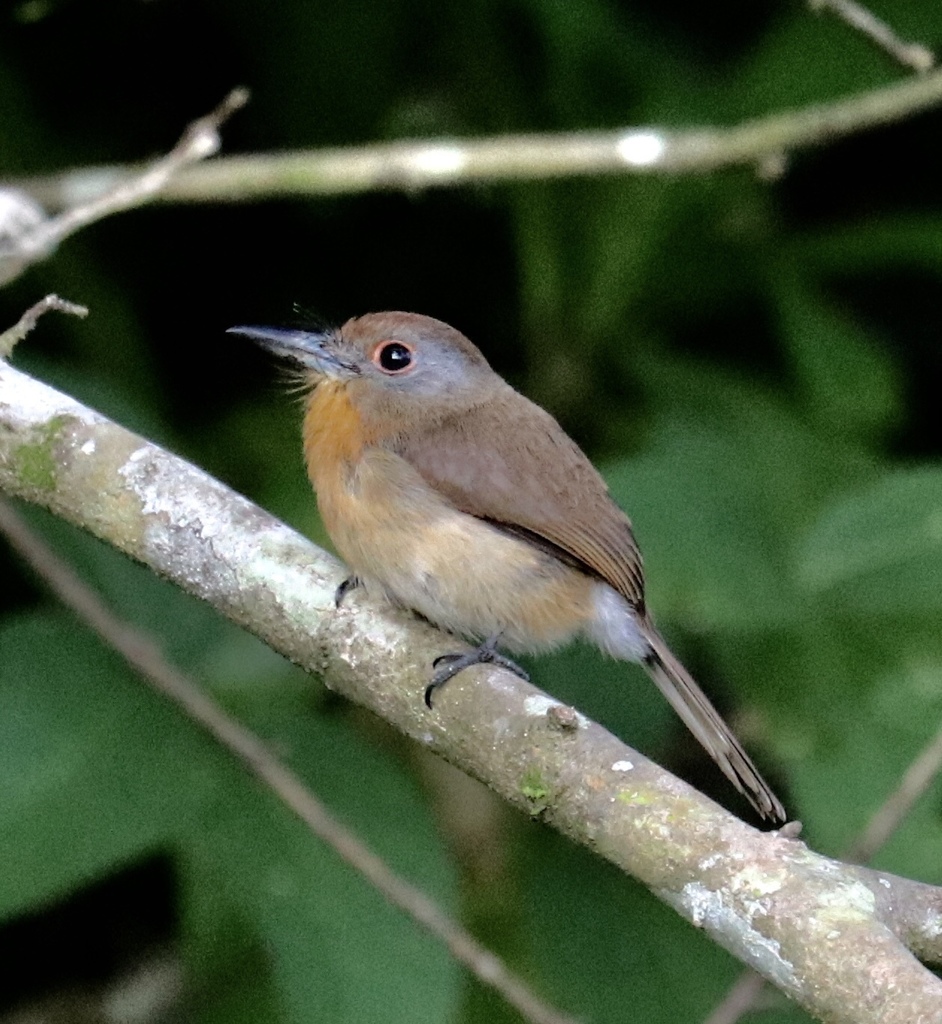
Grey-cheeked Nunlet
Photo © Aitor
Photo © Aitor — CC BY 4.0 — Source: iNaturalist photo #42303238Identification
The grey-cheeked nunlet is a small puffbird, measuring 14 to 15 cm in length and weighing between 14.5 and 19.5 grams. The nominate subspecies is characterized by a very dark chestnut crown and plain brown upperparts that lighten toward the rump. Its most distinctive feature is the predominantly gray face with a striking ring of bare red skin encircling the dark brown eye. The tail is dark brown, becoming almost black near the tip, while the chin, throat, breast, and flanks are rufous with a buffy belly. The bill is mostly blue-gray, and the feet are dull brown or greenish-gray. Other subspecies show regional variations: N. f. stulta has a darker tail and drabber rump, while N. f. pallescens displays much paler upperparts and a buff throat and breast.
Range & Habitat
The grey-cheeked nunlet has a somewhat restricted range extending from central Panama to north-central Colombia, with different subspecies occupying distinct regions. N. f. stulta inhabits central Panama and extreme northwestern Colombia, N. f. pallescens favors the Caribbean lowlands of northern Colombia, and the nominate subspecies is found in the interior of northern Colombia. The species shows a preference for moist to humid primary and secondary forests, gallery forests, thickets, and especially woodlands along rivers. It typically forages in the lower forest levels but may venture into the subcanopy, occurring from sea level to 1,000 meters in elevation.
Behaviour & Diet
While the grey-cheeked nunlet's specific feeding behavior remains poorly documented, it has been observed consuming a variety of arthropod prey and occasionally joins mixed-species foraging flocks. The species breeds from February to June in Colombia, though details of its breeding phenology are limited. Little is known about nesting in this genus, though related species like the rusty-breasted nunlet nest in shallow scrapes covered with twigs and leaves, typically laying clutches of four eggs. The grey-cheeked nunlet's distinctive song is a plaintive, measured series of up to 20 notes, rendered as "weeip weeip, weeip..."
Best Time & Places to See It
The breeding season from February to June is the most active period for observing and hearing this species, when males vocalize to defend territories. The species is considered uncommon to rare in Panama but fairly common in parts of Colombia. Birders should focus on moist forest habitats, particularly woodlands bordering rivers and streams in the lowlands and foothills of northwestern Colombia and central Panama. Early morning visits to suitable habitat offer the best chances of encountering this elusive puffbird, particularly when listening for its distinctive song.
Photography Tips
The grey-cheeked nunlet's small size and preference for lower forest levels present challenges for photographers. Its habit of remaining in shaded understory areas demands fast film speeds or high ISO settings and patience. The striking red eye-ring and contrasting facial pattern offer compelling subjects when adequate light can be achieved. Since the bird sometimes joins mixed-species flocks, following feeding parties may increase encounter rates. Early morning light filtering through the canopy can effectively highlight the distinctive facial markings and plumage colors that characterize this understory specialist.
General de División Omar Torrijos Herrera National Park
La Pintada, Panama
+401 birds+2 mammals
Across the highlands of central Panama, where the continental divide funnels moisture-laden trade winds into steep river valleys, the terrain rises and falls in a landscape…
VIEW NATIONAL PARKDarién National Park
Tucutí, Panama
+534 birds+13 mammals
Where the spine of Central America crumbles into wetland and rainforest, Darién National Park sprawls across more than 20,000 square kilometres of some of the tropics'…
VIEW NATIONAL PARKNo community photos yet. Log in to add the first one.
No community observations of this species yet.