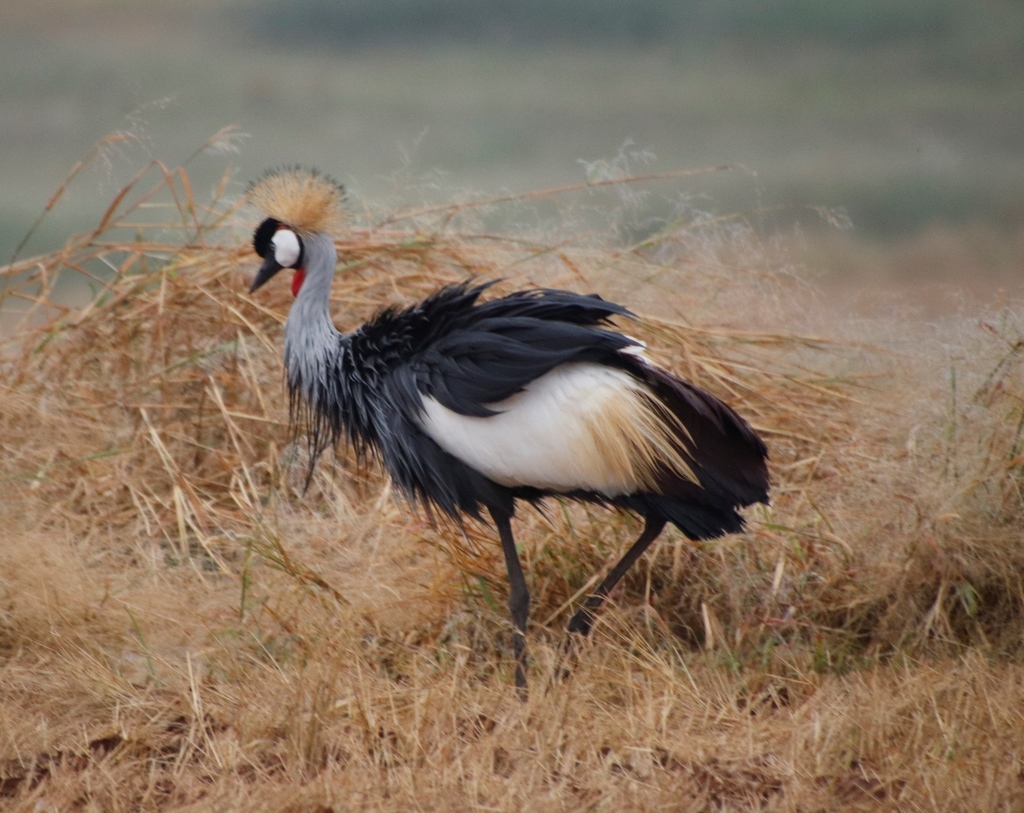
Grey Crowned Crane
Photo © Tony Rebelo
Photo © Tony Rebelo — CC BY-SA 4.0 — Source: iNaturalist #107195413Identification
The grey crowned crane is a striking large crane, standing approximately 1 metre (3 feet 3 inches) tall with a 2-metre wingspan and weighing around 3.5 kilograms (7.7 pounds). Its most distinctive feature is a crown of stiff golden feathers atop the head, complemented by white cheeks and a bright red inflatable throat pouch. The body plumage is predominantly grey, while the wings display a dramatic combination of white, dark grey, and dark red with golden-yellow patches. The bill is relatively short and grey, and the legs are black and notably long, providing excellent balance for wading through grassy terrain. Younger birds appear greyer than adults, with a buff-coloured feathered face. Males tend to be slightly larger than females. A unique characteristic sets crowned cranes apart from all other crane species: they possess a long hind toe that allows them to roost in trees—an ancestral trait lost in other crane species.
Range & Habitat
Native to Sub-Saharan Africa, the grey crowned crane occurs mainly in dry savannah environments, though it nests in somewhat wetter habitats. The species is found across marshes, cultivated lands, and grassy flatlands near rivers and lakes throughout Uganda, Kenya, and as far south as South Africa. Two subspecies exist: the East African crested crane (B. r. gibbericeps) in the eastern Democratic Republic of the Congo, Uganda, Kenya, and eastern South Africa, and the smaller South African crowned crane (B. r. regulorum) breeding from Angola southwards. Unlike many crane species, this bird has no set migration patterns; tropical populations are typically sedentary, while birds in more arid regions such as Namibia undertake localised seasonal movements during drier periods.
Behaviour & Diet
Grey crowned cranes are highly social birds, with flocks of 30–150 individuals not uncommon. They are renowned for their elaborate breeding display involving dancing, bowing, and jumping, performed by both adults and immature birds at any time of year. The species produces a distinctive booming call accompanied by inflation of the red throat sac, and makes honking sounds quite different from the trumpeting of other cranes. As omnivores, they consume plants, seeds, grain, insects, frogs, worms, snakes, small fish, and aquatic animal eggs. They characteristically stamp their feet while walking to flush out insects, which they catch and eat with rapid precision. The birds also benefit from associating with grazing herbivores such as antelopes and gazelles, catching prey items disturbed by these animals. They spend their entire day foraging, roosting in trees at night.
Best Time & Places to See It
The grey crowned crane can be encountered year-round across its range, though breeding timing varies geographically. In East Africa, breeding occurs throughout the year but most frequently during drier periods, while in Southern Africa it coincides with the rains. Uganda and Kenya offer particularly reliable viewing opportunities, as does South Africa. Look for these birds in dry savannahs and near wetland areas, marshes, and cultivated lands adjacent to rivers and lakes. Early morning and late afternoon often provide the best viewing opportunities, as the birds spend daylight hours actively foraging.
Photography Tips
The grey crowned crane's striking appearance—particularly its golden crown, white cheeks, and red throat pouch—presents excellent photographic subjects against savannah backdrops. Photograph birds during dawn or dusk when light is warm and directional, enhancing the subtle grey plumage and golden crown. Flocking behaviour provides opportunities for group compositions, while their elaborate dancing displays offer dynamic action shots. The contrast between the grey body and white wing patches creates strong visual impact. Access to wetland areas near trees increases chances of capturing roosting behaviour and the birds' unique tree-perching abilities, distinguishing them from other crane species. Patient observation near water sources and grasslands will reward photographers with intimate behavioural moments.
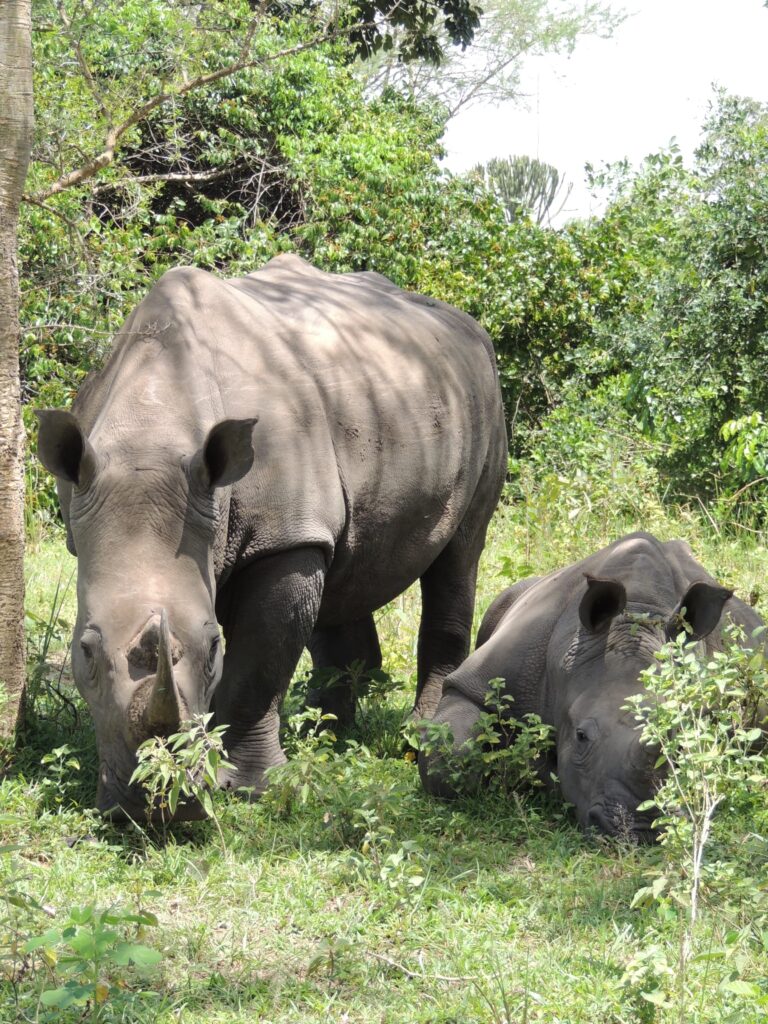
3 days safari to Murchison Falls via Ziwa
Serengeti National Park
Tanzania
+558 birds+57 mammals
Across Tanzania's northern plateau, where volcanic soils meet acacia woodland and open grassland, unfolds one of Earth's most dynamic ecosystems. The Serengeti National Park sprawls across…
VIEW NATIONAL PARKArusha National Park
Tanzania
+555 birds+16 mammals
Where the slopes of Mount Mawenzi rise above the Arusha region, a compact yet ecologically rich national park unfolds across montane forest, moorland, and alpine zones.…
VIEW NATIONAL PARKMapungubwe National Park
Musina Local Municipality, South Africa
+358 birds+29 mammals
Where the Limpopo River cuts through sandstone ridges at the convergence of South Africa, Botswana, and Zimbabwe, Mapungubwe National Park preserves a landscape of profound ecological…
VIEW NATIONAL PARKChobe National Park
Botswana
+446 birds+45 mammals
Where the Chobe River cuts a sinuous path through northern Botswana, the landscape transforms into one of Africa's most dynamic wetland-savanna mosaics. This national park encompasses…
VIEW NATIONAL PARKNxai Pan National Park
Botswana
+226 birds+16 mammals
Across the northwestern reaches of Botswana stretches a landscape of profound seasonal transformation—a sprawling pan system where shallow depressions fill and empty with the rains, creating…
VIEW NATIONAL PARKVirunga National Park
Uganda
+418 birds+13 mammals
Where the Western Rift Valley fractures the landscape of North Kivu, Virunga National Park sprawls across terrain as geologically dramatic as it is ecologically vital. Volcanic…
VIEW NATIONAL PARKBwindi Impenetrable National Park
Kanyashogi, Uganda
+603 birds+26 mammals
Steep ridges cloaked in montane forest rise from Uganda's southwestern borderlands, where the landscape grows so dense and tangled that early explorers named it impenetrable. At…
VIEW NATIONAL PARKKidepo Valley National Park
Uganda
+478 birds+24 mammals
Where the Narus and Kidepo rivers carve through northeastern Uganda's semi-arid lowlands, a landscape of sparse acacia woodland, grassland, and riverine thickets creates one of East…
VIEW NATIONAL PARKMurchison Falls National Park
Uganda
+608 birds+33 mammals
Where the Victoria Nile compresses through a narrow gorge and explodes across a 45-meter precipice, the landscape speaks in thunder. Murchison Falls National Park sprawls across…
VIEW NATIONAL PARKMgahinga Gorilla National Park
Cyanika, Uganda
+429 birds+6 mammals
Where the Virunga Mountains rise steeply from the Uganda–Rwanda–Democratic Republic of Congo frontier, montane forest cloaks the volcanic slopes in a dense, moisture-laden embrace. Mgahinga Gorilla…
VIEW NATIONAL PARKLake Mburo National Park
Uganda
+505 birds+24 mammals
Rolling acacia woodland and scattered lakes define this intimate savanna preserve in southwestern Uganda, where the rift valley's geological drama shapes every water source and grassland.…
VIEW NATIONAL PARKTsavo East National Park
Athi ward, Kenya
+468 birds+50 mammals
Across the semi-arid lowlands of southeastern Kenya, where acacia woodland fragments into scrubland and the landscape rolls toward the Indian Ocean horizon, lies one of Africa's…
VIEW NATIONAL PARKTsavo West National Park
Mwatate, Kenya
+513 birds+49 mammals
Where volcanic ridges and weathered lava flows meet the semi-arid lowlands of south-central Kenya, Tsavo West National Park unfolds across a landscape sculpted by fire and…
VIEW NATIONAL PARKMount Elgon National Park
Matumbei ward, Kenya
+164 birds+7 mammals
Where the volcanic slopes of Mount Elgon rise above the Trans-Nzoia landscape, a montane wilderness unfolds across multiple ecological zones, each harbouring distinct communities adapted to…
VIEW NATIONAL PARKAmboseli National Park
Etonet/Lenkism ward, Kenya
+501 birds+43 mammals
Where the Amboseli basin opens toward the Tanzanian frontier, a shallow alkaline lake mirrors vast skies across one of East Africa's most iconic savanna landscapes. The…
VIEW NATIONAL PARKMount-Kenya National Park
Abothuguchi west ward, Kenya
+334 birds+11 mammals
Where the slopes of Kenya's second-highest mountain rise steeply from the Meru County foothills, a landscape of profound ecological richness unfolds across Mount Kenya National Park.…
VIEW NATIONAL PARKTarangire National Park
Tanzania
+527 birds+50 mammals
Acacia woodland and grassland sweep across the Manyara Region where the Tarangire River carves through low hills and volcanic soils, creating one of East Africa's most…
VIEW NATIONAL PARKNgorongoro Conservation Area
Tanzania
+626 birds+55 mammals
Volcanic calderas and open grassland dominate this high plateau in northern Tanzania, where the landscape rises above 2,000 metres and ancient geological forces have shaped both…
VIEW WILDLIFE MANAGEMENT AREAToro-Semliki Proposed National Park
Uganda
+474 birds+5 mammals
Where the Albertine Rift's western escarpment rises above the Semliki River valley, a vast mosaic of forest, savanna and wetland converges to create one of East…
VIEW NATIONAL PARKQueen Elizabeth National Park
Uganda
+672 birds+30 mammals
Across the southwestern escarpment of Uganda, where the Western Rift Valley descends through ancient volcanic terrain, Queen Elizabeth National Park sprawls across more than 8,300 square…
VIEW NATIONAL PARKMabamba Swamp
Memere, Uganda
+464 birds+2 mammals
Across the Central Region of Uganda spreads one of Africa's most biodiverse freshwater wetlands, a sprawling nature reserve of roughly 283 square kilometres where papyrus swamps…
VIEW NATURE RESERVEKruger National Park
Ba-Phalaborwa Local Municipality, South Africa
+540 birds+91 mammals
Across the low-lying savanna of northeastern South Africa unfolds one of Africa's largest and most ecologically intact protected areas, where acacia woodlands merge into mopane scrub…
VIEW NATIONAL PARKSehlabathebe National Park
South Africa
+60 birds+1 mammals
Where the Drakensberg escarpment rises to meet the sky, Sehlabathebe National Park unfolds across a landscape of dramatic basalt cliffs, rolling alpine grassland, and crystal-clear mountain…
VIEW NATIONAL PARKZiwa Rhino and Wildlife Ranch
Nakasongola, Uganda
+359 birds+11 mammals
Where papyrus wetlands merge into sprawling savanna, Uganda's central landscape opens into one of East Africa's most vital rhino recovery zones. Ziwa Rhino and Wildlife Ranch…
VIEW WILDLIFE SANCTUARYMakgadikgadi Pans National Park
Gucta, Botswana
+272 birds+27 mammals
Where salt-crusted flatlands stretch endlessly toward a shimmering horizon, one of Africa's most extraordinary ecosystems awakens with the rains. The Makgadikgadi Pans comprise vast mineral-rich basins…
VIEW NATIONAL PARKNairobi National Park
Nairobi, Kenya
+515 birds+35 mammals
Just minutes from Kenya's capital, where the Nairobi River winds through acacia woodland and open grassland, lies one of Africa's most paradoxical wildlife sanctuaries. The park's…
VIEW NATIONAL PARKLake Nakuru National Park
Nakuru West, Kenya
+494 birds+32 mammals
Alkaline waters ringed by acacia woodland and grassland create one of East Africa's most distinctive wetland ecosystems, where the interplay of geology and climate sustains a…
VIEW NATIONAL PARKAberdare National Park
Mweiga ward, Kenya
+394 birds+30 mammals
Where the central highlands of Kenya rise to their elemental grandeur, the Aberdare range unfolds across Nyeri County as a montane stronghold of cool, misty forest…
VIEW NATIONAL PARKSamburu National Reserve
Samburu, Kenya
+430 birds+42 mammals
Across the arid plains of northern Kenya, where scattered acacia woodland gives way to rocky outcrops and dry riverbeds, Samburu National Park unfolds as one of…
VIEW NATURE RESERVEHell’s Gate National Park
Olkaria ward, Kenya
+388 birds+18 mammals
Volcanic scarps and geothermal vents dominate the floor of Hell's Gate, where the East African Rift has carved a dramatic gorge through crystalline rock formations. The…
VIEW NATIONAL PARKSaiwa Swamp National Park
Sinyerere ward, Kenya
+255 birds+4 mammals
Where papyrus and sedge marshes stretch across a highland plateau in western Kenya, Saiwa Swamp National Park shelters one of East Africa's most productive freshwater wetland…
VIEW NATIONAL PARKChyulu Hills National Park
Kibwezi East, Kenya
+232 birds+30 mammals
Volcanic cones rise abruptly from the Kenyan savanna floor, their flanks clothed in dense acacia woodland and grassland that transforms the Chyulu Hills into an ecological…
VIEW NATIONAL PARKNo community photos yet. Log in to add the first one.