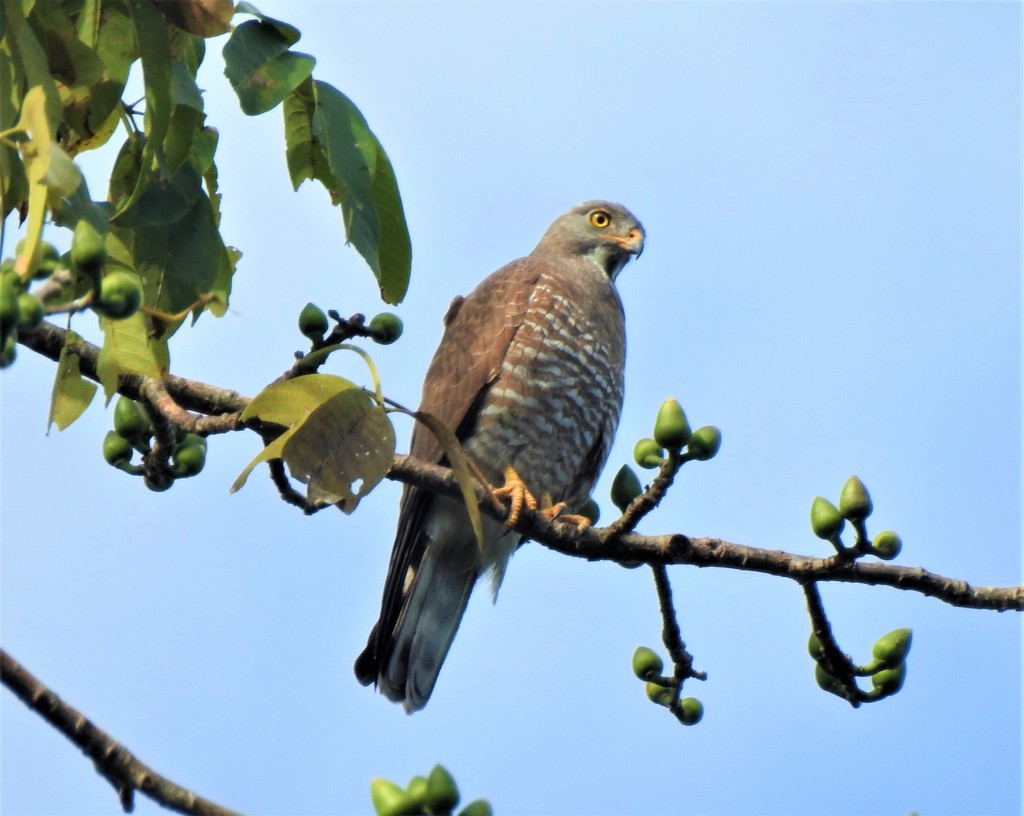
Grey-faced Buzzard
Photo © Pauline Carmel Joy Eje
Photo © Pauline Carmel Joy Eje — CC BY 4.0 — Source: iNaturalist #39266005Identification
The grey-faced buzzard is a small raptor, typically 41–46 cm (16–18 in) in length. Adults are distinctive, with a grey head, breast and neck contrasting against a white throat, black moustaches and facial stripes, brown back and upperwings, and brown bars on white underparts and underwings. Males and females are identical in coloration. The wings are pointed and narrow with thin, translucent-looking feathers in flight. The tail is ashy brown with horizontal barring, and the iris is bright yellow. Juveniles are less distinctive, showing brown and mottled plumage above, pale underparts with brown streaks, a broad white supercilium, and brown face markings.
Range & Habitat
The grey-faced buzzard breeds across Manchuria, Korea and Japan, with the majority found in Japan, particularly in Satoyama—a landscape of diverse habitats including woodlands, paddy-fields, streams and grasslands. In its breeding range, it inhabits coniferous and mixed evergreen forests in mountains, forest edges, fields, meadows, marshes and agricultural lands. The species winters in South-east Asia, particularly Indochina, Malaysia and the Philippines. Taiwan lies on a major migration route, where large numbers pass through in spring and autumn, with some individuals overwintering on Lanyu Island.
Behaviour & Diet
During breeding season, males spend up to 90% of their day perched and searching for prey, typically hunting from a perch about 500 metres from the nest. They employ a search-and-ambush hunting strategy from trees and utility poles overlooking open habitats such as rice fields and clearings. The species feeds on lizards, small mammals, large insects, frogs, crustaceans and occasionally other birds. Diet varies seasonally and by foraging location: in paddy fields, frogs and small mammals predominate; in levees and grass-arable fields, a diverse range including snakes is taken; in woodlands, insects and frogs are favoured.
Best Time & Places to See It
Grey-faced buzzards arrive in their Japanese breeding grounds from late March to early April and depart on autumn migration from late September to mid-October. Taiwan offers excellent viewing opportunities along the Hengchun Peninsula in October, when large numbers migrate southward, and in late March and early April along the terraced mountains of Taichung and Changhua, when birds move northward. The species is a common spring and summer migrant throughout Taiwan. Satoyama habitat in Japan is particularly productive during the breeding season.
Photography Tips
Photograph perched birds during midday when males are actively hunting—look for them on exposed perches near open fields and paddy-fields. The yellow iris and facial markings are distinctive field marks worth capturing in detail. During migration, position yourself along known flyways such as Taiwan's Hengchun Peninsula or mountain passes in Taichung and Changhua for flight shots. The pointed, narrow wings and translucent feathers are striking in-flight characteristics best photographed against clear skies. Early morning and late afternoon light will enhance the grey head and rich brown upperparts.
Hat Noppharat Thara-Mu Ko Phi Phi National Park
Ao Nang, Thailand
+253 birds+9 mammals
Where limestone karsts rise dramatically from turquoise waters, Hat Noppharat Thara-Mu Ko Phi Phi National Park unfolds across a mosaic of beach, mangrove forest, and island…
VIEW NATIONAL PARKKhao Yai National Park
Prachantakham District, Thailand
+377 birds+46 mammals
Evergreen dipterocarp forest blankets the rolling terrain of this national park in eastern Thailand, where limestone hills rise abruptly from the forest floor and seasonal streams…
VIEW NATIONAL PARKMu Ko Similan National Park
Lam Kaen, Thailand
+82 birds+1 mammals
Granite islands rise from the Andaman Sea in a scattered archipelago where limestone cliffs meet turquoise shallows, their steep faces weathered into caves and overhangs that…
VIEW NATIONAL PARKKhao Laem Ya-Mu Ko Samet National Park
Mueang Rayong District, Thailand
+159 birds+3 mammals
Where limestone hills meet the Gulf of Thailand, Khao Laem Ya–Mu Ko Samet National Park stitches together a mosaic of terrestrial and marine worlds that few…
VIEW NATIONAL PARKGiant Panda National Park
Mianyang, China
+447 birds+47 mammals
Where the eastern slopes of China's Sichuan plateau descend into cloud-wrapped valleys, one of Asia's most biodiverse landscapes unfolds across more than 350,000 square kilometres. This…
VIEW NATIONAL PARKTaman Negara National Park
Kampong Samas, Malaysia
+393 birds+48 mammals
Where ancient rainforest meets limestone peaks, one of Southeast Asia's oldest protected wilderness preserves sprawls across 4,343 square kilometers of primordial landscape. Dipterocarp giants tower overhead,…
VIEW NATIONAL PARKPenang National Park
Balik Pulau, Malaysia
+107 birds+2 mammals
Granite peaks rise abruptly from the Andaman Sea where tropical rainforest clings to steep slopes in one of Malaysia's oldest protected landscapes. Mangrove forests fringe the…
VIEW NATIONAL PARKWest Bali National Park
Gerokgak, Indonesia
+240 birds+8 mammals
Across West Bali's northwestern reaches, where the Indian Ocean meets volcanic slopes and limestone cliffs plunge toward turquoise shallows, sprawls a protected realm of roughly 325…
VIEW NATIONAL PARKAketajawe Lolobata National Park
Oba Tengah, Indonesia
+123 birds+2 mammals
Across the northeastern arm of Halmahera, where the Wallace Line once marked the boundary between Asian and Australasian fauna, lies a sprawling wilderness of over 13,800…
VIEW NATIONAL PARKLore Lindu National Park
Indonesia
+177 birds+4 mammals
Across the mountainous spine of Central Sulawesi spreads a wilderness of montane forest, rolling ridges, and deep valleys that rises from the island's volcanic bedrock to…
VIEW NATIONAL PARKLand of the Leopard National Park
Khasansky District, Russia
+83 birds+11 mammals
Where coniferous and mixed forests sweep across the rolling terrain of Russia's Far East, Land of the Leopard National Park embraces a landscape shaped by the…
VIEW NATIONAL PARKNortheast China Tiger and Leopard National Park
Mu Dan Jiang Shi, China
+202 birds+19 mammals
Across the temperate forests of northeastern China, where winters grip the landscape in subzero silence and summers remain cool and brief, the Mudanjiang region supports a…
VIEW NATIONAL PARKHainan Tropical Rainforest National Park
Haikou, China
+69 birds+1 mammals
Tropical forests blanket the volcanic slopes of central Hainan, where moisture-laden winds from the South China Sea collide with mountainous terrain to create some of China's…
VIEW NATIONAL PARKWuyishan National Park
Yanshan County, China
+141 birds+2 mammals
Where subtropical monsoon rains sustain a perpetually humid landscape, Wuyishan National Park rises from Fujian's eastern plateau as a realm of forested ridges, cascading streams, and…
VIEW NATIONAL PARKWolong National Nature Reserve
Wenchuan County, China
+333 birds+17 mammals
Where the Qingyi River cuts through the eastern flanks of the Minshan Range, a temperate montane forest cloaks steep valleys in dense canopy that thins dramatically…
VIEW NATURE RESERVENo community photos yet. Log in to add the first one.
No community observations of this species yet.