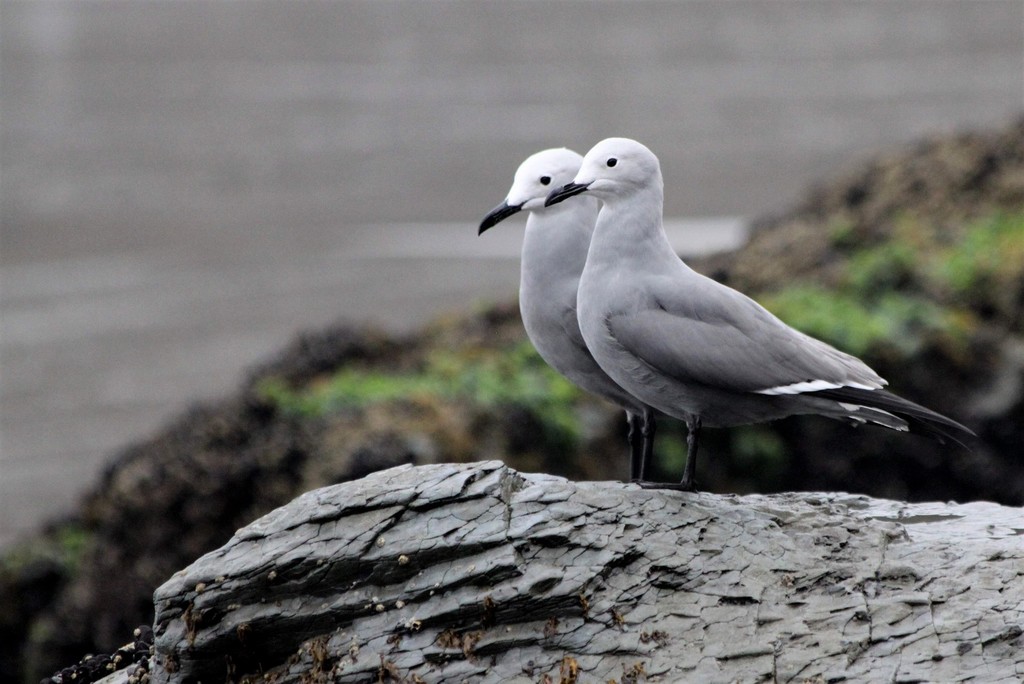
Identification
The grey gull is a medium-sized gull, growing to about 45 cm (18 in) in length and weighing 360 to 400 g (13 to 14 oz). The sexes are similar in appearance. Adults display a striking seasonal change: the head is white during summer but becomes brownish-grey in winter. The body and wings are grey overall, with the dorsal surface noticeably darker than the pale ventral region. In flight, the black flight feathers are distinctive, with white tips visible on the inner primaries and secondaries. The tail features a black band edged with white. The legs and beak are black, and the iris is brown. The grey gull's call resembles that of the laughing gull.
Range & Habitat
This South American gull has an unusual and split distribution. It breeds inland in the extremely dry Atacama Desert in northern Chile, a remarkable adaptation among gulls. The non-breeding range extends along much of the Pacific coast, including Costa Rica, Colombia, Ecuador, Peru and Chile, with records from the Falkland Islands, South Georgia and the South Sandwich Islands. The species is occasionally reported as a vagrant to Panama and Florida.
Outside the breeding season, the grey gull favours sandy beaches and mudflats along the western coasts of South America. The breeding sites are located in waterless regions of the Atacama Desert, some 35 to 100 km (22 to 62 mi) inland from the coast.
Behaviour & Diet
The grey gull's breeding ecology is remarkable. For many years, the location of breeding colonies remained a mystery until 1945, when populations were discovered nesting in the Atacama Desert's harsh interior. The birds construct simple nests—scrapes in the sand, often near rocks—in an environment with few predators. Once eggs hatch, parents alternate in making round trips to the sea to bring food and water to their chicks, an extraordinary commitment given the vast distances involved. To cope with the desert's extreme conditions, the gulls employ various thermoregulatory mechanisms; during the hottest parts of the day, parents stand over nests to prevent overheating. The eggs possess impervious shells that reduce water loss through evaporation to about one-third that of Heermann's gull, another desert-nesting species. Turkey vultures are their chief predator.
Along the coast, grey gulls probe in sand and mudflats with their beaks, searching for invertebrate prey—particularly mole crabs—as well as fish and ragworms. They also scavenge for offal and follow fishing boats opportunistically.
Best Time & Places to See It
Grey gulls are present year-round along the Pacific coasts of Ecuador, Peru and Chile, making these regions the most reliable locations for observation. Sandy beaches and mudflats are the prime habitats for viewing outside the breeding season. The inland Atacama Desert breeding sites in northern Chile are remote and difficult to access, but serious birdwatchers interested in this species' remarkable breeding behaviour may attempt visits during the breeding season.
Photography Tips
The seasonal plumage change offers excellent photography opportunities; shooting the same individuals during summer and winter can capture the dramatic difference between white and brownish-grey heads. The white-tipped flight feathers are best photographed in flight. The species' habit of probing along beaches and mudflats provides chances for natural behavioural photography. Given the population's downward trend, patient, non-intrusive documentation is important for conservation records.
Parque Nacional de Galápagos
Santo Tomás, Ecuador
+139 birds+23 mammals
Volcanic peaks and weathered lava fields dominate this remote archipelago in the Pacific, where the interplay of cold ocean currents and tropical latitude creates an ecological…
VIEW ISLAND & ARCHIPELAGOChiloé National Park
Dalcahue, Chile
+122 birds+6 mammals
Temperate rainforest cloaks the Chiloé archipelago's northwestern reaches, where granite ridges thrust through dense, moisture-laden canopy and freshwater streams carve ravines toward the Pacific. Across approximately…
VIEW NATIONAL PARKPan de Azúcar National Park
Chañaral, Chile
+74 birds+4 mammals
Where the Atacama Desert plunges toward the Pacific, Pan de Azúcar National Park sprawls across 727 square kilometres of one of Earth's most extreme transitions—a landscape…
VIEW NATIONAL PARKNo community photos yet. Log in to add the first one.
No community observations of this species yet.