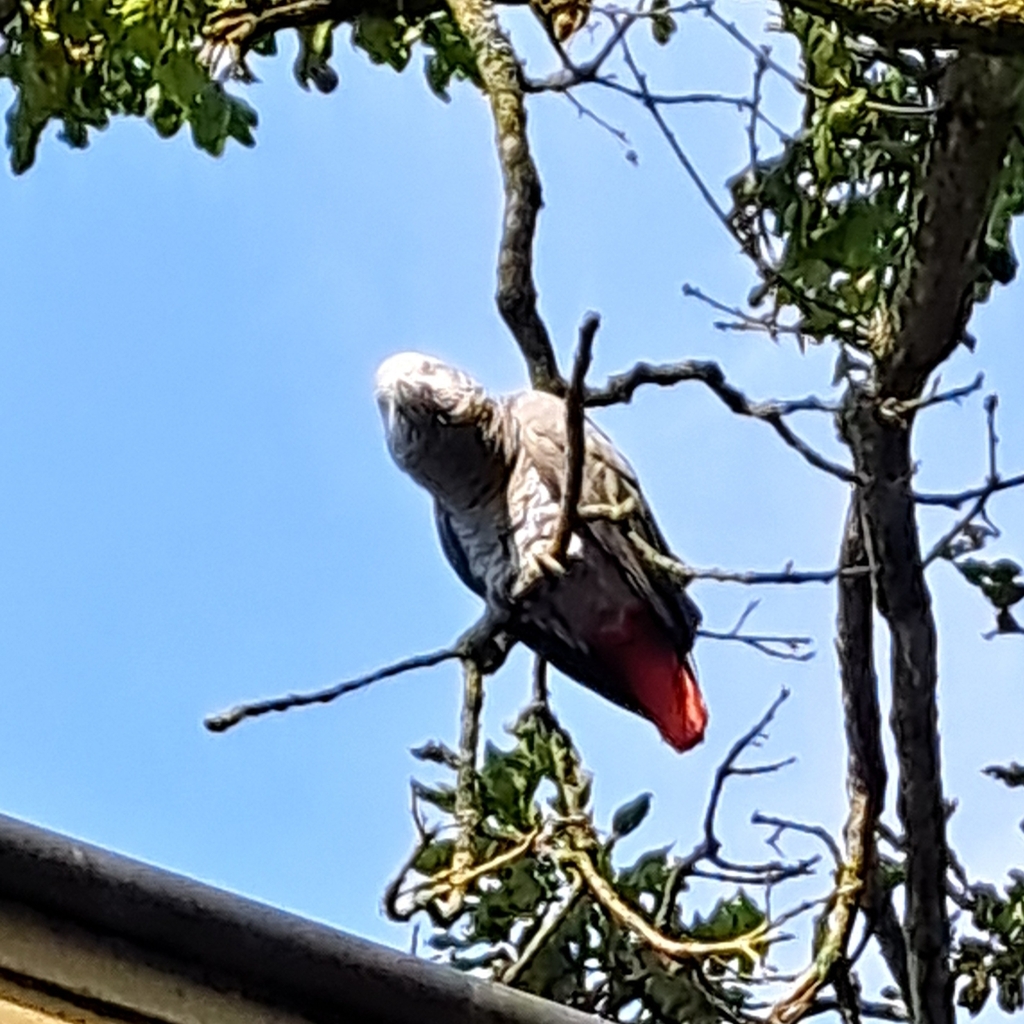
Grey Parrot
Photo © Daniel Onneweer
Photo © Daniel Onneweer — CC BY 4.0 — Source: iNaturalist #242684665Identification
The grey parrot is a medium to large African parrot, predominantly grey in plumage with distinctive features that make it unmistakable in the field. Adults typically weigh 418–526 grams and measure approximately 33 centimetres in length, with a wingspan of 46–52 centimetres. The head and wings are noticeably darker than the body, while the most striking feature is the bright red tail with occasional black markings. The bird has a black bill and, crucially for field identification, yellow irises around dark pupils—a key distinction from juveniles, which possess dark grey to black eyes and grey-tinged undertail coverts.
Both males and females appear virtually identical in plumage. The head and body feathers display subtle white edges, giving the bird a slightly textured appearance. Juvenile grey parrots resemble adults but lack the characteristic yellow eye-ring, making age determination possible for attentive observers.
Range & Habitat
The grey parrot is native to equatorial Africa, with its range extending from Kenya in the east to Ivory Coast in the west, encompassing countries including Angola, Cameroon, the Congo, Gabon, Ghana, and Uganda. The species favours dense forests but demonstrates habitat flexibility, also inhabiting forest edges, gallery forests, and savanna woodlands. Current global population estimates remain uncertain, ranging from 630,000 to 13 million birds, though populations are declining worldwide.
Populations vary significantly by region. Ghana has experienced catastrophic declines, with numbers falling 90–99% since 1992 following habitat loss and intensive trapping for the pet trade. Cameroon supports apparently stable populations, while the Congo continues to experience heavy harvesting pressure, with an estimated 15,000 birds taken annually for trade despite official quotas.
Behaviour & Diet
Grey parrots are remarkably vocal and intelligent birds with extensive sound-mimicry abilities in the wild. Recordings from the Democratic Republic of the Congo documented individuals with repertoires exceeding 200 different calls, including imitations of other bird species and even bat sounds. Despite their conspicuousness in captivity, wild grey parrots possess secretive personalities, making them challenging to study in their natural habitat.
The species is primarily frugivorous, feeding mainly on fruits, nuts, seeds, and oil palm fruit, with occasional consumption of flowers, tree bark, insects, and snails. Notably, grey parrots forage partly on the ground. Breeding birds are monogamous, nesting in tree cavities where each pair requires an individual tree. Females incubate 3–5 eggs for 30 days while fed by their mates, and fledged young remain dependent on parental care for 4–5 weeks after leaving the nest at 12 weeks of age.
Best Time & Places to See It
Observing wild grey parrots presents significant challenges due to habitat loss and declining populations across much of their range. Cameroon represents the most reliable location for encounters, given stable populations there. However, travellers should be aware that populations have been virtually eliminated from Ghana and are severely depleted throughout much of West and Central Africa due to deforestation and illegal trapping for the pet trade.
Forest habitats, particularly dense forests and gallery forests, offer the best prospects. Early morning hours often provide the best opportunities, as parrots are most active during feeding periods. Patience and quiet observation are essential, as these birds' naturally secretive behaviour and status as prey animals make them wary and difficult to approach.
Photography Tips
The grey parrot's striking plumage—particularly the brilliant red tail contrasting against grey and black—presents excellent photographic potential, though obtaining images requires patience and skill. The bird's wariness demands a telephoto lens of at least 400–600 millimetres to maintain distance while capturing detail. Early morning light is ideal for rendering the subtle white-edged feathering and capturing the characteristic yellow eye-ring that distinguishes adults from juveniles.
Forest canopy settings present challenges for lighting and composition. Positioning yourself near fruiting trees or known roost sites at dawn increases encounter probability. The bird's tendency to remain partially concealed within foliage necessitates a fast shutter speed to freeze movement and ensure sharp images despite dappled light conditions. Silhouettes of the distinctive tail shape make for compelling compositional opportunities when backlighting is available.
Rubondo Island National Park
Tanzania
+99 birds+8 mammals
Across the waters of Lake Victoria's northeastern arm, Rubondo Island rises as a freshwater wilderness where papyrus swamps grade into acacia woodlands and dense thickets of…
VIEW NATIONAL PARKVirunga National Park
Uganda
+418 birds+13 mammals
Where the Western Rift Valley fractures the landscape of North Kivu, Virunga National Park sprawls across terrain as geologically dramatic as it is ecologically vital. Volcanic…
VIEW NATIONAL PARKBwindi Impenetrable National Park
Kanyashogi, Uganda
+603 birds+26 mammals
Steep ridges cloaked in montane forest rise from Uganda's southwestern borderlands, where the landscape grows so dense and tangled that early explorers named it impenetrable. At…
VIEW NATIONAL PARKMurchison Falls National Park
Uganda
+608 birds+33 mammals
Where the Victoria Nile compresses through a narrow gorge and explodes across a 45-meter precipice, the landscape speaks in thunder. Murchison Falls National Park sprawls across…
VIEW NATIONAL PARKLake Mburo National Park
Uganda
+505 birds+24 mammals
Rolling acacia woodland and scattered lakes define this intimate savanna preserve in southwestern Uganda, where the rift valley's geological drama shapes every water source and grassland.…
VIEW NATIONAL PARKToro-Semliki Proposed National Park
Uganda
+474 birds+5 mammals
Where the Albertine Rift's western escarpment rises above the Semliki River valley, a vast mosaic of forest, savanna and wetland converges to create one of East…
VIEW NATIONAL PARKQueen Elizabeth National Park
Uganda
+672 birds+30 mammals
Across the southwestern escarpment of Uganda, where the Western Rift Valley descends through ancient volcanic terrain, Queen Elizabeth National Park sprawls across more than 8,300 square…
VIEW NATIONAL PARKMabamba Swamp
Memere, Uganda
+464 birds+2 mammals
Across the Central Region of Uganda spreads one of Africa's most biodiverse freshwater wetlands, a sprawling nature reserve of roughly 283 square kilometres where papyrus swamps…
VIEW NATURE RESERVECamargue Regional Nature Park
Saintes-Maries-de-la-Mer, France
+378 birds+48 mammals
Where the Rhône Delta sprawls into the Mediterranean, a landscape of stark and haunting beauty emerges—vast salt marshes punctuated by shallow lagoons, reed beds, and scrubland…
VIEW NATURAL PARKZiwa Rhino and Wildlife Ranch
Nakasongola, Uganda
+359 birds+11 mammals
Where papyrus wetlands merge into sprawling savanna, Uganda's central landscape opens into one of East Africa's most vital rhino recovery zones. Ziwa Rhino and Wildlife Ranch…
VIEW WILDLIFE SANCTUARYNo community photos yet. Log in to add the first one.
No community observations of this species yet.