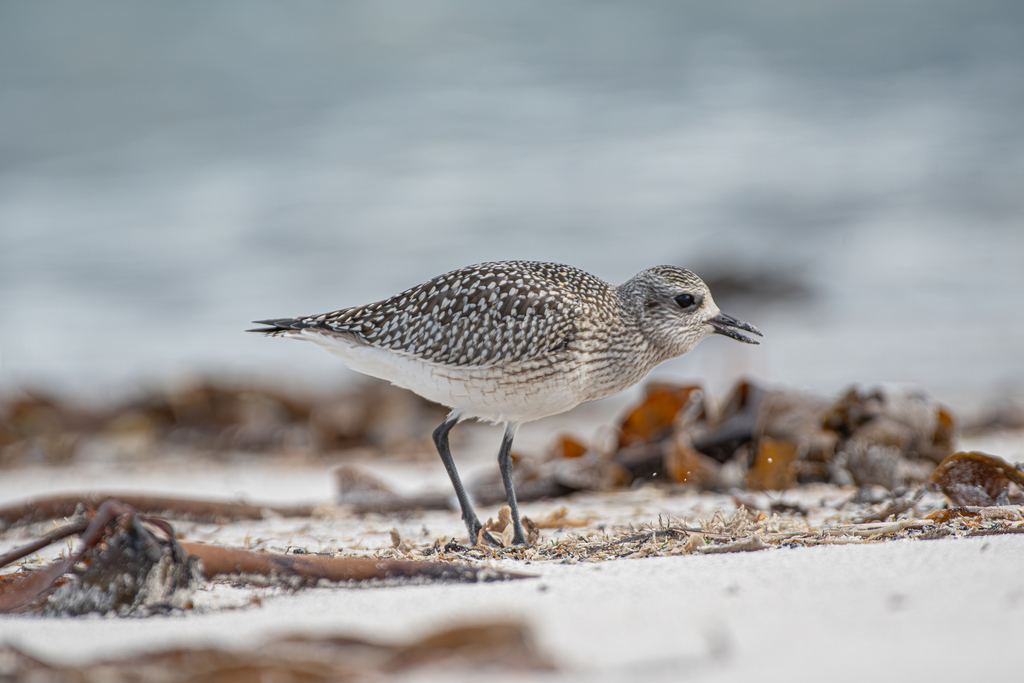
Grey Plover
Photo © Rafael Würtemberger
Photo © Rafael Würtemberger — CC BY 4.0 — Source: iNaturalist photo #294808336Identification
The grey plover is a large, robust plover measuring 27–30 cm in length with a wingspan of 71–83 cm. In breeding plumage (late April or May through August), it is unmistakable: adults display striking black and white spotting on the back and wings, with a black face, neck, breast and belly contrasted sharply by white borders and rump. The tail is white with black barring, and the bill and legs are black. In winter, the plumage becomes much plainer, with grey tones replacing the bold black and white pattern, though the breast retains grey speckles above a white belly.
In flight, the grey plover is readily distinguished from its three close relatives in the genus Pluvialis by distinctive black inner flanks and axillary feathers at the base of the underwing. On the ground, its larger and heavier bill (24–34 mm) separates it from other Pluvialis species. Juveniles and first-winter birds resemble adult winter plumage but feature blacker back feathers with creamy white edging.
Range & Habitat
The grey plover is a long-distance migrant with a nearly worldwide coastal distribution outside the breeding season. It breeds across Arctic islands and coastal areas of Alaska, Canada, and Russia, nesting on the ground in dry, open tundra with good visibility. Three subspecies are recognized, with populations breeding in north Eurasia and Alaska, on Wrangel Island in northeast Siberia, and in northern Canada.
Wintering birds are found throughout coastal regions globally: in the New World from southwest British Columbia and Massachusetts south to Argentina and Chile; in the western Old World from Ireland and southwestern Norway through coastal Africa to South Africa; and in the eastern Old World from southern Japan through coastal Asia and Australia, with occasional records reaching New Zealand. The species makes regular non-stop transcontinental flights but is mostly rare inland, appearing on continental interiors only when forced down by severe weather or occasionally feeding at large lakes such as the Great Lakes, where it is a common passage migrant.
Behaviour & Diet
Grey plovers forage for food on beaches and tidal flats, typically using sight to locate prey. Their diet consists of small molluscs, polychaete worms, crustaceans, and insects. Unlike other Pluvialis species, grey plovers are less gregarious and do not form dense feeding flocks; instead, they spread out widely over beaches with birds well spaced apart. However, they do congregate into dense flocks at high tide roosts.
Young birds do not breed until two years old and typically remain on their wintering grounds until their second summer. Breeding adults nest in shallow gravel scrapes, laying four eggs (occasionally three) in early June. The eggs incubate for 26–27 days, and chicks fledge when 35–45 days old.
Best Time & Places to See It
Grey plovers are best observed during migration periods and on wintering grounds along coastal areas worldwide. The species is particularly abundant on coastal migration routes during spring and autumn movements. Passage migrants concentrate at suitable coastal habitats and are common migrants at locations like the Great Lakes. Winter plumage birds are found throughout their wintering range from autumn through spring.
Consistent locations include coastal regions of Europe, Africa, Asia, Australia, and the Americas depending on your geography. The Great Lakes region of North America hosts reliable numbers during migration seasons. For those travelling to breeding regions, Arctic islands and northern coastal areas of Alaska, Canada, and Russia offer opportunities during the northern summer breeding season.
Photography Tips
The grey plover's bold breeding plumage in spring and early summer provides striking photographic opportunities, with the stark black and white contrast highly effective in images. In winter, the subtler grey tones require careful exposure management to capture the delicate plumage detail. The bird's habit of spreading out while feeding means you can often approach individuals or small groups on beaches and tidal flats.
In flight, the distinctive black axillary feathers under the wing are a key identifying feature to capture. Photograph roosting birds at high tide when they gather in denser groups, providing better compositional opportunities. Early morning and late afternoon light on coastal habitats enhances the plumage details, whether breeding or winter birds. The species' preference for open, exposed ground means minimal vegetation obstruction for clean subject images.
Queen Elizabeth National Park
Tombstone Territorial Park
Abijata-Shalla Lakes National Park
Acadia National Park
Addo Elephant National Park
Agulhas National Park
Alaska Maritime National Wildlife Refuge
Algonquin Provincial Park
Alligator River National Wildlife Refuge
Nothing matches these filters.
No community photos yet. Log in to add the first one.
No community observations of this species yet.