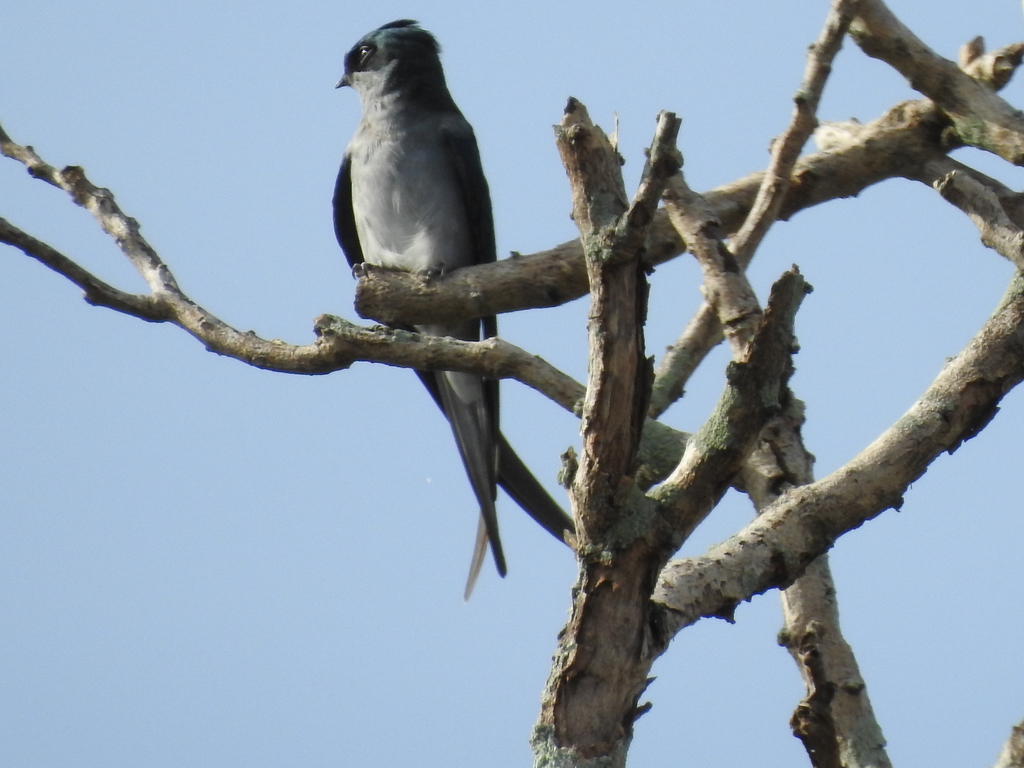
Grey-rumped Treeswift
Photo © anukma
Photo © anukma — CC BY 4.0 — Source: iNaturalist #9098762Identification
The grey-rumped treeswift is a small, distinctive bird with several key field marks. Adult males are particularly striking, featuring a dark grey throat and chest that contrasts sharply with a white belly. Both sexes display a greenish sheen on their upper parts, and males are further distinguished by dull orange-red or chestnut-colored ear coverts—a feature absent in females. When perched, a characteristic shared with all treeswifts, the wing tips cross over the tail, creating a compact silhouette quite different from the appearance of true swifts.
Range & Habitat
This species has an extremely large range across Southeast Asia, found in Brunei, Indonesia, Malaysia, Myanmar, the Philippines, Singapore, and Thailand. It is commonly found in peninsular Malaysia. The grey-rumped treeswift shows a preference for forested and wetland habitats, occurring in subtropical or tropical moist lowland forests, mangrove forests, and moist montane forests.
Behaviour & Diet
Unlike true swifts, grey-rumped treeswifts are arboreal birds, typically seen perched on trees, high-tension power transmission lines, and pylons rather than in continuous flight. They are insectivorous, occasionally catching prey in flight by sallying—making short hunting flights—from their perches. Their most remarkable adaptation is their extraordinary nest construction: they build tiny, half-saucer-shaped nests made from hardened saliva interspersed with feathers, mosses, and flakes of tree bark, attached to tree branches. The fragility of this nest structure is extraordinary; it is attached to the branch on only one side, so the incubating parent does not sit directly on it. Instead, the bird perches on the branch above the nest and fluffs out its breast feathers to cover and incubate the single egg, which is held in place by saliva. Both sexes participate in incubation duties, and during shifts of parental care, the arriving partner carefully slides over the nest to take over brooding responsibilities.
Best Time & Places to See It
Peninsular Malaysia offers reliable opportunities to encounter grey-rumped treeswifts, where they are commonly found. Suitable habitat throughout their range—particularly in lowland and montane forests, as well as mangrove areas—should yield sightings. However, specific information about population trends and seasonal movements is limited, so local guides familiar with current distribution patterns in your chosen destination will be invaluable.
Photography Tips
Photographing grey-rumped treeswifts requires patience and attention to their perching behavior. Since they are arboreal and spend considerable time stationary on perches, including power lines and pylons, these perches offer excellent opportunities for detailed photography of plumage and field marks. The contrast between the males' dark grey chest and white belly, along with the chestnut ear coverts, provides striking compositional elements. Position yourself to capture the characteristic crossed wing tips over the tail when they are perched, as this is a defining feature of the species. Early morning and late afternoon light will best reveal the greenish sheen of their upper parts.
Hat Noppharat Thara-Mu Ko Phi Phi National Park
Ao Nang, Thailand
+253 birds+9 mammals
Where limestone karsts rise dramatically from turquoise waters, Hat Noppharat Thara-Mu Ko Phi Phi National Park unfolds across a mosaic of beach, mangrove forest, and island…
VIEW NATIONAL PARKBako National Park
Kuching, Malaysia
+210 birds+17 mammals
Weathered sandstone cliffs rise dramatically from the South China Sea, their ochre faces sculpted by millennia of wind and tide into a landscape of extraordinary geological…
VIEW NATIONAL PARKKuching Wetlands National Park
Kuching, Malaysia
+103 birds+4 mammals
Where brackish waters meet mangrove stilts and freshwater swamps blend into coastal mudflats, one of Southeast Asia's most dynamic wetland ecosystems unfolds across Sarawak's northwestern coast.…
VIEW NATIONAL PARKTaman Negara National Park
Kampong Samas, Malaysia
+393 birds+48 mammals
Where ancient rainforest meets limestone peaks, one of Southeast Asia's oldest protected wilderness preserves sprawls across 4,343 square kilometers of primordial landscape. Dipterocarp giants tower overhead,…
VIEW NATIONAL PARKPenang National Park
Balik Pulau, Malaysia
+107 birds+2 mammals
Granite peaks rise abruptly from the Andaman Sea where tropical rainforest clings to steep slopes in one of Malaysia's oldest protected landscapes. Mangrove forests fringe the…
VIEW NATIONAL PARKTaman Negara Bukit Lambir National Park
Miri, Malaysia
+153 birds+7 mammals
Rainforest cascades down sandstone ridges where crystal streams carve through ancient geology, creating a landscape of profound biological richness in Sarawak's interior. This 68-square-kilometre sanctuary protects…
VIEW NATIONAL PARKGunung Mulu National Park
Long Seridan, Malaysia
+280 birds+39 mammals
Where granite monoliths pierce the rainforest canopy of Sarawak, an ancient limestone karst landscape reveals one of Southeast Asia's most biodiverse strongholds. Soaring peaks cloaked in…
VIEW NATIONAL PARKTaman Nasional Baluran
Situbondo, Indonesia
+189 birds+9 mammals
Across the northeastern tip of East Java, where monsoon winds sweep down from the Bali Strait, a landscape of contrasts unfolds within 374 square kilometres of…
VIEW NATIONAL PARKTaman Nasional Meru Betiri
Jember, Indonesia
+93 birds+1 mammals
Across East Java's southeastern coast, where the Indian Ocean meets a landscape of volcanic soils and monsoon-fed forests, sprawls a national park that epitomizes the ecological…
VIEW NATIONAL PARKWest Bali National Park
Gerokgak, Indonesia
+240 birds+8 mammals
Across West Bali's northwestern reaches, where the Indian Ocean meets volcanic slopes and limestone cliffs plunge toward turquoise shallows, sprawls a protected realm of roughly 325…
VIEW NATIONAL PARKBogani Nani Wartabone National Park
Bolaang Mongondow, Indonesia
+154 birds+4 mammals
Across North Sulawesi's rugged interior, where tectonic uplift has carved steep ridges and deep valleys through ancient volcanic terrain, Bogani Nani Wartabone National Park sprawls across…
VIEW NATIONAL PARKGunung Ciremai National Park
Majalengka, Indonesia
+116 birds+1 mammals
Volcanic slopes rise sharply from West Java's interior, where Gunung Ciremai's 3,078-metre summit dominates a landscape carved by geological upheaval and shaped by equatorial monsoon rainfall.…
VIEW NATIONAL PARKMount Merapi National Park
Hargobinangun, Indonesia
+150 birds+3 mammals
Where the volcanic slopes of central Java rise into mist and montane forest, Mount Merapi National Park guards one of Indonesia's most dynamic landscapes. Spanning roughly…
VIEW NATIONAL PARKLore Lindu National Park
Indonesia
+177 birds+4 mammals
Across the mountainous spine of Central Sulawesi spreads a wilderness of montane forest, rolling ridges, and deep valleys that rises from the island's volcanic bedrock to…
VIEW NATIONAL PARKGunung Palung National Park
Kayong Utara, Indonesia
+38 birds+1 mammals
Rainforest swells across the steep terrain of West Kalimantan, where ancient volcanic ridges rise abruptly from lowland swamps and weathered plateaus. Gunung Palung National Park encompasses…
VIEW NATIONAL PARKWay Kambas National Park
Lampung Timur, Indonesia
+237 birds+20 mammals
Across the low swamplands of eastern Lampung, where freshwater wetlands merge into tidal mangrove forests along the Sunda Strait, sprawls one of Sumatra's most vital sanctuaries.…
VIEW NATIONAL PARKNo community photos yet. Log in to add the first one.
No community observations of this species yet.