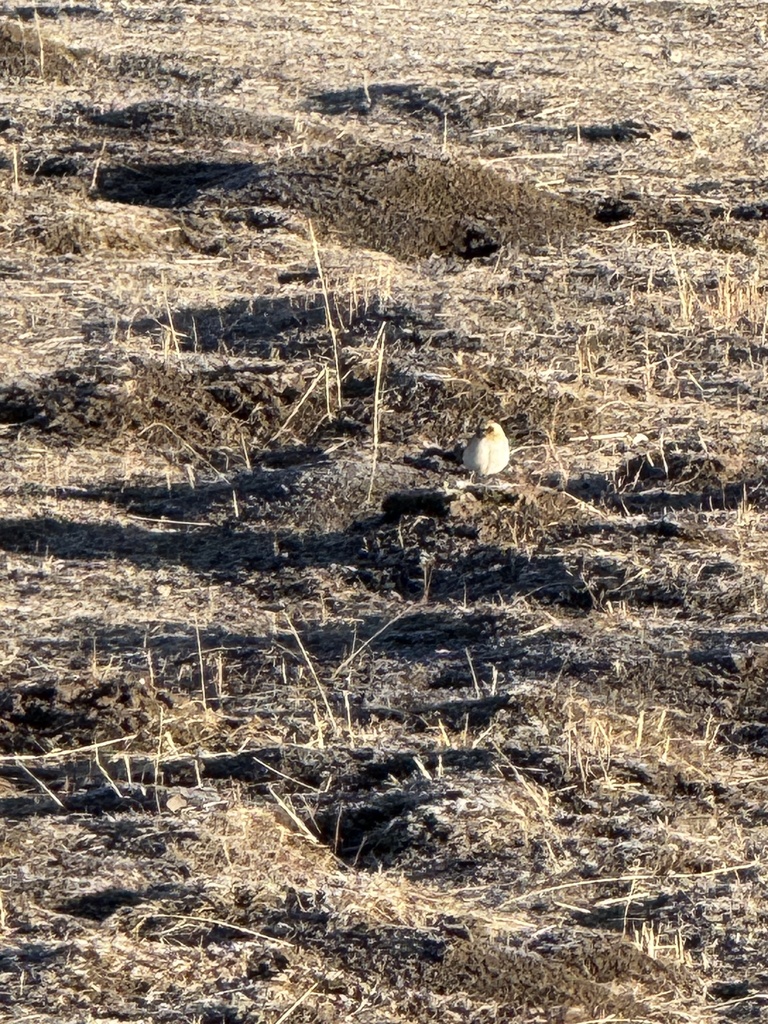
Ground Tit
Photo © chrisdt
Photo © chrisdt — CC BY 4.0 — Source: iNaturalist #347204307The ground tit, Tibetan ground tit, or Hume's ground tit (Pseudopodoces humilis) is a bird of the Tibetan plateau north of the Himalayas. The peculiar appearance confused ornithologists who in the past variously called it Hume's groundpecker, Hume's ground jay or Tibetan ground jay on the assumption it belonged to the family Corvidae that includes the crows and jays. Although morphologically confusing, the species has since been identified using molecular sequence comparisons as being a member of the tit family (Paridae), and is now treated as the only species in the genus Pseudopodoces. It is found in the Tibetan Plateau of China, India, Nepal & Bhutan. == Description == Pseudopodoces is somewhat similar in appearance to the unrelated ground jays (Podoces), but much smaller, about the size of a house sparrow (Passer domesticus), and lacks any conspicuous markings. More distinctly however, it resembles a wheatear (Oenanthe) in habitus, but lacks black feathers, and has a strong and slightly downcurved bill resembling that of a chough (Pyrrhocorax) in shape (though not in colour). Its soft, lax body plumage is extremely cryptic in its natural habitat. The underside is a greyish-fawn in colour, with a tawny hue. The upper parts are mostly…
Sagarmatha National Park
Khumjung, Nepal
+219 birds+7 mammals
Soaring peaks and deep glacial valleys define this alpine wilderness in northeastern Nepal, where the terrain rises from forested foothills into a realm of high-altitude tundra…
VIEW NATIONAL PARKKhangchendzonga National Park
Sakkyong, India
+290 birds+1 mammals
Where the eastern Himalayas surge toward their crowning peaks, Khangchendzonga National Park embraces a landscape of almost overwhelming vertical drama. Rising from subtropical river valleys into…
VIEW NATIONAL PARKJiuzhai Valley
Jiuzhaigou County, China
+226 birds+7 mammals
Where crystalline alpine streams cascade through limestone gorges and karst terrain rises in dramatic vertical walls, Jiuzhai Valley unfolds across nearly 1,300 square kilometers of southwestern…
VIEW NATURAL MONUMENTHemis National Park
Raigahar Dhar, India
+131 birds+13 mammals
Where granite gorges cleave through the Himalayas at dizzying altitudes, a vast wilderness of alpine desert unfolds across the rain shadow of Ladakh. Hemis sprawls across…
VIEW NATIONAL PARKSanjiangyuan National Park
Nagqu, China
+187 birds+25 mammals
Where the headwaters of three great Asian rivers emerge from a high alpine plateau, the landscape unfolds in tundra and dwarf shrubland—a world of austere beauty…
VIEW NATIONAL PARKQiangtang National Nature Reserve
Ngari Prefecture, China
+34 birds+5 mammals
Across the high Tibetan plateau north of Nagqu sprawls one of Earth's most extreme alpine tundra ecosystems, where vast expanses of sparse grassland and barren terrain…
VIEW NATURE RESERVEQinghai Lake National Nature Reserve
Hainan Tibetan Autonomous Prefecture, China
+243 birds+11 mammals
At 3,200 metres above sea level on the Tibetan plateau, where winter temperatures plunge far below freezing and snow blankets the landscape for half the year,…
VIEW NATURE RESERVENo community photos yet. Log in to add the first one.
No community observations of this species yet.