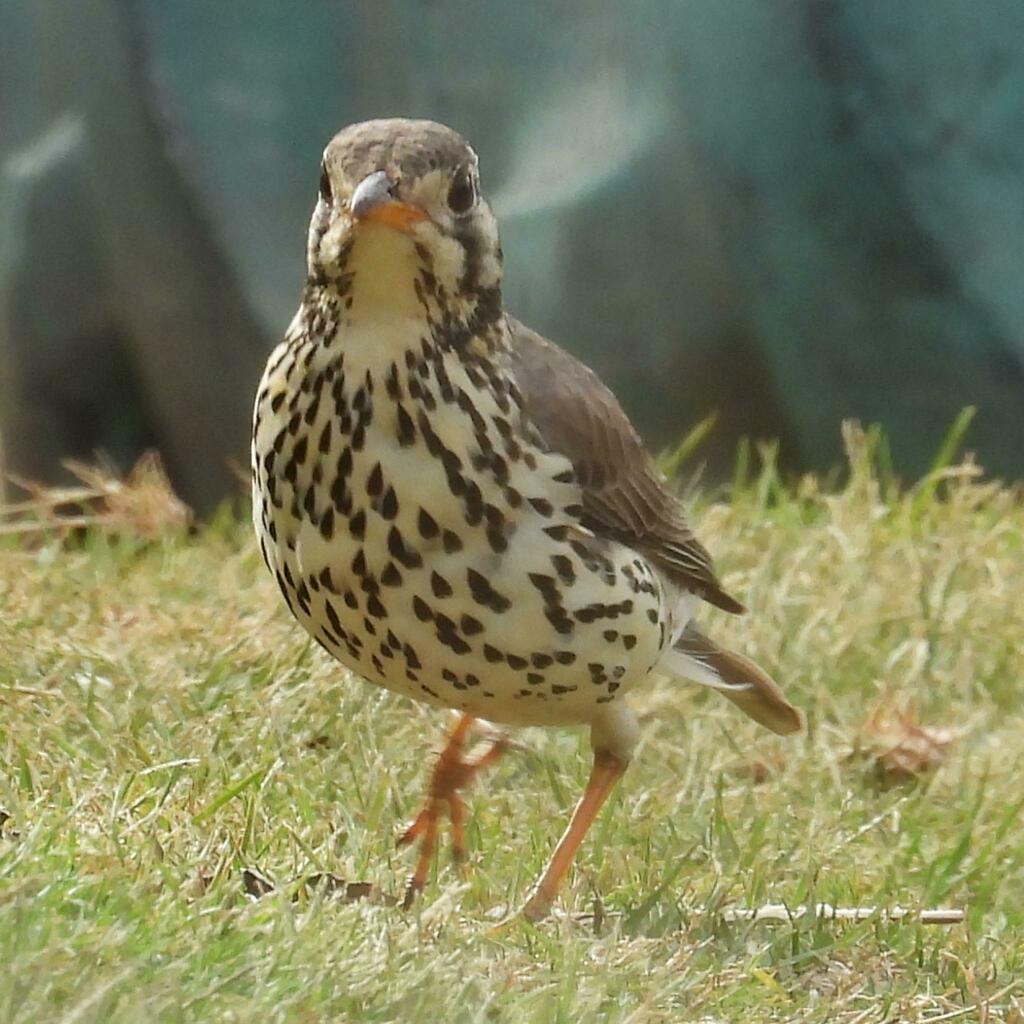
Groundscraper Thrush
Photo © Henry de Lange
Photo © Henry de Lange — CC BY 4.0 — Source: iNaturalist #259505631Identification
The groundscraper thrush is a medium-sized passerine measuring 22–24 centimetres in length, distinguished by its notably erect posture, short tail, heavy bill, and fairly long legs. Its plumage combines subtle tones: plain grey-brown upperparts contrasting with a distinctive chestnut wing-panel, while the underparts are white heavily marked with black spots. The face is white with bold black markings that give the species a striking appearance. In flight, the underwing reveals a striking black and white pattern, particularly visible during the bird's characteristic undulating flight.
Vocally, the groundscraper thrush is recognizable by its slow whistled song and distinctive clicking call, making it identifiable even when obscured by vegetation or distance.
Range & Habitat
The groundscraper thrush is endemic to southern and eastern Africa, with three recognized subspecies. The most southerly form, T. l. litsitsirupa, ranges from Namibia, Botswana, Zimbabwe, and Mozambique south to the northern and eastern parts of South Africa. T. l. pauciguttata occupies southern Angola, northern Namibia, and north-west Botswana, while T. l. stierlingae forms a band across northern Angola through to western Tanzania, Malawi, and north-west Mozambique.
This adaptable species is notably tame and readily forages in parks, gardens, and around picnic sites, making it accessible to travellers even in semi-developed areas. This comfort around human activity distinguishes it from many other thrush species.
Behaviour & Diet
The groundscraper thrush is a ground forager, as its common name suggests, spending much of its time searching the soil and vegetation for food. Its long legs and terrestrial habits reflect an evolutionary adaptation to a scratching lifestyle on the ground.
During breeding season, the bird constructs a distinctive cup-shaped nest woven from vegetation and spider-webs, carefully lined with feathers or leaves. The female typically lays three or four eggs, which are bluish in ground colour with lilac and red-brown spots and blotches. These eggs are incubated for 14 to 15 days. The species' tameness extends to its breeding behaviour, with birds sometimes nesting in areas frequented by humans.
Best Time & Places to See It
The groundscraper thrush's affinity for parks, gardens, and picnic sites makes it one of the more accessible thrush species for travellers throughout southern and eastern Africa. Its presence in semi-cultivated areas means that visitors need not venture into remote wilderness to encounter this species. Travellers in Namibia, Botswana, Zimbabwe, Mozambique, South Africa, Angola, Tanzania, and Malawi all have opportunities to observe this bird.
The bird's tameness and ground-foraging habits make it relatively straightforward to locate once you are in suitable habitat, though patience and quiet observation will yield the best encounters.
Photography Tips
The groundscraper thrush's erect posture and distinctive facial markings make it a rewarding photographic subject. The bold black markings on the white face provide strong contrast that photographs well in both soft morning light and brighter midday conditions. Position yourself to capture the bird's ground-foraging behaviour, which is characteristic and visually interesting.
The striking black and white underwing pattern is a unique field mark worth capturing in flight, though this requires anticipation and quick reflexes. The chestnut wing-panel is also a key identification feature that benefits from clear, well-lit photography. The bird's tendency toward tameness means patient photographers can often approach closer than with more skittish thrush species.
Mapungubwe National Park
Musina Local Municipality, South Africa
+358 birds+29 mammals
Where the Limpopo River cuts through sandstone ridges at the convergence of South Africa, Botswana, and Zimbabwe, Mapungubwe National Park preserves a landscape of profound ecological…
VIEW NATIONAL PARKChobe National Park
Botswana
+446 birds+45 mammals
Where the Chobe River cuts a sinuous path through northern Botswana, the landscape transforms into one of Africa's most dynamic wetland-savanna mosaics. This national park encompasses…
VIEW NATIONAL PARKKhaudum National Park
Botswana
+213 birds+13 mammals
Where the Okavango's northern tributaries meander through miombo woodland and riverine forest, Khaudum National Park unfolds across a landscape of profound ecological richness and isolation. This…
VIEW NATIONAL PARKPilanesberg National Park
Moses Kotane Local Municipality, South Africa
+364 birds+49 mammals
Granite peaks and volcanic ridges rise unexpectedly from the savanna floor across this 734-square-kilometre expanse in the North West province, creating a landscape of profound ecological…
VIEW NATIONAL PARKKruger National Park
Ba-Phalaborwa Local Municipality, South Africa
+540 birds+91 mammals
Across the low-lying savanna of northeastern South Africa unfolds one of Africa's largest and most ecologically intact protected areas, where acacia woodlands merge into mopane scrub…
VIEW NATIONAL PARKMarakele National Park
Modimolle Local Municipality, South Africa
+341 birds+36 mammals
Granite ridges and sprawling grasslands dominate this 1,176-square-kilometre reserve in Limpopo's heartland, where bushveld transitions between rocky outcrops and open savanna. The park's rugged topography creates…
VIEW NATIONAL PARKKhaudum National Park
Namibia
+221 birds+13 mammals
Where the Kavango River flows through northeastern Namibia, vast miombo woodlands and riverine forests create one of southern Africa's most remote and biodiverse wilderness corridors. Khaudum…
VIEW NATIONAL PARKBwabwata National Park
Namibia
+377 birds+35 mammals
Where the Kavango River winds through northeastern Namibia, vast floodplains and dense riparian woodland create one of southern Africa's most ecologically dynamic protected landscapes. Spanning 14,249…
VIEW NATIONAL PARKEtosha National Park
Namibia
+356 birds+58 mammals
Across northern Namibia's stark semi-arid plateau, a vast shallow depression transforms seasonally into one of Africa's most dramatic wildlife theaters. Etosha National Park, encompassing more than…
VIEW NATIONAL PARKWaterberg Plateau National Park
Okambukonde, Namibia
+198 birds+27 mammals
Where ancient sandstone cliffs rise 200 metres above the surrounding bushveld, a fortress of geology creates one of southern Africa's most compelling ecosystems. The plateau's steep…
VIEW NATIONAL PARKMakgadikgadi Pans National Park
Gucta, Botswana
+272 birds+27 mammals
Where salt-crusted flatlands stretch endlessly toward a shimmering horizon, one of Africa's most extraordinary ecosystems awakens with the rains. The Makgadikgadi Pans comprise vast mineral-rich basins…
VIEW NATIONAL PARKNo community photos yet. Log in to add the first one.
No community observations of this species yet.